Medium Organ System Questions Practice Questions
Concept Explanation
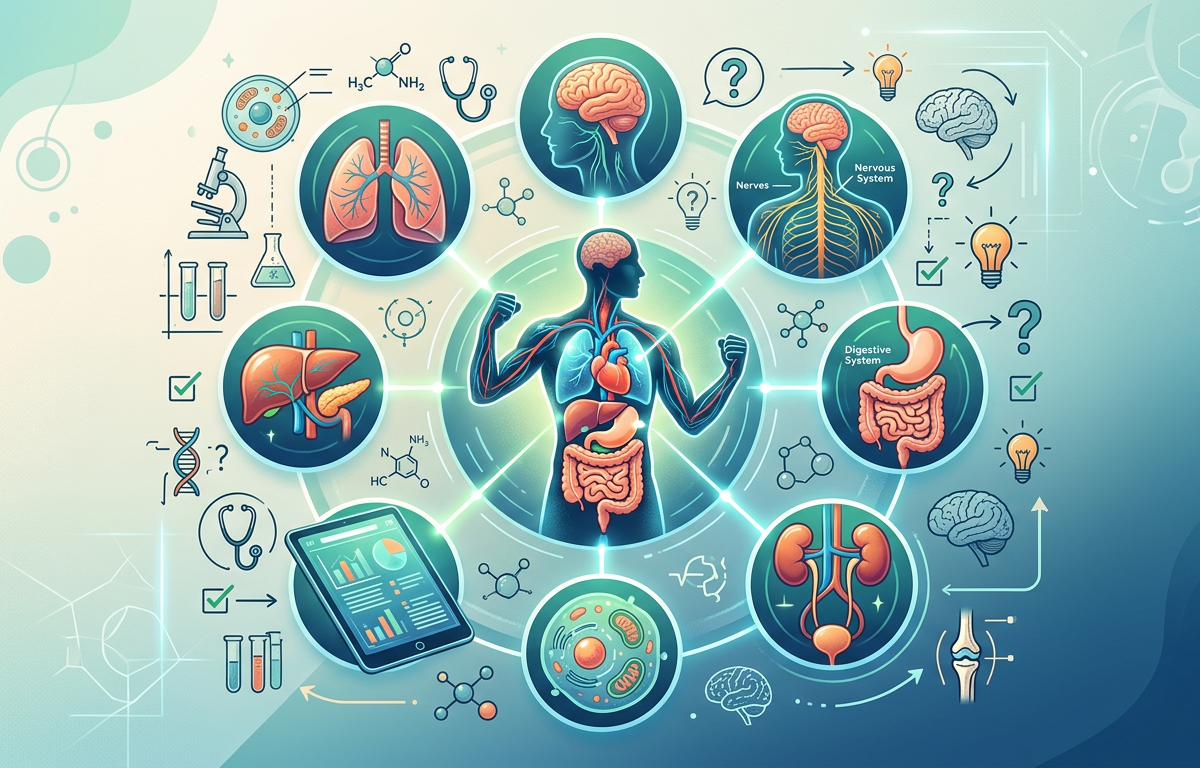
An organ system is a group of organs that work together to perform one or more complex physiological functions within the body. These systems represent a higher level of biological organization, bridging the gap between individual organs and the entire organism. Each system, such as the cardiovascular system or the respiratory system, relies on the precise coordination of various tissues and organs to maintain homeostasis. For example, while the heart is a single organ, it cannot circulate blood throughout the body without the network of arteries, veins, and capillaries that comprise the rest of the circulatory system. Understanding Medium Organ System Questions requires a grasp of how these systems interact, how they are regulated by the nervous system, and how they respond to external stressors. According to the National Cancer Institute, the human body consists of eleven major organ systems, including the integumentary, skeletal, muscular, nervous, endocrine, cardiovascular, lymphatic, respiratory, digestive, urinary, and reproductive systems.
Solved Examples
Reviewing solved Medium Organ System Questions helps clarify the relationships between different anatomical structures and their physiological roles.
- Explain the primary role of the diaphragm in the respiratory system and how it facilitates breathing.
- Identify the diaphragm as a dome-shaped muscle located at the base of the lungs.
- Describe the contraction phase: When the diaphragm contracts, it flattens and moves downward, increasing the volume of the thoracic cavity.
- Apply Boyle's Law: The increased volume creates a lower pressure inside the lungs compared to the atmosphere, causing air to rush in (inhalation).
- Describe the relaxation phase: When the diaphragm relaxes, it moves upward, decreasing thoracic volume and forcing air out (exhalation).
- How does the urinary system contribute to the regulation of blood pressure?
- Recognize the kidney as the primary organ for filtering blood.
- Identify the role of the Renin-Angiotensin-Aldosterone System (RAAS). When blood pressure drops, kidneys release the enzyme renin.
- Explain the outcome: Renin triggers a cascade that leads to the production of Angiotensin II (a vasoconstrictor) and Aldosterone (which increases salt and water retention).
- Conclude that by managing fluid volume and vessel diameter, the urinary system stabilizes blood pressure.
- Describe the path of a red blood cell from the right atrium to the aorta.
- Start at the right atrium, where the cell passes through the tricuspid valve into the right ventricle.
- The right ventricle pumps the cell through the pulmonary valve into the pulmonary arteries leading to the lungs.
- In the lungs, the cell picks up oxygen and returns via pulmonary veins to the left atrium.
- From the left atrium, it moves through the mitral valve into the left ventricle, which then pumps it through the aortic valve into the aorta.
Practice Questions
Test your knowledge with these Medium Organ System Questions designed to challenge your understanding of human biology.
- Which organ system is responsible for the production of vitamin D and provides a physical barrier against pathogens?
- Describe the mechanical and chemical digestion processes that occur specifically in the stomach.
- How do the endocrine system and the nervous system differ in their methods of communication and speed of response?
- What is the functional unit of the kidney, and what are its three main processes in urine formation?
- Explain the role of the lymphatic system in maintaining fluid balance and immune defense.
- Which part of the brain acts as the primary link between the nervous system and the endocrine system?
- Contrast the functions of the sympathetic and parasympathetic divisions of the autonomic nervous system.
- How does the skeletal system interact with the circulatory system regarding blood cell production?
- Identify the specific site of gas exchange in the lungs and the process by which it occurs.
- What is the role of the gallbladder in the digestive system, and which organ produces the substance it stores?
Answers & Explanations
- Integumentary System: This system consists of the skin, hair, and nails. It produces Vitamin D when exposed to UV light and serves as the body's first line of defense against infection.
- Stomach Digestion: Mechanical digestion occurs through churning (peristalsis) of the stomach walls. Chemical digestion involves gastric juices, specifically hydrochloric acid and the enzyme pepsin, which begins the breakdown of proteins.
- Endocrine vs. Nervous: The nervous system uses electrical impulses and neurotransmitters for rapid, short-lived responses. The endocrine system uses hormones released into the bloodstream for slower, longer-lasting effects.
- Nephron: The nephron is the functional unit. The three processes are filtration (at the glomerulus), reabsorption (returning nutrients to blood), and secretion (moving waste into the tubule).
- Lymphatic System: It collects excess interstitial fluid and returns it to the bloodstream to prevent edema. It also houses lymphocytes in lymph nodes to filter pathogens from the lymph.
- Hypothalamus: This region of the brain controls the pituitary gland, thereby regulating the hormonal output of the endocrine system based on neural signals.
- Autonomic Divisions: The sympathetic system triggers the "fight or flight" response (increased heart rate), while the parasympathetic system governs "rest and digest" activities (decreased heart rate, stimulated digestion).
- Bone Marrow: The skeletal system contains red bone marrow, which is the site of hematopoiesis—the production of red blood cells, white blood cells, and platelets.
- Alveoli: Gas exchange occurs in the alveoli via simple diffusion. Oxygen moves from the air sacs into the blood, while carbon dioxide moves from the blood into the air sacs.
- Gallbladder: It stores and concentrates bile. Bile is produced by the liver and is essential for the emulsification and subsequent digestion of fats.
1. Which organ system is primarily responsible for the transport of nutrients, gases, and waste products throughout the body?
Frequently Asked Questions
What is the difference between an organ and an organ system?
An organ is a structure composed of multiple tissue types working together for a specific task, like the heart pumping blood. An organ system is a group of related organs that coordinate to fulfill a broader physiological purpose, such as the entire circulatory system. For more foundational concepts, check out our Organ System Questions Practice Questions.
How do the respiratory and cardiovascular systems work together?
The respiratory system facilitates the exchange of oxygen and carbon dioxide between the air and the blood. The cardiovascular system then transports that oxygenated blood to tissues and carries carbon dioxide back to the lungs for removal. This collaboration is essential for cellular respiration, which you can learn more about in our Medium Organelles Questions guide.
Can an organ belong to more than one organ system?
Yes, several organs have dual roles, such as the pancreas which functions in the digestive system (secreting enzymes) and the endocrine system (secreting insulin). The pharynx is another example, serving both the respiratory and digestive tracts as a common passageway for air and food.
What happens if one organ system fails?
Because organ systems are highly interdependent, the failure of one often leads to a domino effect that disrupts homeostasis across the entire body. For instance, kidney failure (urinary system) leads to toxic waste buildup that can damage the heart (cardiovascular system) and the brain (nervous system). Information on how cells maintain internal environments can be found in our Medium Cell Membrane Questions.
Why is the skin considered an organ?
The skin is considered an organ because it consists of multiple layers of tissues, including epithelial, connective, and nervous tissues, that work together to protect the body. According to National Geographic, it is actually the largest organ in the human body by both surface area and weight.
Enjoyed this article?
Share it with others who might find it helpful.
Related Articles
Hard Le Chatelier’s Principle Practice Questions
Master Hard Le Chatelier’s Principle Practice Questions with our comprehensive guide featuring solved examples, practice problems, and detailed explanations.
Mar 30, 2026

Hard Reaction Quotient (Q) Practice Questions
Hard Reaction Quotient (Q) Practice Questions
Mar 30, 2026
Grams to Moles Practice Questions with Answers
Master grams to moles conversions with our comprehensive guide. Includes step-by-step examples, practice questions, and detailed answers for chemistry students.
Mar 26, 2026
Avogadro’s Number Practice Questions with Answers
Master the mole concept with our Avogadro’s Number practice questions. Includes step-by-step solved examples, a quick quiz, and detailed explanations.
Mar 26, 2026
Empirical Formulas: Solving Ratios from Mass and Percent Data
Master empirical formula calculations with 10 practice questions, worked answers, and a free step-by-step calculator for mass, percentage, and combustion problems.
Mar 26, 2026