Medium Cell Membrane Questions Practice Questions
Medium Cell Membrane Questions Practice Questions
The cell membrane is a fundamental component of all known cells, acting as the gatekeeper that controls what enters and leaves. Understanding its structure and the various transport mechanisms is crucial for mastering biology. This guide provides a series of medium-level cell membrane questions designed to test and deepen your knowledge of this essential organelle. We will cover everything from the fluid mosaic model to the specifics of active and passive transport, ensuring you're well-prepared for your exams.
Concept Explanation
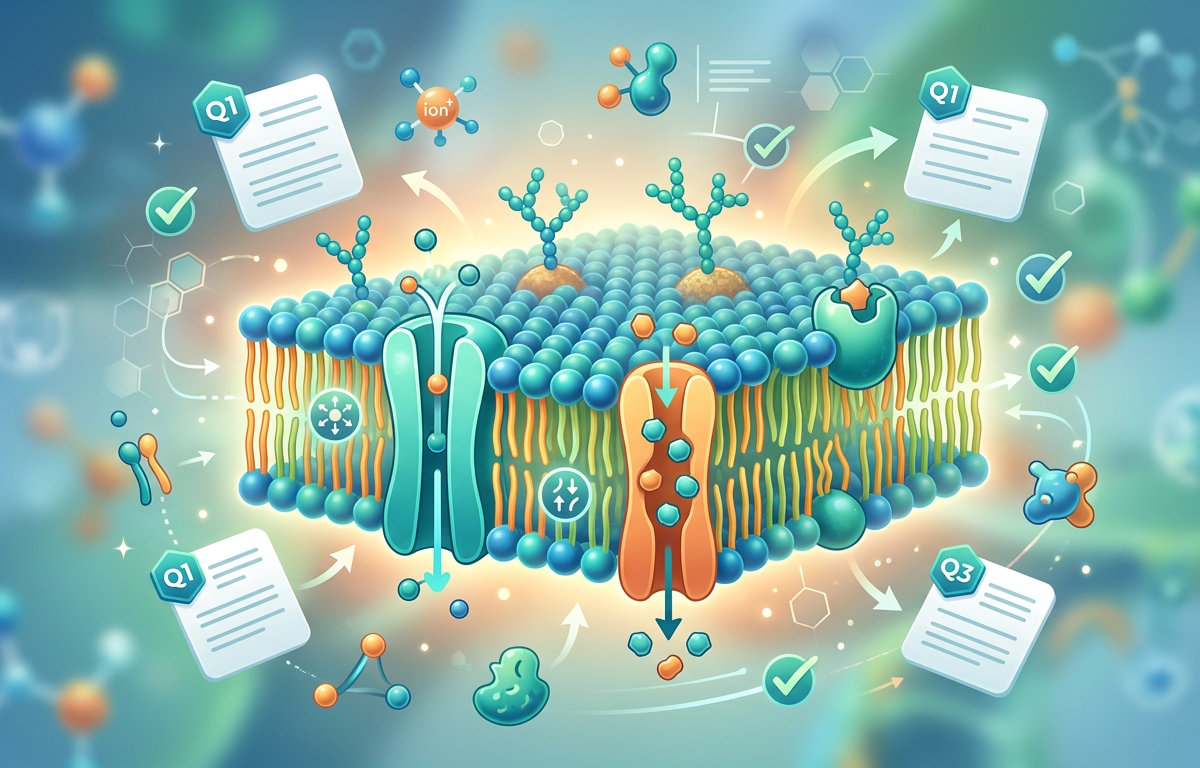
The cell membrane is the semipermeable, phospholipid bilayer that surrounds the cytoplasm of a cell, controlling the passage of substances in and out. This structure is best described by the fluid mosaic model, which states that the membrane is not a static sheet but a dynamic, fluid environment where components like proteins, cholesterol, and carbohydrates are embedded or attached to the phospholipid bilayer. The phospholipids themselves have hydrophilic (water-loving) heads facing the aqueous environments inside and outside the cell, and hydrophobic (water-fearing) tails facing inward, creating a nonpolar barrier. This arrangement is fundamental to its function. Key functions of the cell membrane include protecting the cell, facilitating transport of materials, and enabling cell communication through signaling pathways. You can learn more about the history and details of this concept from Nature's Scitable resource.
Solved Examples of Cell Membrane Questions
This section provides worked-out solutions to common medium-level cell membrane questions, demonstrating how to apply key concepts to specific scenarios.
Example 1: Osmosis and Red Blood Cells
Question: A human red blood cell, which has an internal solute concentration of about 0.9%, is placed into a beaker of pure, distilled water. What will happen to the cell, and why?
Solution:
Identify the solutions: The inside of the red blood cell (cytosol) is a 0.9% solute solution. The outside environment (distilled water) is a 0% solute solution. Therefore, the external solution is hypotonic relative to the cell's interior.
Determine water movement: Osmosis is the net movement of water across a semipermeable membrane from an area of higher water concentration (lower solute concentration) to an area of lower water concentration (higher solute concentration). In this case, water will move from the beaker into the red blood cell.
Predict the outcome: As water rushes into the cell, it will swell. Because animal cells like red blood cells lack a rigid cell wall, the continuous influx of water will increase the internal pressure until the cell membrane ruptures. This process is called hemolysis.
Example 2: Active Transport and the Sodium-Potassium Pump
Question: Explain why the sodium-potassium (Na+/K+) pump is an example of primary active transport and requires energy in the form of ATP.
Solution:
Define Primary Active Transport: This form of transport moves substances against their concentration gradient (from a low concentration area to a high concentration area). It requires energy directly from the hydrolysis of ATP.
Analyze the Na+/K+ Pump's Function: The pump actively transports three sodium ions (Na+) out of the cell and two potassium ions (K+) into the cell. Both ions are moved against their respective concentration gradients—Na+ concentration is typically higher outside the cell, and K+ concentration is higher inside.
Explain the Role of ATP: To move these ions against their gradients, the pump must use energy. A molecule of ATP binds to the pump protein. The hydrolysis of ATP into ADP and an inorganic phosphate (Pi) causes the protein to change its shape (a process called phosphorylation). This conformational change allows it to first release Na+ outside the cell and then bind K+ from the outside to bring it in. Therefore, the direct use of ATP to power this movement classifies it as primary active transport. This process is fundamental for maintaining cell potential and is a great example of how cells must expend energy, a concept explored in our Work, Energy, and Power Practice Questions.
Example 3: Facilitated vs. Simple Diffusion
Question: Compare and contrast the transport of a small, nonpolar molecule like oxygen (O2) with a larger, polar molecule like glucose across the cell membrane.
Solution:
Transport of Oxygen (O2): Oxygen is a small, nonpolar molecule. It can move directly across the hydrophobic lipid bilayer without assistance. This type of passive transport is called simple diffusion. It moves down its concentration gradient, from an area of high concentration to low concentration, and does not require energy or a transport protein.
Transport of Glucose: Glucose is a larger, polar molecule. It cannot easily pass through the nonpolar, hydrophobic interior of the phospholipid bilayer. It requires the help of a specific transport protein (a carrier protein) embedded in the membrane. This process is called facilitated diffusion.
Comparison: Both simple and facilitated diffusion are forms of passive transport, meaning they do not require metabolic energy (ATP) and move substances down their concentration gradient. The key difference is the mechanism. Simple diffusion occurs directly through the lipid bilayer, while facilitated diffusion requires a membrane protein (channel or carrier) to "facilitate" the movement of the substance. You can find more details on this topic at Khan Academy's overview of passive transport.
Practice Questions
Test your understanding of cell membrane structure and function with these practice questions.
1. Describe the orientation of phospholipids in the cell membrane and explain the chemical properties that cause them to arrange in a bilayer.
2. What is the primary role of cholesterol within the plasma membrane of animal cells, particularly in response to temperature changes?
3. A freshwater plant cell is placed in a beaker of saltwater. Describe what happens to the cell's vacuole and plasma membrane, and name the process that occurs.
Start Learning Smarter Today
Join thousands of students using AI-powered study tools to achieve better results.
Get Started Free
Start Learning Smarter Today
Join thousands of students using AI-powered study tools to achieve better results.
Get Started Free4. Explain the difference between primary and secondary active transport. Provide a biological example for each.
5. How do channel proteins and carrier proteins, both used in facilitated diffusion, differ in their mechanism of transporting substances across the membrane?
6. A cell needs to import a large quantity of a specific nutrient, even though the concentration of that nutrient is already higher inside the cell than outside. What specific type of transport mechanism must be used? Explain why.
7. Describe the functions of glycoproteins and glycolipids on the exterior surface of the cell membrane.
8. Why is the term "fluid mosaic model" an accurate description of the cell membrane? Explain both the "fluid" and "mosaic" aspects of the model.
9. Certain poisons, such as cyanide, work by inhibiting the cell's ability to produce ATP. Which transport processes across the cell membrane would be immediately affected, and which would remain largely unaffected?
10. Compare the processes of phagocytosis and pinocytosis. Are these forms of active or passive transport? Explain your reasoning.
Answers & Explanations
Here are the detailed solutions and explanations for the practice questions above.
1. Phospholipids are amphipathic molecules, meaning they have both a hydrophilic (water-loving) and a hydrophobic (water-fearing) part. The head contains a phosphate group and is polar and hydrophilic. The two tails are fatty acid chains, which are nonpolar and hydrophobic. In an aqueous environment, they spontaneously arrange into a bilayer where the hydrophilic heads face the watery cytoplasm and extracellular fluid, while the hydrophobic tails face inward, away from the water. This structure forms a stable barrier between two aqueous compartments.
2. Cholesterol acts as a fluidity buffer in the animal cell membrane. At high temperatures, it restrains the movement of phospholipids, preventing the membrane from becoming too fluid. At low temperatures, it prevents phospholipids from packing too closely together, which keeps the membrane from becoming too rigid and solidifying. This ensures the membrane remains functional across a range of temperatures.
3. The saltwater is a hypertonic solution relative to the plant cell's cytoplasm. Due to osmosis, water will move out of the cell's large central vacuole and into the surrounding saltwater. This causes the vacuole to shrink, and the plasma membrane pulls away from the cell wall. This process is called plasmolysis. The outward force, or turgor pressure, is lost, causing the plant to wilt. Understanding these forces is similar to problems found in our Force Calculation Practice Questions.
4. Primary active transport directly uses a source of chemical energy, such as ATP, to move molecules against their concentration gradient. The sodium-potassium pump is a classic example. Secondary active transport (or cotransport) uses the electrochemical gradient created by primary active transport as an energy source. It does not use ATP directly. For example, the sodium-glucose cotransporter (SGLT1) uses the steep Na+ gradient (maintained by the Na+/K+ pump) to pull glucose into the cell against its own concentration gradient.
5. Channel proteins form a hydrophilic pore or channel through the membrane. When open, they allow specific ions or small molecules to pass through quickly. They are often gated, opening and closing in response to a signal. Carrier proteins bind to the specific substance they transport. This binding causes the carrier protein to change its shape, which moves the substance to the other side of the membrane. This process is slower than transport through a channel protein.
6. The cell must use active transport. This is because the nutrient is being moved against its concentration gradient (from a low external concentration to a high internal concentration). Passive transport mechanisms (simple and facilitated diffusion) only allow substances to move down their concentration gradient. Active transport requires energy, typically from ATP, to power the protein pumps that move the substance against its natural tendency to diffuse.
7. Glycoproteins (proteins with attached carbohydrates) and glycolipids (lipids with attached carbohydrates) form the glycocalyx on the cell's exterior. They function primarily in cell-cell recognition, allowing cells to identify each other (e.g., distinguishing the body's own cells from foreign invaders). They also play roles in cell adhesion (sticking to each other to form tissues) and as receptors in cell signaling.
8. The model is accurate for two reasons. \"Fluid\" refers to the fact that the components of the membrane, including phospholipids and proteins, are not fixed in place but can move laterally, much like icebergs floating in a lipid sea. \"Mosaic\" refers to the membrane being composed of a patchwork of many different types of molecules—phospholipids, cholesterol, and a variety of proteins (integral, peripheral) that perform different functions. The concentrations of these components are analogous to the concepts in Mixture Problems Practice Questions.
9. All forms of active transport (both primary and secondary) and bulk transport (endocytosis, exocytosis) would be immediately affected and would cease to function, as they are all energy-dependent processes requiring ATP. Passive transport processes, including simple diffusion, facilitated diffusion, and osmosis, would remain largely unaffected in the short term, as they rely on concentration gradients, not metabolic energy.
10. Phagocytosis ("cell eating") is a type of endocytosis where the cell engulfs large solid particles, such as bacteria or cellular debris, by forming a large vesicle called a phagosome. Pinocytosis ("cell drinking") is a type of endocytosis where the cell takes in extracellular fluid containing small, dissolved solutes by forming small vesicles. Both are forms of active transport because the process of engulfing material and forming/moving vesicles requires significant energy (ATP) to rearrange the cytoskeleton and membrane.
1. This quick quiz tests your core knowledge of the cell membrane's structure and transport mechanisms.1. Which component of the animal cell membrane is responsible for acting as a 'fluidity buffer'?
Frequently Asked Questions
These are some common questions students have about the cell membrane.
What is the fluid mosaic model?
The fluid mosaic model describes the cell membrane as a dynamic structure composed of a patchwork (mosaic) of components—phospholipids, cholesterol, proteins, and carbohydrates—that are able to move laterally (fluid). It emphasizes that the membrane is not a rigid, static barrier but a flexible and constantly changing one.
Why is the cell membrane called semipermeable?
The cell membrane is called semipermeable (or selectively permeable) because it allows some substances to pass through freely while restricting the passage of others. Small, nonpolar molecules can often pass through easily, while large or charged molecules require specific transport proteins to cross.
What's the difference between active and passive transport?
The key difference is energy use. Passive transport (simple diffusion, facilitated diffusion, osmosis) does not require metabolic energy and moves substances down their concentration gradient. Active transport requires energy (usually ATP) to move substances against their concentration gradient.
How does temperature affect cell membrane fluidity?
Higher temperatures increase the kinetic energy of phospholipids, making the membrane more fluid. Lower temperatures decrease their movement, making the membrane more rigid. Cholesterol helps to buffer these effects in animal cells, maintaining optimal fluidity.
What would happen if an animal cell had no cholesterol in its membrane?
Without cholesterol, an animal cell's membrane would become too fluid at high temperatures and too rigid at low temperatures. This would compromise its integrity and function, likely leading to cell death as it would be unable to regulate the passage of substances properly or withstand temperature fluctuations.
Do plant cells have cell membranes?
Yes, all cells, including plant cells, have a cell membrane. In plants, the cell membrane is located just inside the rigid cell wall. It performs the same functions of regulating transport and communication as it does in animal cells.
Start Learning Smarter Today
Join thousands of students using AI-powered study tools to achieve better results.
Get Started FreeEnjoyed this article?
Share it with others who might find it helpful.
Related Articles
Hard Cell Membrane Questions Practice Questions
Master advanced cell biology with our hard cell membrane practice questions. Test your knowledge on electrochemical gradients, transport mechanisms, and more.
Apr 25, 2026
Easy Cell Membrane Questions Practice Questions
Master the basics of the cell membrane with our easy practice questions. Learn about the phospholipid bilayer, membrane proteins, and selective permeability with worked examples.
Apr 25, 2026
Cell Membrane Questions Practice Questions with Answers
Master Cell Membrane Questions with our comprehensive guide featuring solved examples, practice problems, and detailed explanations of the fluid mosaic model.
Apr 25, 2026
Hard Microbiology Practice Questions Practice Questions
Hard Microbiology Practice Questions Practice Questions
Apr 26, 2026
Medium Microbiology Practice Questions Practice Questions
Master microbiology with our medium-level practice questions covering bacterial growth, genetics, and metabolism. Includes solved examples and a quick quiz.
Apr 26, 2026

Easy Microbiology Practice Questions Practice Questions
Easy Microbiology Practice Questions Practice Questions
Apr 26, 2026

Hard Enzyme Questions Practice Questions
Master complex biochemistry with these hard enzyme questions. Cover Michaelis-Menten kinetics, inhibition types, and Lineweaver-Burk plots with solved examples.
Apr 26, 2026

Medium Enzyme Questions Practice Questions
Master enzyme kinetics and regulation with our Medium Enzyme Questions Practice Questions. Includes solved examples, detailed explanations, and a quick quiz.
Apr 26, 2026