Organ System Questions Practice Questions with Answers
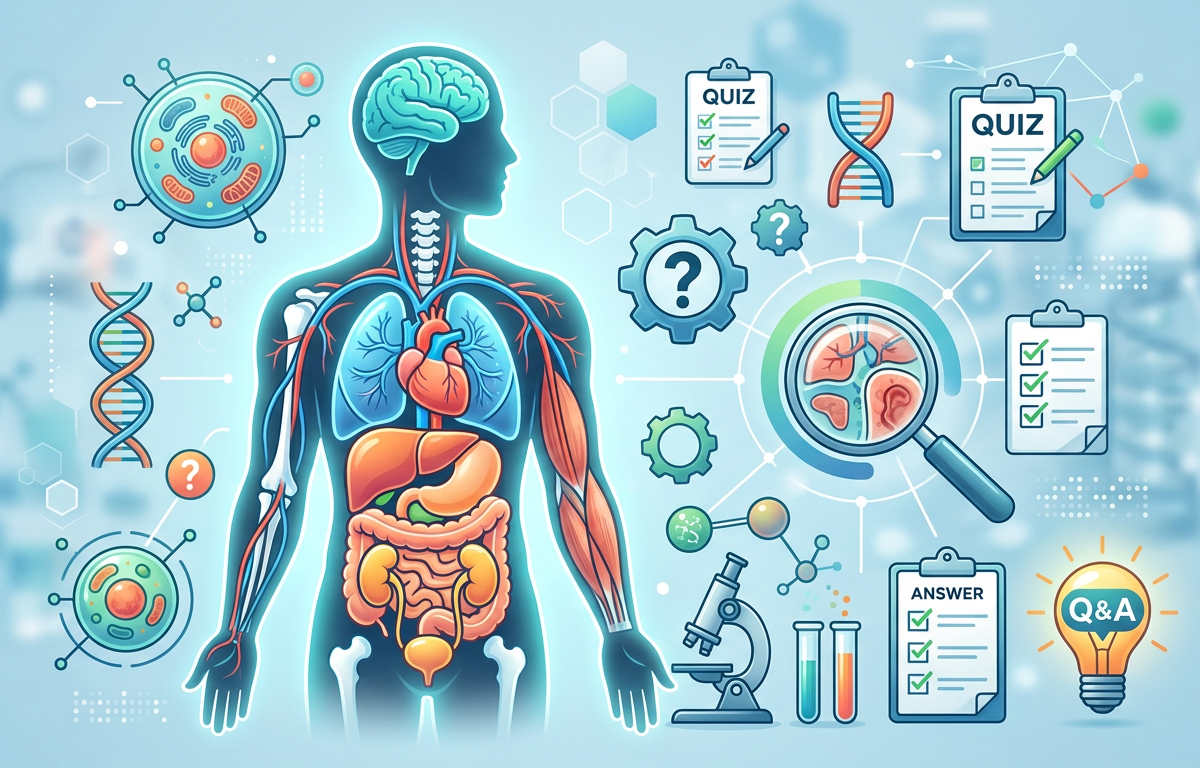
Concept Explanation
An organ system is a group of organs that work together to perform one or more complex functions within the body. In the human body, there are 11 major organ systems, including the circulatory, respiratory, digestive, nervous, and endocrine systems, each playing a unique role in maintaining homeostasis. While each system has a specific primary function—such as the respiratory system’s role in gas exchange—they do not operate in isolation. For example, the muscular system relies on the skeletal system for structural support, while the nervous system sends electrical signals to trigger muscle contractions. Understanding how these systems interact is fundamental to biology and medicine. Just as you might study organelles questions to understand the cellular level of life, studying organ systems allows you to see the "big picture" of how a multicellular organism survives and thrives in its environment.
Hierarchy of Biological Organization
To master organ system questions, you must understand where they fit in the biological hierarchy. Life is organized from the smallest unit to the largest: Cells → Tissues → Organs → Organ Systems → Organism. An organ like the heart contains muscle tissue, nervous tissue, and connective tissue, all working to pump blood as part of the circulatory system.
Key Human Organ Systems
System Primary Function Major Organs Circulatory Transport of nutrients, gases, and waste Heart, Blood vessels Digestive Breakdown of food and absorption of nutrients Stomach, Intestines, Liver Endocrine Hormone production and regulation Pancreas, Thyroid, Adrenal glands
Solved Examples
Reviewing solved examples helps clarify how different organs coordinate to achieve a physiological goal. Here are three fully worked examples of common organ system questions.
Question: Which two systems work most closely together to ensure that oxygen reaches the cells of the big toe?
Solution:Identify the requirement: Oxygen delivery.
Identify the source: The Respiratory System (lungs) takes in oxygen from the atmosphere.
Identify the transport mechanism: The Circulatory System (heart and blood) moves that oxygen from the lungs to the rest of the body.
Conclusion: The Respiratory and Circulatory systems work together.
Question: How does the Integumentary system contribute to the Skeletal system's health?
Solution:Recall the functions of the Integumentary system (skin). One function is synthesizing Vitamin D when exposed to sunlight.
Recall the needs of the Skeletal system. Bones require calcium for strength.
Connect the two: Vitamin D is necessary for the small intestine to absorb calcium from food.
Conclusion: The skin produces Vitamin D, which allows for calcium absorption to maintain bone density.
Question: If a person's pancreas is not functioning correctly, which two systems are primarily affected?
Solution:Identify the pancreas's roles. It produces digestive enzymes and hormones like insulin.
Match functions to systems: Enzymes are part of the Digestive System; insulin regulation is part of the Endocrine System.
Conclusion: Both the Digestive and Endocrine systems are affected.
Practice Questions
Which organ system is responsible for filtering waste products from the blood and maintaining water balance?
The production of red blood cells occurs within the marrow of bones. This represents an interaction between which two systems?
Which system acts as the body's primary defense against pathogens like bacteria and viruses?
[CTA_BLOCK_0]
Describe the pathway of a nutrient molecule from the moment it is eaten until it reaches a muscle cell in the leg. List the systems involved.
The hypothalamus in the brain senses a drop in body temperature and sends signals to muscles to shiver. Which three systems are interacting here?
Which organ system contains the largest organ in the human body?
Contrast the roles of the Autonomic Nervous System and the Somatic Nervous System.
A patient has a condition that prevents their small intestine from absorbing fats. Which system's primary organ is failing, and what other system might lack energy as a result?
How does the Lymphatic system support the Circulatory system?
Which system is responsible for the rapid relay of electrical messages throughout the body to maintain homeostasis?
Answers & Explanations
Urinary (Excretory) System: The kidneys filter the blood to remove urea and excess salts, which are then excreted as urine. This maintains the body's internal chemical balance.
Skeletal and Circulatory Systems: The skeletal system provides the site for hematopoiesis (blood cell formation), while the circulatory system transports these cells to where they are needed.
Immune (Lymphatic) System: This system uses white blood cells and antibodies to identify and destroy foreign invaders. Much like how cell membrane questions focus on the cell's outer barrier, the immune system acts as the organism's barrier and defense.
Digestive, Circulatory, and Muscular: The Digestive system breaks down the food; the Circulatory system transports the glucose/nutrients through the blood; the Muscular system uses the nutrients for energy.
Nervous, Muscular, and Integumentary: The Nervous system (brain) detects the change and sends the signal; the Muscular system shivers to generate heat; the Integumentary system (skin) may constrict blood vessels to conserve heat.
Integumentary System: The skin is the body's largest organ, covering an average surface area of about 20 square feet in adults.
Nervous System sub-divisions: The Somatic system controls voluntary movements (skeletal muscles), while the Autonomic system regulates involuntary actions like heart rate and digestion.
Digestive and Muscular/All Systems: The small intestine is the primary organ of the Digestive system. Without fat absorption, the body lacks a concentrated energy source and fat-soluble vitamins, affecting all metabolic processes.
Fluid Balance: The Lymphatic system collects excess interstitial fluid that leaks out of capillaries and returns it to the bloodstream, preventing tissue swelling (edema).
Nervous System: Using neurons and neurotransmitters, this system provides near-instantaneous communication, unlike the slower chemical communication of the endocrine system.
1. Which organ system is primarily responsible for the exchange of carbon dioxide and oxygen between the blood and the atmosphere?
Frequently Asked Questions
What is the difference between an organ and an organ system?
An organ is a single structure made of multiple tissues, like the stomach, while an organ system is a group of organs, such as the digestive system, working together for a common goal. For more on smaller structures, you might find cell structure practice questions helpful.
How many organ systems are in the human body?
Most biological texts recognize 11 major organ systems: Integumentary, Skeletal, Muscular, Nervous, Endocrine, Circulatory, Lymphatic, Respiratory, Digestive, Urinary, and Reproductive. Some classifications may group the Lymphatic and Immune systems together.
Can an organ belong to more than one system?
Yes, several organs have dual roles, such as the pancreas, which functions in both the digestive system (enzymes) and the endocrine system (hormones). The pharynx is another example, serving both the respiratory and digestive tracts.
What is homeostasis in the context of organ systems?
Homeostasis is the state of steady internal conditions maintained by living things, such as temperature and pH balance. Organ systems work via feedback loops to ensure these levels stay within a narrow, healthy range despite external changes.
Which organ system is the most important?
No single system is the most important because they are all interdependent; if one system fails completely, the organism cannot survive. For instance, according to the National Institutes of Health, failure of the circulatory system leads to rapid death because all other systems lose their oxygen supply.
How do the nervous and endocrine systems differ in communication?
The nervous system uses electrical impulses for rapid, short-term responses, while the endocrine system uses chemical hormones transported through the blood for slower, long-lasting effects. Both are essential for coordinating body activities.
Start Learning Smarter Today
Join thousands of students using AI-powered study tools to achieve better results.
Get Started FreeEnjoyed this article?
Share it with others who might find it helpful.
Related Articles
Hard Le Chatelier’s Principle Practice Questions
Master Hard Le Chatelier’s Principle Practice Questions with our comprehensive guide featuring solved examples, practice problems, and detailed explanations.
Mar 30, 2026

Hard Reaction Quotient (Q) Practice Questions
Hard Reaction Quotient (Q) Practice Questions
Mar 30, 2026

Grams to Moles Practice Questions with Answers
Master grams to moles conversions with our comprehensive guide. Includes step-by-step examples, practice questions, and detailed answers for chemistry students.
Mar 26, 2026
Avogadro’s Number Practice Questions with Answers
Master the mole concept with our Avogadro’s Number practice questions. Includes step-by-step solved examples, a quick quiz, and detailed explanations.
Mar 26, 2026

Empirical Formulas: Solving Ratios from Mass and Percent Data
Master empirical formula calculations with 10 practice questions, worked answers, and a free step-by-step calculator for mass, percentage, and combustion problems.
Mar 26, 2026