Medium Nervous System Questions Practice Questions
1. Concept Explanation
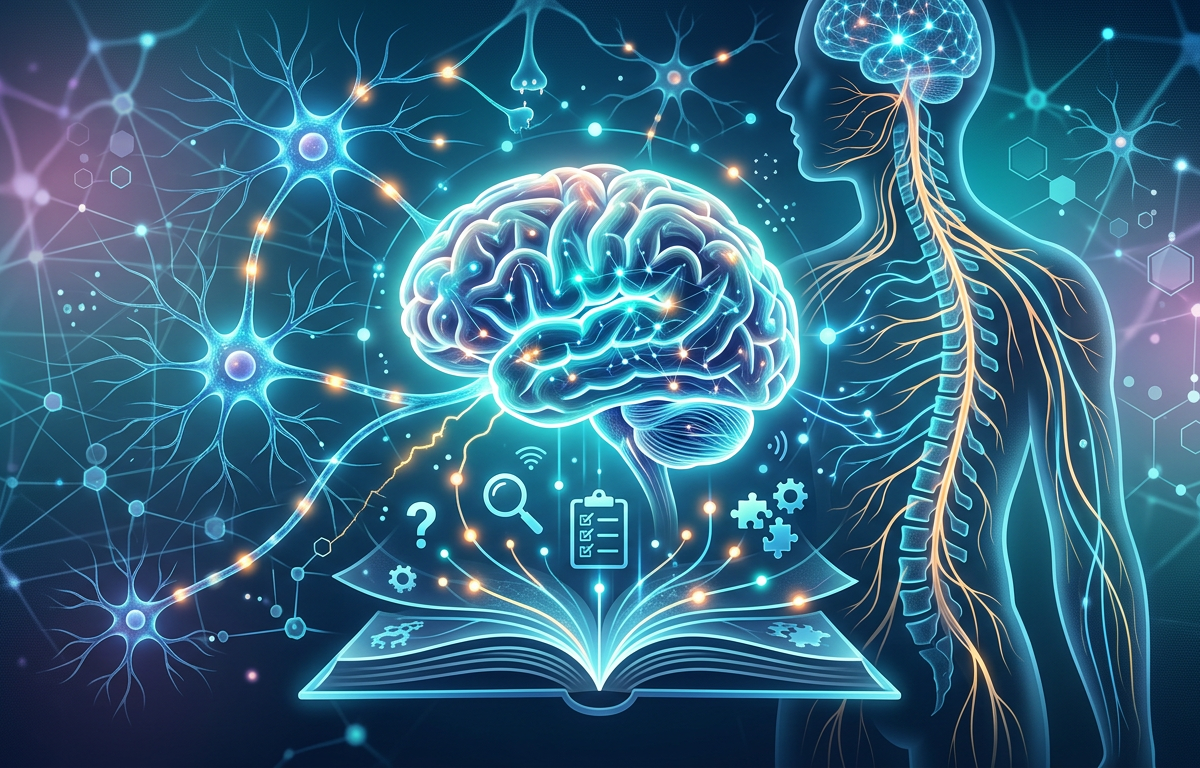
The nervous system is a complex network of specialized cells that transmit signals between different parts of the body, acting as the primary control and communication center for all physiological activities. To master Medium Nervous System Questions, one must understand the structural division between the Central Nervous System (CNS)—comprising the brain and spinal cord—and the Peripheral Nervous System (PNS). At the cellular level, neurons utilize electrochemical gradients to propagate action potentials, while glial cells provide essential support, insulation, and protection. Understanding these mechanisms is crucial for succeeding in Anatomy Practice Questions. Key processes include the movement of sodium and potassium ions across the axonal membrane, the release of neurotransmitters at the synaptic cleft, and the integration of sensory input to produce motor output through the somatic and autonomic pathways.
2. Solved Examples
Below are three worked examples that demonstrate how to analyze and solve common problems related to neural physiology and anatomy.
- Example: Calculating Resting Membrane Potential
A neuron has a high concentration of K+ inside the cell and a high concentration of Na+ outside. If the membrane becomes suddenly permeable only to K+, in which direction will the ions move and what happens to the charge?
- Identify the concentration gradient: K+ is higher inside than outside.
- Determine the flow: K+ will move out of the cell following its concentration gradient.
- Analyze the electrical result: As positive charge leaves the cell, the interior becomes more negative (hyperpolarization).
- Example: Reflex Arc Pathway
Trace the path of a signal when a person touches a hot stove and pulls their hand away.
- Sensory receptors in the skin detect thermal stimulus.
- Afferent (sensory) neurons carry the impulse toward the spinal cord.
- An interneuron in the gray matter of the spinal cord processes the signal.
- Efferent (motor) neurons carry the command to the biceps muscle.
- The muscle contracts, withdrawing the hand.
- Example: Autonomic System Differentiation
A patient presents with a rapid heart rate, dilated pupils, and inhibited digestion. Which branch of the nervous system is dominant?
- Review the symptoms: These are "fight or flight" responses.
- Identify the system: The Sympathetic Nervous System (SNS) is responsible for mobilizing energy during stress.
- Contrast with the Parasympathetic: The Parasympathetic system would slow the heart and stimulate digestion ("rest and digest").
3. Practice Questions
- Which specific type of glial cell is responsible for forming the myelin sheath around axons within the Central Nervous System?
- During an action potential, what specific event triggers the rapid repolarization of the axonal membrane?
- A patient suffers a stroke that damages Broca’s area in the left cerebral hemisphere. What specific functional deficit would you expect to observe?
- Explain the role of the Sodium-Potassium Pump (Na+/K+-ATPase) in maintaining the resting membrane potential of a neuron.
- Which part of the brain is primarily responsible for maintaining homeostasis by regulating body temperature, hunger, and the endocrine system?
- Distinguish between the white matter and gray matter of the spinal cord in terms of structure and function.
- What is the function of the nodes of Ranvier in saltatory conduction?
- If the ventral root of a spinal nerve is severed, what would be the primary clinical result in the region of the body served by that nerve?
- Contrast the functions of the cerebellum and the basal nuclei in the coordination of movement.
- What neurotransmitter is primarily released at the neuromuscular junction to trigger skeletal muscle contraction?
4. Answers & Explanations
- Oligodendrocytes. While Schwann cells myelinate the Peripheral Nervous System, oligodendrocytes provide the myelin sheath for multiple axons within the CNS. This is a common point of confusion in Organ System Questions.
- The closing of sodium channels and the opening of voltage-gated potassium channels. As K+ ions flow out of the cell, the internal environment returns to a negative state.
- Difficulty in speech production (Expressive Aphasia). Broca's area is responsible for the motor aspects of speech; the patient would likely understand language but struggle to form words.
- Maintenance of concentration gradients. The pump moves 3 Na+ ions out and 2 K+ ions in against their gradients using ATP, ensuring the cell remains polarized at roughly -70mV.
- Hypothalamus. It acts as the link between the nervous and endocrine systems via the pituitary gland. For more on cellular regulation, see Cell Structure Practice Questions.
- Gray matter contains cell bodies and dendrites (processing), while white matter contains myelinated axons (transmission). In the spinal cord, gray matter is internal (H-shaped) and white matter is external.
- Increasing signal speed. These gaps in the myelin sheath contain a high density of voltage-gated channels, allowing the action potential to "jump" from node to node.
- Loss of motor function (paralysis). The ventral root contains efferent (motor) fibers, while the dorsal root contains afferent (sensory) fibers.
- Cerebellum handles balance and fine-tuning; Basal nuclei handle the initiation and inhibition of movement. Damage to the cerebellum causes ataxia, while damage to basal nuclei (like in Parkinson's) causes tremors or rigidity.
- Acetylcholine (ACh). When ACh binds to receptors on the muscle fiber, it triggers depolarization and subsequent contraction.
1. Which division of the nervous system is responsible for the "rest and digest" response?
6. Frequently Asked Questions
What is the difference between an afferent and an efferent neuron?
Afferent neurons are sensory neurons that carry impulses from peripheral receptors toward the central nervous system. Efferent neurons are motor neurons that carry instructions away from the brain or spinal cord to muscles and glands.
How does the myelin sheath increase the speed of a nerve impulse?
The myelin sheath acts as an electrical insulator that prevents ion leakage across the axonal membrane. This forces the action potential to jump between the nodes of Ranvier, a process called saltatory conduction, which is significantly faster than continuous conduction.
What role does the blood-brain barrier play in the nervous system?
The blood-brain barrier is a highly selective semipermeable border formed by endothelial cells and astrocytes that protects the brain from circulating toxins and pathogens. It allows the passage of water, some gases, and lipid-soluble molecules while blocking larger or harmful substances.
What is the synaptic cleft?
The synaptic cleft is the microscopic gap between the presynaptic neuron and the postsynaptic cell. Neurotransmitters diffuse across this space to bind with receptors, converting an electrical signal into a chemical one and back again.
Why is the "all-or-none" principle important for neural signaling?
The all-or-none principle states that if a stimulus is strong enough to reach the threshold, an action potential of constant magnitude will fire. This ensures that signals are transmitted reliably without losing strength over long distances along the axon.
Enjoyed this article?
Share it with others who might find it helpful.
Related Articles
Hard Le Chatelier’s Principle Practice Questions
Master Hard Le Chatelier’s Principle Practice Questions with our comprehensive guide featuring solved examples, practice problems, and detailed explanations.
Mar 30, 2026

Hard Reaction Quotient (Q) Practice Questions
Hard Reaction Quotient (Q) Practice Questions
Mar 30, 2026

Grams to Moles Practice Questions with Answers
Master grams to moles conversions with our comprehensive guide. Includes step-by-step examples, practice questions, and detailed answers for chemistry students.
Mar 26, 2026
Avogadro’s Number Practice Questions with Answers
Master the mole concept with our Avogadro’s Number practice questions. Includes step-by-step solved examples, a quick quiz, and detailed explanations.
Mar 26, 2026

Empirical Formulas: Solving Ratios from Mass and Percent Data
Master empirical formula calculations with 10 practice questions, worked answers, and a free step-by-step calculator for mass, percentage, and combustion problems.
Mar 26, 2026