Medium MCAT Biology Practice Questions

Concept Explanation
Medium MCAT Biology Practice Questions focus on the integration of fundamental biological principles with complex physiological systems and cellular processes. These questions require more than simple memorization; they demand an understanding of how distinct systems—such as the endocrine system and the nervous system—interact to maintain homeostasis. To succeed, students must apply concepts like enzyme kinetics, metabolic pathways, and molecular genetics to experimental passages or discrete scenarios. Mastery involves identifying the underlying biological mechanism and predicting the outcome of a specific physiological perturbation, a skill often honed through retrieval practice.
Solved Examples
Review these worked examples to understand the logic required for medium-difficulty MCAT biology questions.
- Enzyme Inhibition: Analysis of a Michaelis-Menten plot shows that in the presence of an inhibitor, the remains unchanged while the increases. What type of inhibition is occurring?
- Identify the characteristics of different inhibition types. Competitive inhibitors bind at the active site, increasing the amount of substrate needed to reach half-maximal velocity () but not affecting the maximum rate ().
- Non-competitive inhibitors decrease without changing .
- Since is constant and increases, the answer is competitive inhibition.
- Genetics and Probability: In a species of plant, red flowers (R) are dominant to white flowers (r), and tall stems (T) are dominant to short stems (t). If two plants with genotype RrTt are crossed, what is the probability of producing a white-flowered, tall offspring?
- Use the law of independent assortment to treat each trait separately.
- For flower color: yields rr (white).
- For height: yields tall (TT or Tt).
- Multiply the probabilities: .
- Action Potentials: If a neuron is treated with a drug that blocks voltage-gated potassium channels, how would the action potential be affected?
- Recall the phases of an action potential. Depolarization is caused by sodium influx, while repolarization is caused by potassium efflux.
- If potassium channels are blocked, the cell cannot effectively repolarize after the peak of the action potential.
- The result is a prolonged plateau or a significantly delayed return to the resting membrane potential.
Practice Questions
Test your knowledge with these Medium MCAT Biology Practice Questions covering various topics from cell biology to physiology.
- A researcher observes that a specific protein is found in high concentrations in the lumen of the rough endoplasmic reticulum but is absent from the cytosol. Which of the following is most likely true about the synthesis of this protein?
- During strenuous exercise, the hemoglobin-oxygen dissociation curve shifts to the right. Which of the following physiological changes contributes most directly to this Bohr effect?
- A mutation in the gene encoding the p53 protein prevents it from binding to DNA. What is the most likely cellular consequence of this mutation?
Need more MCAT practice questions?
Generate unlimited MCAT-style questions with instant explanations and adaptive practice powered by Bevinzey AI.
Generate Questions Free- In the nephron, the majority of glucose reabsorption occurs in which segment?
- If a segment of DNA has the sequence 5'-ATG-GCA-TTA-3', what is the sequence of the corresponding mRNA transcript?
- Which of the following hormones is secreted by the posterior pituitary gland?
- An unknown cell type is observed to have a thick peptidoglycan cell wall and no membrane-bound organelles. How should this cell be classified?
- In the Citric Acid Cycle, which enzyme catalyzes the conversion of succinate to fumarate?
- A patient presents with a condition that inhibits the function of the parathyroid glands. Which of the following electrolyte imbalances is most likely?
- Which of the following best describes the role of the sarcoplasmic reticulum in muscle contraction?
Answers & Explanations
- Answer: It contains a signal sequence at its N-terminus. Proteins destined for the secretory pathway or for organelles like the ER are synthesized by ribosomes that dock onto the rough ER. This docking is mediated by a signal recognition particle (SRP) that recognizes a specific signal sequence on the growing polypeptide chain.
- Answer: Increased partial pressure of carbon dioxide () and decreased pH. The Bohr effect describes the decrease in hemoglobin's affinity for oxygen in response to increased and decreased pH (increased ). This allows for more efficient oxygen delivery to metabolically active tissues. Learn more about blood gas exchange at Nature Scitable.
- Answer: Uncontrolled cell division and tumor formation. p53 is a tumor suppressor protein that regulates the cell cycle and apoptosis. If it cannot bind DNA to act as a transcription factor, it cannot stop the cycle in response to DNA damage.
- Answer: Proximal convoluted tubule. Under normal physiological conditions, almost 100% of filtered glucose is reabsorbed in the proximal convoluted tubule via secondary active transport.
- Answer: 5'-AUG-GCA-UUA-3'. During transcription, mRNA is complementary to the template strand and identical to the coding (nontemplate) strand, except that Uracil (U) replaces Thymine (T). Since the provided sequence is usually written 5' to 3' as the coding strand, the mRNA matches it with U substitutions.
- Answer: Antidiuretic hormone (ADH) or Oxytocin. The posterior pituitary stores and releases hormones produced in the hypothalamus. ADH (vasopressin) and oxytocin are the two primary hormones released here.
- Answer: Gram-positive bacterium. Thick peptidoglycan layers are characteristic of Gram-positive bacteria. The absence of membrane-bound organelles confirms it is a prokaryote. More details on bacterial structure can be found on Wikipedia.
- Answer: Succinate dehydrogenase. This enzyme is unique because it is also part of the electron transport chain (Complex II). It facilitates the oxidation of succinate to fumarate while reducing FAD to .
- Answer: Hypocalcemia. Parathyroid hormone (PTH) increases blood calcium levels. Damage to these glands leads to a deficiency in PTH, resulting in low serum calcium levels.
- Answer: Storage and release of calcium ions. The sarcoplasmic reticulum (SR) sequestering calcium ions is vital for muscle relaxation. Upon stimulation, the SR releases calcium into the sarcoplasm, which binds to troponin to initiate contraction.
1. Which organelle is responsible for the post-translational modification and sorting of proteins?
Frequently Asked Questions
What makes a biology question "medium" difficulty on the MCAT?
Medium questions typically require multi-step reasoning or the application of a concept to a new scenario rather than simple recall. They often involve interpreting data from a graph or understanding the interaction between two different organ systems.
How should I study for medium-level MCAT biology?
Effective study strategies include using retrieval practice to reinforce connections between topics. Focus on understanding the "why" behind physiological processes rather than just the "what."
Are genetics questions common in the medium difficulty tier?
Yes, genetics problems involving Punnett squares, recombination frequencies, or pedigree analysis are frequently categorized as medium difficulty. They require both conceptual knowledge and basic mathematical application.
Do I need to memorize every enzyme in the Citric Acid Cycle?
For the MCAT, you should know the rate-limiting enzymes, the substrates, and the products of major metabolic pathways. Medium-level questions often test your ability to predict what happens to the cycle if one specific enzyme is inhibited.
How does the MCAT test the endocrine system at this level?
The MCAT often tests the endocrine system through feedback loops and hormonal regulation of homeostasis. You might be asked to predict the effect of a hormone deficiency on a distant organ or blood chemistry.
Need more MCAT practice questions?
Generate unlimited MCAT-style questions with instant explanations and adaptive practice powered by Bevinzey AI.
Generate Questions FreeReviewed by
Michael Danquah, MS, PhD
Dr. Michael Danquah is a professor of pharmaceutical sciences and founder of several educational technology platforms focused on improving student learning and performance.
Enjoyed this article?
Share it with others who might find it helpful.
Related Articles

Hard MCAT Biology Exam Practice Questions
Hard MCAT Biology Exam Practice Questions
May 9, 2026

Applying Coulomb’s Law and Potential to MCAT Biological Systems
MCAT Electrostatics Practice Questions with Answers
May 14, 2026
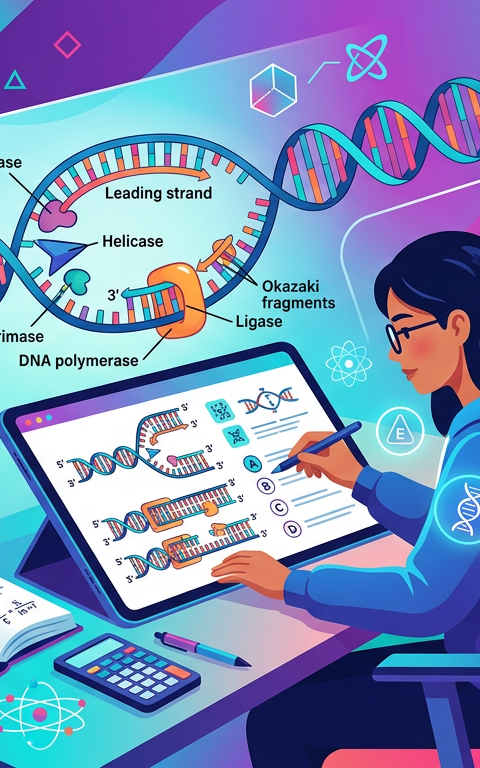
Hard MCAT DNA Replication Practice Questions
Master high-level DNA replication concepts with these hard MCAT practice questions covering enzymes, directionality, and telomeres.
May 14, 2026
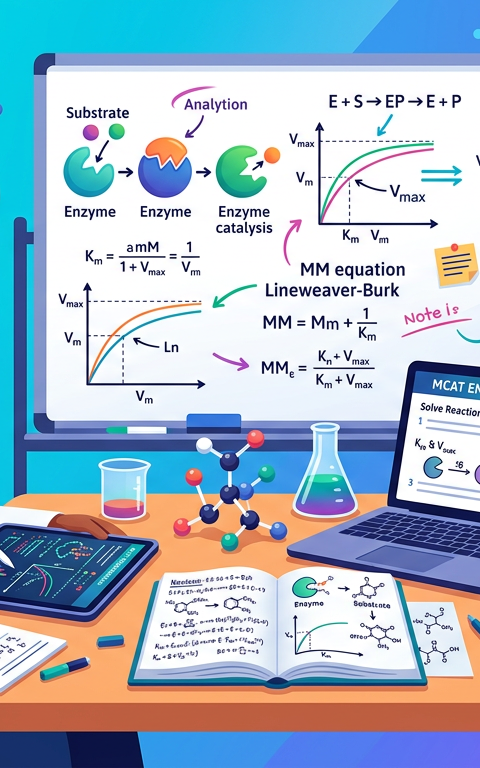
Hard MCAT Enzyme Practice Questions
Hard MCAT Enzyme Practice Questions
May 14, 2026

Medium MCAT DNA Replication Practice Questions
Medium MCAT DNA Replication Practice Questions
May 14, 2026

Medium MCAT Enzyme Practice Questions
Medium MCAT Enzyme Practice Questions
May 14, 2026

Easy MCAT DNA Replication Practice Questions
Master DNA replication with these easy MCAT practice questions. Learn about helicase, polymerase, and semi-conservative replication with detailed explanations.
May 14, 2026

MCAT Enzyme Kinetics: Solving KM and Vmax Without a Calculator
Easy MCAT Enzyme Practice Questions
May 14, 2026