Medium Ideal Gas Law (PV = nRT) Practice Questions
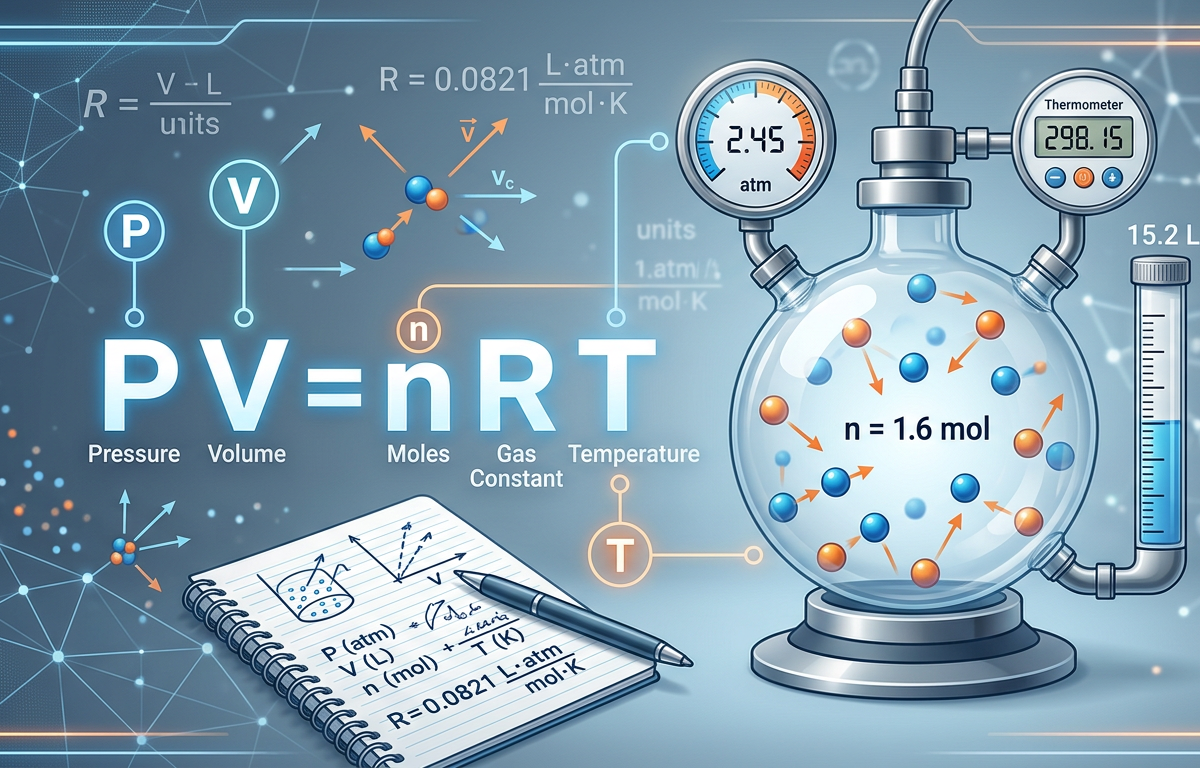
Mastering the Medium Ideal Gas Law (PV = nRT) Practice Questions is a critical milestone for students in chemistry and physics, as it bridges the gap between simple gas behaviors and complex thermodynamic systems. The Ideal Gas Law provides a mathematical framework to predict how a gas will react to changes in its environment, assuming the gas particles occupy no volume and exert no intermolecular forces. Whether you are preparing for your college chemistry exams or the MCAT, understanding the relationship between pressure, volume, moles, and temperature is essential for solving real-world scientific problems.
Concept Explanation
The Ideal Gas Law is a single equation, PV = nRT, that relates the four macroscopic properties of an ideal gas: pressure (P), volume (V), amount of substance in moles (n), and absolute temperature (T). This law is a combination of several empirical observations, including Boyle's Law (P ∝ 1/V), Charles's Law (V ∝ T), and Avogadro's Law (V ∝ n). By integrating these relationships, scientists created a universal formula that describes the state of a gas under a wide range of conditions.
To use the Ideal Gas Law correctly, you must ensure that your units are consistent with the Ideal Gas Constant (R). The most common values for R are:
- 0.08206 L·atm/(mol·K): Used when pressure is in atmospheres and volume is in liters.
- 8.314 J/(mol·K): Used when working with SI units (pressure in Pascals and volume in cubic meters).
- 62.36 L·mmHg/(mol·K): Used when pressure is in millimeters of mercury or Torr.
One of the most frequent mistakes students make is using Celsius instead of Kelvin. Always add 273.15 to the Celsius temperature to get the absolute temperature. Additionally, while no gas is perfectly "ideal," most real gases behave ideally at high temperatures and low pressures, where the Kinetic Molecular Theory assumptions hold true. For gases that deviate significantly from this behavior, chemists often use the van der Waals equation, which corrects for particle volume and attraction.
Solved Examples
The following examples demonstrate how to manipulate the PV = nRT equation to solve for different variables while maintaining unit consistency.
- Calculating Moles from Pressure and Volume: A 5.0 L container holds oxygen gas at a pressure of 2.5 atm and a temperature of 300 K. How many moles of oxygen are in the container?
- Identify the knowns: P = 2.5 atm, V = 5.0 L, T = 300 K, R = 0.08206 L·atm/(mol·K).
- Rearrange the formula for n: n = PV / RT.
- Substitute the values: n = (2.5 atm × 5.0 L) / (0.08206 L·atm/(mol·K) × 300 K).
- Calculate the result: n = 12.5 / 24.618 = 0.508 moles.
- Finding Pressure with Mass: A 2.0 L flask contains 10.0 grams of Neon (Ne) gas at 25°C. What is the pressure inside the flask in atm?
- Convert mass to moles: Neon has a molar mass of ~20.18 g/mol. n = 10.0 g / 20.18 g/mol = 0.496 moles.
- Convert temperature to Kelvin: T = 25 + 273.15 = 298.15 K.
- Identify V and R: V = 2.0 L, R = 0.08206 L·atm/(mol·K).
- Rearrange for P: P = nRT / V.
- Substitute: P = (0.496 mol × 0.08206 × 298.15 K) / 2.0 L = 6.07 atm.
- Determining Molar Mass: A 1.50 g sample of an unknown gas occupies 0.75 L at 1.2 atm and 310 K. What is the molar mass of the gas?
- Find the number of moles (n) first: n = PV / RT.
- Substitute values: n = (1.2 atm × 0.75 L) / (0.08206 × 310 K) = 0.9 / 25.4386 = 0.0354 moles.
- Calculate molar mass (M): M = mass / moles.
- Final calculation: M = 1.50 g / 0.0354 mol = 42.37 g/mol.
Practice Questions
Test your understanding with these Medium Ideal Gas Law (PV = nRT) Practice Questions. Ensure you convert all units to liters, atmospheres, and Kelvin before solving.
- A weather balloon is filled with 15.0 moles of Helium. If the pressure is 0.95 atm and the temperature is 15°C, what is the volume of the balloon?
- How many grams of CO₂ (molar mass 44.01 g/mol) are contained in a 10.0 L tank at 4.5 atm and 27°C?
- What is the temperature (in °C) of 2.2 moles of gas that occupies 45.0 L at a pressure of 1.15 atm?
Want unlimited practice questions like these?
Generate AI-powered questions with step-by-step solutions on any topic.
Try Question Generator Free →- A 250 mL rigid canister contains Nitrogen gas at 1,500 mmHg and 22°C. How many moles of Nitrogen are present?
- Calculate the density of Argon gas (Ar, 39.95 g/mol) at a pressure of 1.5 atm and a temperature of 50°C.
- A sample of gas with a mass of 0.350 g is collected in a 125 mL flask. The pressure is 745 Torr and the temperature is 95°C. Calculate the molar mass of the gas.
- If 0.75 moles of an ideal gas are compressed into a 3.0 L container at 400 K, what will the pressure be in kilopascals (kPa)? (Use R = 8.314 L·kPa/(mol·K)).
- A chemical reaction produces 0.125 moles of H₂ gas. If this gas is collected at STP (Standard Temperature and Pressure: 1 atm, 273.15 K), what volume will it occupy?
- A 5.0 L cylinder of Chlorine gas (Cl₂) is at a pressure of 10.0 atm and 20°C. If the valve is opened and the pressure drops to 1.0 atm (while temperature remains constant), how many moles of gas escaped?
- Identify the volume of 32.0 g of O₂ gas at 350 mmHg and 30°C.
Answers & Explanations
- Answer: 365.1 L. First, convert 15°C to 288.15 K. Rearrange PV = nRT to V = nRT/P. V = (15.0 mol × 0.08206 × 288.15 K) / 0.95 atm = 365.1 L.
- Answer: 81.3 g. Convert 27°C to 300.15 K. Find moles (n): n = PV / RT = (4.5 × 10.0) / (0.08206 × 300.15) = 1.847 mol. Convert moles to grams: 1.847 mol × 44.01 g/mol = 81.28 g.
- Answer: 13.7°C. Rearrange to find T: T = PV / nR = (1.15 × 45.0) / (2.2 × 0.08206) = 286.84 K. Convert to Celsius: 286.84 - 273.15 = 13.69°C.
- Answer: 0.0204 mol. Convert 250 mL to 0.25 L. Convert 1,500 mmHg to atm: 1500 / 760 = 1.974 atm. Convert 22°C to 295.15 K. n = (1.974 × 0.25) / (0.08206 × 295.15) = 0.0204 mol.
- Answer: 2.26 g/L. Density (d) = PM / RT. Convert 50°C to 323.15 K. d = (1.5 atm × 39.95 g/mol) / (0.08206 × 323.15) = 59.925 / 26.517 = 2.26 g/L.
- Answer: 86.4 g/mol. Convert 125 mL to 0.125 L, 745 Torr to 0.980 atm, and 95°C to 368.15 K. n = (0.980 × 0.125) / (0.08206 × 368.15) = 0.00405 mol. Molar Mass = 0.350 g / 0.00405 mol = 86.42 g/mol.
- Answer: 831.4 kPa. P = nRT / V = (0.75 × 8.314 × 400) / 3.0 = 2494.2 / 3.0 = 831.4 kPa.
- Answer: 2.80 L. V = nRT / P = (0.125 × 0.08206 × 273.15) / 1.0 = 2.80 L. (Note: At STP, 1 mole of gas is 22.4 L. 0.125 × 22.4 = 2.8 L).
- Answer: 1.87 mol. Initial moles (n1) = (10.0 × 5.0) / (0.08206 × 293.15) = 2.079 mol. Final moles (n2) = (1.0 × 5.0) / (0.08206 × 293.15) = 0.208 mol. Escaped = 2.079 - 0.208 = 1.871 mol.
- Answer: 54.1 L. 32.0 g O₂ = 1.0 mol. Pressure = 350 / 760 = 0.4605 atm. Temp = 303.15 K. V = (1.0 × 0.08206 × 303.15) / 0.4605 = 54.05 L.
1. Which of the following conditions is most likely to cause a real gas to deviate from the Ideal Gas Law?
Frequently Asked Questions
What is the difference between an ideal gas and a real gas?
An ideal gas is a theoretical model where particles have no volume and no attractive forces, whereas real gas particles have physical size and experience intermolecular attractions. Real gases behave most like ideal gases at high temperatures and low pressures according to LibreTexts Chemistry.
Why must temperature always be in Kelvin for gas law calculations?
Kelvin is an absolute temperature scale where zero represents the total absence of thermal energy, ensuring that ratios in the gas laws remain mathematically valid. Using Celsius would result in negative volumes or pressures, which are physically impossible.
Can I use the Ideal Gas Law for mixtures of gases?
Yes, the Ideal Gas Law applies to gas mixtures by using the total pressure and total number of moles. For specific components, you should refer to Dalton’s Law Practice Questions to understand partial pressures.
How do I choose the correct value for the gas constant R?
Select the value of R that matches the units of pressure used in your problem, such as 0.08206 for atm or 8.314 for kPa. If the units do not match, you must either convert your pressure units or use a different R value to ensure the units cancel out correctly.
Is it possible to calculate gas density using PV = nRT?
Yes, by substituting the definition of moles (mass/molar mass) into the Ideal Gas Law, you can derive the formula Density = (P × Molar Mass) / (RT). This allows you to find how heavy a gas is per unit volume under specific conditions.
What happens to the Ideal Gas Law at absolute zero?
At absolute zero (0 K), the Ideal Gas Law predicts that the volume of a gas would be zero, which is why it is a theoretical limit. In reality, all gases liquefy or solidify before reaching this temperature as intermolecular forces become dominant.
Enjoyed this article?
Share it with others who might find it helpful.
Related Articles

Hard Ideal Gas Law (PV = nRT) Practice Questions
Master complex gas law problems with these hard Ideal Gas Law (PV = nRT) practice questions, including density, molar mass, and stoichiometry calculations.
Apr 2, 2026

Ideal Gas Law (PV = nRT) Practice Questions with Answers
Ideal Gas Law (PV = nRT) Practice Questions with Answers
Apr 2, 2026

Calculating High-Stakes Meds: BSA Mosteller Formula Practice
Master hard body surface area-based dosage calculations with our comprehensive guide, solved examples, and practice questions for healthcare students.
May 17, 2026

Solving High-Stakes IV Titrations and Weight-Based Infusions
Master advanced IV flow rate calculations with these hard practice questions. Covers weight-based dosing, titrations, and dimensional analysis for nurses.
May 17, 2026

Solving Weight-Based Dosing: The 2.2 Conversion and Rounding Logic
Weight-Based Dosage Calculations Practice Questions with Answers
May 17, 2026

Predicting Periodic Anomalies: Beyond Basic Trend Rules
Hard Periodic Trends Practice Questions
Apr 4, 2026

Hard Electron Configuration Practice Questions
Hard Electron Configuration Practice Questions
Apr 4, 2026
Medium Electron Configuration Practice Questions
Master medium-level electron configuration with our comprehensive guide, including solved examples, stability exceptions, and practice questions with answers.
Apr 4, 2026