Medium Balancing Redox Practice Questions
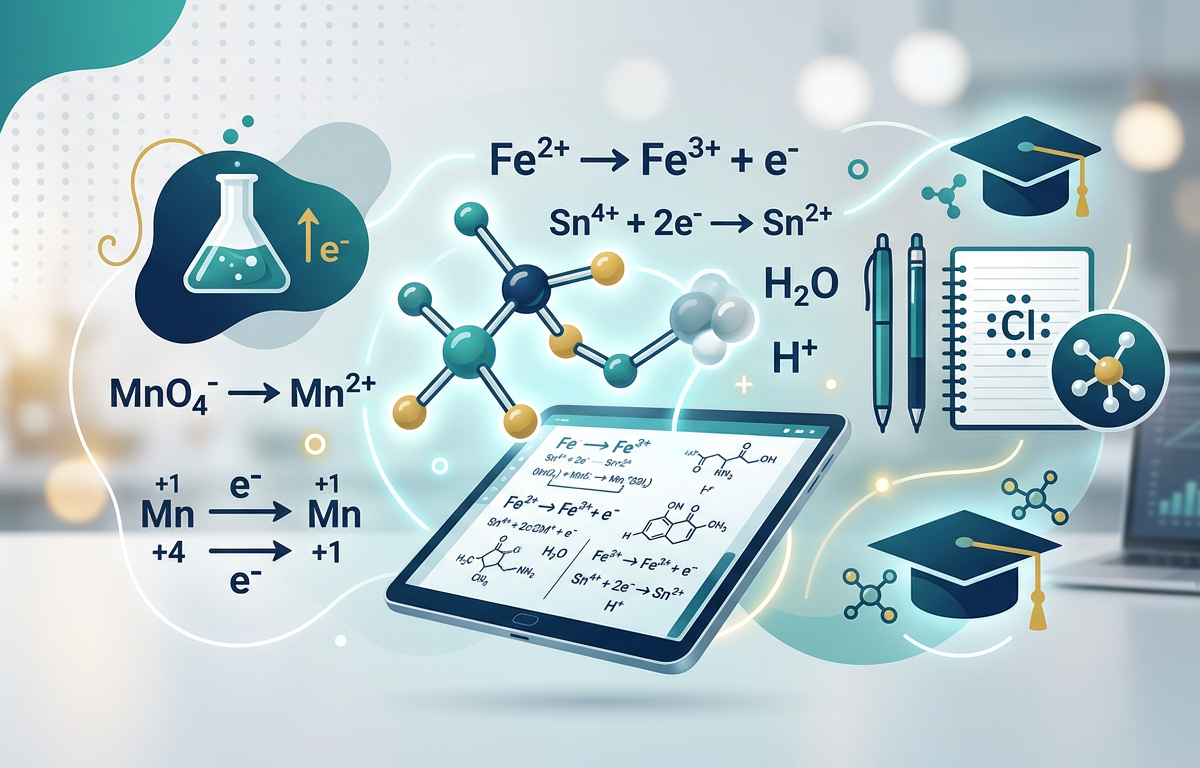
Concept Explanation
Balancing redox reactions is the process of ensuring that both the total number of atoms of each element and the total electrical charge are equal on both sides of a chemical equation. Unlike standard chemical equations, redox (reduction-oxidation) reactions involve the transfer of electrons between species. To balance these correctly, chemists typically use the half-reaction method, which splits the process into an oxidation component and a reduction component. This method is essential because mass balance alone is insufficient; the number of electrons lost by the reducing agent must exactly match the number of electrons gained by the oxidizing agent. Understanding these principles is a core component of electrochemistry and is vital for calculating cell potential calculations in galvanic and electrolytic cells.
The Half-Reaction Method Steps
To master Medium Balancing Redox Practice Questions, follow these systematic steps for reactions occurring in acidic or basic solutions:
Identify and Split: Assign oxidation numbers to all atoms and separate the equation into two half-reactions: oxidation and reduction.
Balance Non-O and Non-H Atoms: Balance all elements except oxygen and hydrogen.
Balance Oxygen: Add H2O molecules to the side deficient in oxygen.
Balance Hydrogen: Add H+ ions to the side deficient in hydrogen.
Balance Charge: Add electrons (e-) to the more positive side so that the net charge on both sides of the half-reaction is equal.
Equalize Electrons: Multiply the half-reactions by integers so that the number of electrons lost equals the number of electrons gained.
Combine and Simplify: Add the half-reactions together and cancel out species that appear on both sides.
Basic Solution Adjustment: If the reaction is in a basic medium, add OH- ions to both sides to neutralize H+, forming water, and then simplify.
Solved Examples
Reviewing these worked examples will help you prepare for more complex redox reaction practice questions.
Example 1: Acidic Solution
Balance the following reaction in acidic solution: MnO4- + Fe2+ → Mn2+ + Fe3+
Split: Reduction: MnO4- → Mn2+; Oxidation: Fe2+ → Fe3+.
Balance Mn and Fe: Both are already balanced (1 on each side).
Balance O: MnO4- → Mn2+ + 4H2O.
Balance H: MnO4- + 8H+ → Mn2+ + 4H2O.
Balance Charge: Reduction: MnO4- + 8H+ + 5e- → Mn2+ + 4H2O; Oxidation: Fe2+ → Fe3+ + 1e-.
Equalize e-: Multiply oxidation by 5: 5Fe2+ → 5Fe3+ + 5e-.
Combine: MnO4- + 8H+ + 5Fe2+ → Mn2+ + 4H2O + 5Fe3+.
Example 2: Basic Solution
Balance the reaction: Cl2 → Cl- + OCl- in basic solution.
Split: Red: Cl2 → Cl-; Ox: Cl2 → OCl-.
Balance Cl: Red: Cl2 → 2Cl-; Ox: Cl2 → 2OCl-.
Balance O: Cl2 + 2H2O → 2OCl-.
Balance H: Cl2 + 2H2O → 2OCl- + 4H+.
Balance Charge: Red: Cl2 + 2e- → 2Cl-; Ox: Cl2 + 2H2O → 2OCl- + 4H+ + 2e-.
Combine: 2Cl2 + 2H2O → 2Cl- + 2OCl- + 4H+. Simplify to: Cl2 + H2O → Cl- + OCl- + 2H+.
Adjust for Base: Add 2OH- to both sides: Cl2 + 2OH- → Cl- + OCl- + H2O.
Example 3: Acidic Solution with Dichromate
Balance: Cr2O72- + C2H5OH → Cr3+ + CH3COOH
Split: Red: Cr2O72- → Cr3+; Ox: C2H5OH → CH3COOH.
Balance Cr and C: Red: Cr2O72- → 2Cr3+; Ox: C2H5OH → CH3COOH (C is balanced).
Balance O: Red: Cr2O72- → 2Cr3+ + 7H2O; Ox: C2H5OH + H2O → CH3COOH.
Balance H: Red: Cr2O72- + 14H+ → 2Cr3+ + 7H2O; Ox: C2H5OH + H2O → CH3COOH + 4H+.
Balance Charge: Red: (+6e-); Ox: (-4e-). LCM of 4 and 6 is 12. Multiply Red by 2 and Ox by 3.
Combine: 2Cr2O72- + 3C2H5OH + 16H+ → 4Cr3+ + 3CH3COOH + 11H2O.
Practice Questions
1. Balance the following redox reaction in an acidic solution: Cu(s) + NO3-(aq) → Cu2+(aq) + NO2(g)
2. Balance the following reaction in a basic solution: Zn(s) + NO3-(aq) → Zn(OH)42-(aq) + NH3(g)
3. Balance the following disproportionation reaction in an acidic solution: Br2(l) → BrO3-(aq) + Br-(aq)
Want unlimited practice questions like these?
Generate AI-powered questions with step-by-step solutions on any topic.
Try Question Generator Free →4. Balance the following reaction in an acidic solution: MnO4- + H2C2O4 → Mn2+ + CO2
5. Balance the following reaction in a basic solution: Al(s) + MnO4-(aq) → MnO2(s) + Al(OH)4-(aq)
6. Balance the following reaction in an acidic solution: Cr2O72- + I- → Cr3+ + I2
7. Balance the following reaction in a basic solution: PbO2(s) + Cl-(aq) → Pb(OH)3-(aq) + ClO-(aq)
8. Balance the following reaction in an acidic solution: S2O32- + I2 → S4O62- + I-
9. Balance the following reaction in a basic solution: H2O2 + ClO2 → ClO2- + O2
10. Balance the following reaction in an acidic solution: As2O3 + NO3- → H3AsO4 + NO
Answers & Explanations
Cu + 4H+ + 2NO3- → Cu2+ + 2NO2 + 2H2O
Oxidation: Cu → Cu2+ + 2e-. Reduction: NO3- + 2H+ + e- → NO2 + H2O. Multiply reduction by 2 and combine.4Zn + NO3- + 7OH- + 6H2O → 4Zn(OH)42- + NH3
Oxidation: Zn → Zn(OH)42- involves 2e-. Reduction: NO3- → NH3 involves 8e-. Multiply Zn half-reaction by 4.3Br2 + 3H2O → BrO3- + 5Br- + 6H+
Oxidation: Br2 → 2BrO3- (10e-). Reduction: Br2 → 2Br- (2e-). Multiply reduction by 5 and simplify.2MnO4- + 5H2C2O4 + 6H+ → 2Mn2+ + 10CO2 + 8H2O
Mn changes from +7 to +2 (5e-). Carbon changes from +3 to +4 (1e- per C, 2e- per molecule). Multiply Mn by 2 and Oxalate by 5.Al + MnO4- + 2H2O → MnO2 + Al(OH)4-
Al → Al3+ (3e-). Mn (+7) → Mn (+4) (3e-). Electrons are already equal. Adding OH- for basic conditions results in this stoichiometry.Cr2O72- + 14H+ + 6I- → 2Cr3+ + 3I2 + 7H2O
Cr reduction gains 6e-. I oxidation loses 1e- per I atom (2e- per I2). Multiply iodide by 3.PbO2 + Cl- + OH- + H2O → Pb(OH)3- + ClO-
Pb (+4) → Pb (+2) (2e-). Cl (-1) → Cl (+1) (2e-). Balance atoms and charges with OH-.2S2O32- + I2 → S4O62- + 2I-
Thiosulfate oxidation loses 1e- per two S atoms. Iodine reduction gains 2e-.H2O2 + 2ClO2 + 2OH- → 2ClO2- + O2 + 2H2O
Peroxide oxygen (-1) → O2 (0). Chlorine (+4) → (+3).3As2O3 + 4NO3- + 7H2O + 4H+ → 6H3AsO4 + 4NO
Arsenic oxidation (+3 to +5) is a 4e- change per As2O3. Nitrogen reduction (+5 to +2) is a 3e- change.
1. Which species is the oxidizing agent in the reaction: Zn + Cu2+ → Zn2+ + Cu?
Frequently Asked Questions
What is the difference between oxidation and reduction?
Oxidation is the loss of electrons resulting in an increase in oxidation state, while reduction is the gain of electrons resulting in a decrease in oxidation state. You can remember this using the mnemonic "OIL RIG" (Oxidation Is Loss, Reduction Is Gain).
Why do we balance redox reactions differently than normal reactions?
Redox reactions require balancing both mass and charge because the movement of electrons must be accounted for. Standard balancing only focuses on the number of atoms, which might leave the electrical charges unequal on both sides.
When should I use the half-reaction method?
The half-reaction method is best used for complex aqueous reactions, especially those occurring in acidic or basic solutions. It allows you to focus on the electron transfer of each species individually before combining them into a final balanced redox equation.
How do you balance hydrogen in a basic solution?
Initially, balance hydrogen using H+ ions as if the solution were acidic. Then, add an equal number of OH- ions to both sides of the equation to neutralize the H+ into water molecules.
Can a single element be both oxidized and reduced?
Yes, this occurs in a disproportionation reaction where a single reactant is simultaneously oxidized and reduced to form two different products. An example is the decomposition of hydrogen peroxide into water and oxygen gas.
Want unlimited practice questions like these?
Generate AI-powered questions with step-by-step solutions on any topic.
Try Question Generator Free →
Want unlimited practice questions like these?
Generate AI-powered questions with step-by-step solutions on any topic.
Try Question Generator Free →Enjoyed this article?
Share it with others who might find it helpful.
Related Articles
Hard Balancing Redox Practice Questions
Master complex chemical equations with our hard balancing redox practice questions. Includes step-by-step solutions for acidic and basic media.
Apr 4, 2026
Balancing Redox Practice Questions with Answers
Master balancing redox reactions with our comprehensive guide featuring step-by-step solved examples, practice questions in acidic and basic solutions, and a quick quiz.
Apr 3, 2026
Hard Redox Reaction Practice Questions
Master complex chemistry with our Hard Redox Reaction Practice Questions. Learn to balance equations in acidic/basic media and calculate cell potentials.
Apr 4, 2026
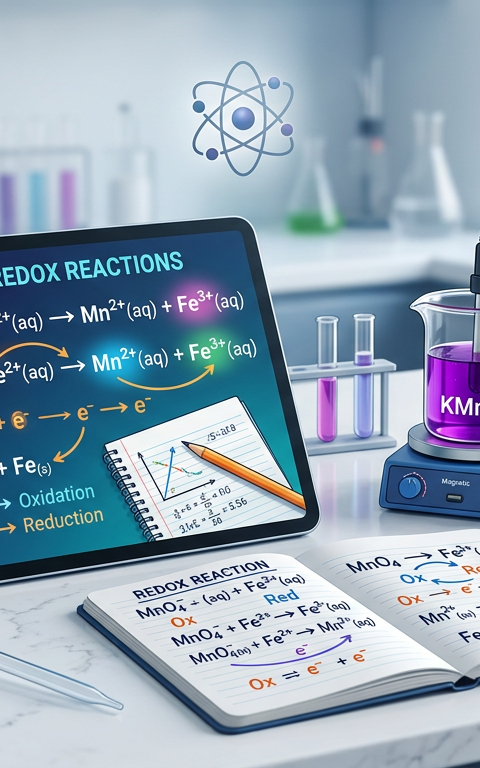
Medium Redox Reaction Practice Questions
Master medium-level redox reaction problems with our comprehensive guide featuring solved examples, balancing tips, and practice questions for students.
Apr 4, 2026
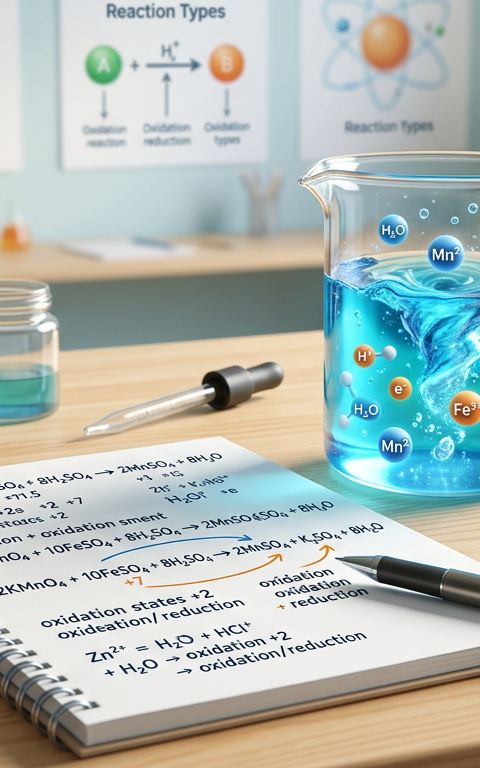
Stop Guessing: How to Balance Redox Charges Without Losing Electrons
Master the basics of oxidation-reduction with these easy balancing redox practice questions and step-by-step solutions for students.
Apr 4, 2026
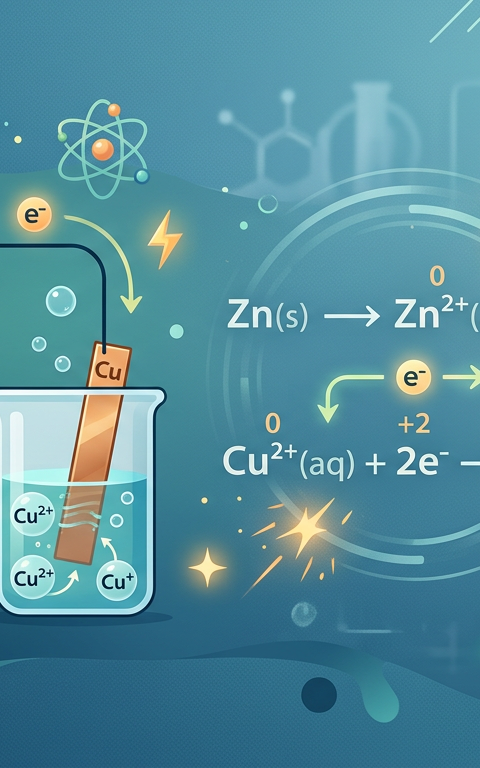
Easy Redox Reaction Practice Questions
Master the basics of electron transfer with these easy redox reaction practice questions, featuring step-by-step solutions and clear explanations.
Apr 4, 2026
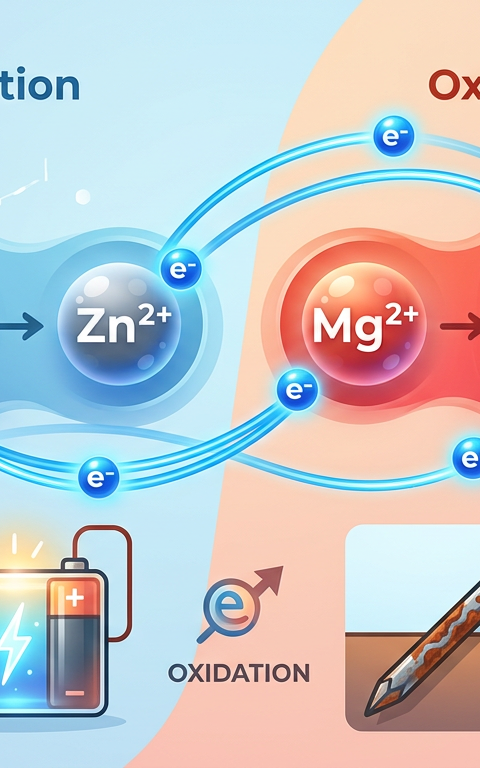
Redox Reaction Practice Questions with Answers
Master redox reactions with these practice questions and answers. Learn to identify oxidation, reduction, and balancing techniques for your chemistry exams.
Apr 3, 2026
Calculating High-Stakes Meds: BSA Mosteller Formula Practice
Master hard body surface area-based dosage calculations with our comprehensive guide, solved examples, and practice questions for healthcare students.
May 17, 2026