Redox Reaction Practice Questions with Answers
Concept Explanation
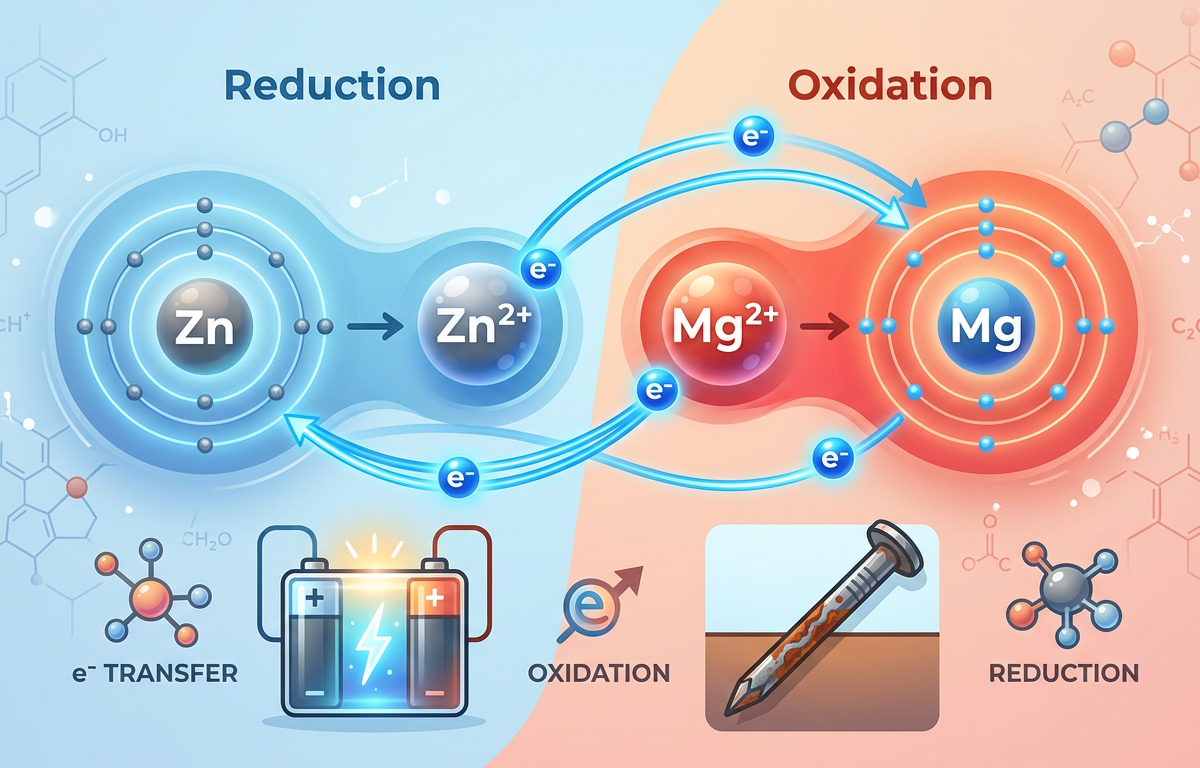
A redox reaction, short for reduction-oxidation reaction, is a chemical process characterized by the transfer of electrons between two species, resulting in changes to their oxidation states. In every redox reaction, two simultaneous processes occur: oxidation, where a substance loses electrons and increases its oxidation state, and reduction, where a substance gains electrons and decreases its oxidation state. A helpful mnemonic to remember this is "OIL RIG" (Oxidation Is Loss, Reduction Is Gain). These reactions are fundamental to biological processes like cellular respiration, industrial applications like metal extraction, and the function of electrochemical cells. To master these concepts, students often transition into calculating electrical potential using cell potential calculations to determine the spontaneity of the process.
Oxidation States and Electron Transfer
Understanding a redox reaction requires identifying the oxidation number of each atom in a compound. According to IUPAC standards, oxidation numbers are assigned based on a set of rules, such as oxygen usually being -2 and hydrogen being +1. When the oxidation number of an element increases during a reaction, it has been oxidized; when it decreases, it has been reduced. The substance that causes another to be reduced (by donating electrons) is known as the reducing agent, while the substance that causes another to be oxidized (by accepting electrons) is the oxidizing agent.
Half-Reactions
Chemists often split a redox reaction into two half-reactions to better visualize the movement of electrons. One half-reaction represents the oxidation component, and the other represents the reduction component. For a complete balanced equation, the number of electrons lost in the oxidation half must equal the number of electrons gained in the reduction half. This method is particularly useful when dealing with complex aqueous reactions. For more specific practice on this technique, you can visit our guide on balancing redox practice questions.
Solved Examples
Review these step-by-step solutions to understand how to identify and analyze redox reactions in practice.
Example 1: Displacement Reaction
Identify which species is oxidized and which is reduced in the reaction: Zn(s) + Cu²⁺(aq) → Zn²⁺(aq) + Cu(s).
Assign oxidation numbers: Zn(s) is 0, Cu²⁺ is +2, Zn²⁺ is +2, and Cu(s) is 0.
Track the changes: Zinc's oxidation number increases from 0 to +2. Copper's oxidation number decreases from +2 to 0.
Determine the process: Since Zinc lost electrons, it is oxidized. Since Copper gained electrons, it is reduced.
Identify agents: Zn is the reducing agent; Cu²⁺ is the oxidizing agent.
Example 2: Reaction with Oxygen
Analyze the combustion of magnesium: 2Mg(s) + O₂(g) → 2MgO(s).
Assign oxidation numbers: Mg and O₂ are both 0 as they are pure elements. In MgO, Mg is +2 and O is -2.
Identify electron flow: Mg goes from 0 to +2 (loses 2 electrons). O goes from 0 to -2 (gains 2 electrons).
Conclusion: Magnesium is oxidized. Oxygen is reduced.
Example 3: Identifying the Oxidizing Agent
In the reaction H₂ + Cl₂ → 2HCl, identify the oxidizing agent.
Oxidation states: H₂ (0), Cl₂ (0) → H (+1), Cl (-1).
Hydrogen increases from 0 to +1 (Oxidation).
Chlorine decreases from 0 to -1 (Reduction).
The oxidizing agent is the species that gets reduced, which is Chlorine (Cl₂).
Practice Questions
Test your knowledge with these redox reaction practice questions ranging from basic identification to complex balancing.
Identify the oxidation state of Manganese (Mn) in KMnO₄.
In the reaction Fe + CuSO₄ → FeSO₄ + Cu, which element is the reducing agent?
Determine if the following is a redox reaction: AgNO₃(aq) + NaCl(aq) → AgCl(s) + NaNO₃(aq).
Want unlimited practice questions like these?
Generate AI-powered questions with step-by-step solutions on any topic.
Try Question Generator Free →Assign oxidation numbers to all atoms in the dichromate ion (Cr₂O₇²⁻).
Balance the following half-reaction in acidic solution: MnO₄⁻ → Mn²⁺.
Identify the substance being oxidized in: 2Na + Cl₂ → 2NaCl.
In the reaction 3MnO₂ + 4Al → 3Mn + 2Al₂O₃, which species is the oxidizing agent?
What is the oxidation state of Sulfur in H₂SO₄?
True or False: A reaction where no oxidation states change can still be a redox reaction.
Identify the oxidation and reduction half-reactions for: Sn²⁺ + 2Fe³⁺ → Sn⁴⁺ + 2Fe²⁺.
Answers & Explanations
Compare your answers with the detailed explanations below to reinforce your understanding of redox reaction mechanics.
Answer: +7. In KMnO₄, Potassium (K) is +1 and Oxygen (O) is -2. The sum of oxidation states must be 0. (+1) + Mn + 4(-2) = 0; Mn - 7 = 0; Mn = +7.
Answer: Iron (Fe). Fe changes from 0 to +2 (oxidized), meaning it donates electrons to Copper. Therefore, Fe is the reducing agent.
Answer: No. This is a double displacement (precipitation) reaction. Ag stays +1, N stays +5, O stays -2, Na stays +1, and Cl stays -1. Since no oxidation numbers change, it is not a redox reaction.
Answer: Cr = +6, O = -2. Oxygen is -2. For two Chromium atoms: 2(Cr) + 7(-2) = -2 (the net charge). 2Cr - 14 = -2; 2Cr = 12; Cr = +6.
Answer: MnO₄⁻ + 8H⁺ + 5e⁻ → Mn²⁺ + 4H₂O. Steps involve balancing Oxygen with water, Hydrogen with H⁺ ions, and finally charge with electrons.
Answer: Sodium (Na). Sodium starts at 0 and ends at +1 in NaCl. Loss of electrons equals oxidation.
Answer: MnO₂. Manganese decreases its oxidation state from +4 to 0. Since it is reduced, it acts as the oxidizing agent.
Answer: +6. H is +1, O is -2. 2(+1) + S + 4(-2) = 0; 2 + S - 8 = 0; S = +6.
Answer: False. By definition, a redox reaction requires a change in oxidation states due to the transfer of electrons.
Answer: Oxidation: Sn²⁺ → Sn⁴⁺ + 2e⁻; Reduction: Fe³⁺ + e⁻ → Fe²⁺. Tin loses electrons while Iron gains them.
1. Which mnemonic describes the gain and loss of electrons in a redox reaction?
Frequently Asked Questions
What is the difference between oxidation and reduction?
Oxidation is the process where an atom or molecule loses electrons, resulting in an increase in oxidation state. Reduction is the opposite process where a species gains electrons, leading to a decrease in its oxidation state.
How do you identify a redox reaction?
A reaction is identified as redox if there is a change in the oxidation numbers of the elements involved from reactants to products. You can track these changes by applying standard oxidation state rules to each atom in the chemical equation.
Can a redox reaction occur without an oxidizing agent?
No, a redox reaction cannot occur without an oxidizing agent because electrons lost by one species must be accepted by another. Oxidation and reduction always occur simultaneously in a closed system.
What are spectator ions in redox reactions?
Spectator ions are ions that appear on both the reactant and product sides of a chemical equation without undergoing any change in their oxidation state. They are typically omitted when writing net ionic redox equations.
Why is balancing redox reactions different in acidic vs basic solutions?
The medium affects how you balance Hydrogen and Oxygen atoms; acidic solutions use H⁺ ions and water, while basic solutions require the addition of OH⁻ ions to neutralize H⁺. This ensures the chemical equation reflects the actual chemical environment of the reaction.
Where can I find more advanced redox problems?
For more advanced topics, you can explore the Nernst Equation practice questions which deal with non-standard conditions. Additionally, Khan Academy offers extensive resources on the theoretical foundations of electrochemistry.
Want unlimited practice questions like these?
Generate AI-powered questions with step-by-step solutions on any topic.
Try Question Generator Free →
Want unlimited practice questions like these?
Generate AI-powered questions with step-by-step solutions on any topic.
Try Question Generator Free →Enjoyed this article?
Share it with others who might find it helpful.
Related Articles
Hard Redox Reaction Practice Questions
Master complex chemistry with our Hard Redox Reaction Practice Questions. Learn to balance equations in acidic/basic media and calculate cell potentials.
Apr 4, 2026
Medium Redox Reaction Practice Questions
Master medium-level redox reaction problems with our comprehensive guide featuring solved examples, balancing tips, and practice questions for students.
Apr 4, 2026
Easy Redox Reaction Practice Questions
Master the basics of electron transfer with these easy redox reaction practice questions, featuring step-by-step solutions and clear explanations.
Apr 4, 2026
Hard Balancing Redox Practice Questions
Master complex chemical equations with our hard balancing redox practice questions. Includes step-by-step solutions for acidic and basic media.
Apr 4, 2026
Medium Balancing Redox Practice Questions
Master medium-level redox balancing with our comprehensive guide featuring solved examples, step-by-step methods for acidic/basic solutions, and practice questions.
Apr 4, 2026
Stop Guessing: How to Balance Redox Charges Without Losing Electrons
Master the basics of oxidation-reduction with these easy balancing redox practice questions and step-by-step solutions for students.
Apr 4, 2026
Balancing Redox Practice Questions with Answers
Master balancing redox reactions with our comprehensive guide featuring step-by-step solved examples, practice questions in acidic and basic solutions, and a quick quiz.
Apr 3, 2026

Easy Reaction Order Practice Questions
Master chemical kinetics with these easy reaction order practice questions. Learn to calculate overall reaction orders and understand zero, first, and second-order reactions.
Apr 2, 2026