MCAT Thermochemistry Practice Questions with Answers

MCAT Thermochemistry Practice Questions with Answers
Mastering MCAT Thermochemistry requires a deep understanding of how energy, heat, and work interact within chemical systems. This guide provides a comprehensive overview of the laws of thermodynamics, enthalpy, entropy, and Gibbs free energy, followed by high-yield practice questions designed to simulate the actual exam experience.
Concept Explanation
MCAT Thermochemistry is the study of the energy changes—specifically heat transfer—that accompany chemical reactions and physical phase changes. This field is governed by the laws of thermodynamics, which dictate whether a process is spontaneous and how much energy is exchanged with the surroundings. To excel in this section, you must distinguish between system (the reaction itself) and surroundings (everything else).
Key Thermodynamic Functions
- Enthalpy (): Measures the heat content of a system at constant pressure. Exothermic reactions release heat (), while endothermic reactions absorb heat ().
- Entropy (): Measures the degree of disorder or randomness. The Second Law of Thermodynamics states that the total entropy of the universe always increases for spontaneous processes.
- Gibbs Free Energy (): Determines spontaneity. The relationship is defined by the equation:
State Functions vs. Process Functions
State functions depend only on the current state of the system, not the path taken to get there (e.g., pressure, density, temperature, volume, enthalpy, internal energy, Gibbs free energy, and entropy). In contrast, process functions like work () and heat () describe the specific path taken between states. Understanding these distinctions is a core component of mastering medical education and complex sciences.
Solved Examples
Example 1: Calculating Enthalpy of Reaction using Bond Enthalpies
Estimate the for the combustion of methane: Given bond energies: , , , .
- Identify bonds broken (reactants): 4 bonds and 2 bonds. Total energy absorbed = .
- Identify bonds formed (products): 2 bonds and 4 bonds. Total energy released = .
- Calculate .
- Result: . The reaction is exothermic.
Example 2: Gibbs Free Energy and Spontaneity
A reaction has and . Is the reaction spontaneous at 25°C (298 K)?
- Convert to kJ: .
- Use the Gibbs equation: .
- Substitute values: .
- Result: . Since , the reaction is spontaneous.
Example 3: Calorimetry and Specific Heat
How much heat is required to raise the temperature of 50g of water from 20°C to 80°C? (Specific heat of water )
- Identify the formula: .
- Calculate temperature change: .
- Plug in values: .
- Final calculation: or .
Practice Questions
1. A reaction is found to be non-spontaneous at all temperatures. Which of the following must be true about the signs of enthalpy and entropy?
2. Using Hess's Law, find the enthalpy change for the reaction given:
3. Carbon dioxide sublimes directly from a solid to a gas at standard pressure. What are the signs of and for this process?
Train like it’s test day.
Build confidence with timed MCAT practice sessions, performance analytics, and AI-powered study support.
Start Timed Practice4. A 100g sample of an unknown metal absorbs 1000 J of heat, causing its temperature to rise by 20°C. What is the specific heat capacity of the metal?
5. Which of the following is a state function? (Work, Heat, Enthalpy, or Path Length)
6. If a reaction is exothermic and results in an increase in entropy, under what temperature conditions will it be spontaneous?
7. Calculate the standard enthalpy of combustion for propane () using standard heats of formation ():
8. According to the Third Law of Thermodynamics, what is the entropy of a pure crystalline substance at absolute zero (0 K)?
9. A piston compresses a gas with 500 J of work while the system releases 200 J of heat. What is the change in internal energy () of the system?
10. If for a reaction is negative, what can be said about the equilibrium constant ?
Answers & Explanations
- Answer: and .
For a reaction to be non-spontaneous at all temperatures, must always be positive. In the equation , if enthalpy is positive (endothermic) and entropy is negative (decreasing disorder), the term becomes positive. Adding two positive values always results in a positive . - Answer: +20 kJ.
Hess's Law states that the total enthalpy change is the sum of the enthalpy changes for the individual steps. Summing the reactions: . Therefore, . - Answer: and .
Sublimation (solid to gas) requires energy to break intermolecular forces, making it endothermic (). Moving from a highly ordered solid to a disordered gas increases entropy (). - Answer: .
Using , rearrange for : . Plugging in: . - Answer: Enthalpy.
Enthalpy is a state function because its value depends only on the state of the system, not how it arrived there. Work and heat are process functions. This concept is vital when using evidence-based study methods to organize scientific principles. - Answer: Spontaneous at all temperatures.
If is negative and is positive, then will always be negative (negative value minus a positive value), regardless of the magnitude of . - Answer: -2220 kJ/mol.
Reaction: .
.
. - Answer: Zero.
The Third Law of Thermodynamics states that the entropy of a perfect crystal at 0 K is exactly zero, as there is no thermal motion and only one possible microstate. - Answer: +300 J.
Use the First Law of Thermodynamics: (where is work done ON the system). Since work is done on the system, . Since heat is released, . Thus, . - Answer: .
The relationship is . If is negative, must be positive, which means must be greater than 1, favoring product formation at equilibrium.
1. Which of the following conditions always guarantees a spontaneous reaction?
Frequently Asked Questions
What is the difference between temperature and heat?
Temperature is an intensive property measuring the average kinetic energy of particles, while heat is an extensive property representing the transfer of thermal energy between systems due to a temperature gradient. You can think of heat as energy in transit and temperature as the "thermal pressure" driving that transit.
How does Hess's Law relate to state functions?
Hess's Law works because enthalpy is a state function, meaning the total enthalpy change for a reaction is independent of the pathway taken. This allows us to calculate the enthalpy of a complex reaction by summing the enthalpies of intermediate steps that add up to the overall reaction.
What is the significance of standard conditions in MCAT Thermochemistry?
Standard conditions (298 K, 1 atm, 1 M concentration) provide a reference point for comparing thermodynamic properties like and . It is important not to confuse these with Standard Temperature and Pressure (STP), which is 273 K and 1 atm, typically used for gas law calculations.
Can a reaction with a negative entropy change be spontaneous?
Yes, a reaction with a negative entropy change () can be spontaneous if the reaction is sufficiently exothermic (). In such cases, the enthalpy term outweighs the entropy term in the Gibbs free energy equation, particularly at lower temperatures.
How do catalysts affect the thermodynamics of a reaction?
Catalysts have no effect on the thermodynamic parameters like , , or ; they only lower the activation energy to increase the reaction rate. A catalyst changes the kinetics (how fast) but not the equilibrium or spontaneity (how far) of a chemical process. This distinction is a frequent focus of retrieval practice in chemistry prep.
Train like it’s test day.
Build confidence with timed MCAT practice sessions, performance analytics, and AI-powered study support.
Start Timed PracticeReviewed by
Michael Danquah, MS, PhD
Dr. Michael Danquah is a professor of pharmaceutical sciences and founder of several educational technology platforms focused on improving student learning and performance.
Enjoyed this article?
Share it with others who might find it helpful.
Related Articles

Hard MCAT Thermochemistry Practice Questions
Hard MCAT Thermochemistry Practice Questions
May 9, 2026
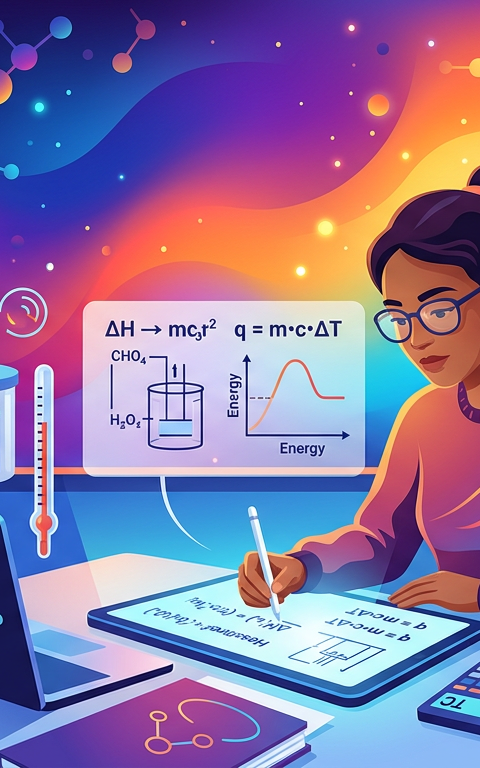
Medium MCAT Thermochemistry Practice Questions
Medium MCAT Thermochemistry Practice Questions
May 9, 2026

Easy MCAT Thermochemistry Practice Questions
Easy MCAT Thermochemistry Practice Questions
May 9, 2026

Easy MCAT Amino Acid Practice Questions
Easy MCAT Amino Acid Practice Questions
May 14, 2026
Easy MCAT Biochemistry Practice Questions
Easy MCAT Biochemistry Practice Questions
May 14, 2026
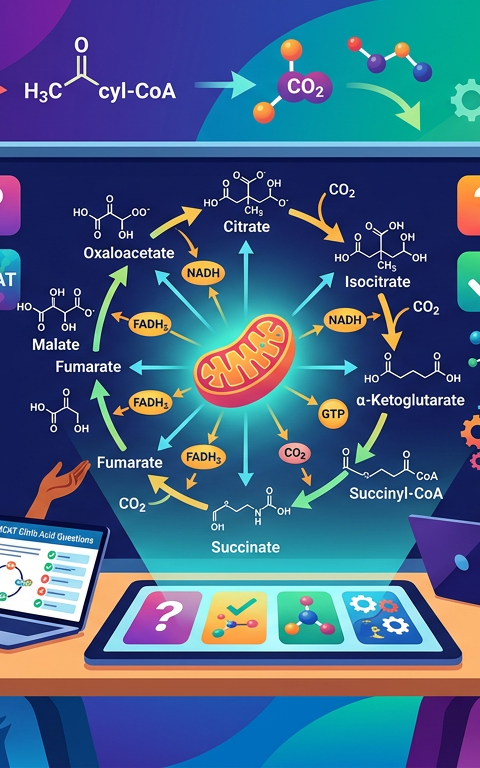
MCAT Citric Acid Practice Questions with Answers
MCAT Citric Acid Practice Questions with Answers
May 14, 2026

MCAT Biochemistry Practice Questions with Answers
MCAT Biochemistry Practice Questions with Answers
May 14, 2026

Solving High-Yield MCAT Stereochemistry: Beyond R and S Basics
Hard MCAT Stereochemistry Practice Questions
May 11, 2026