MCAT Reaction Mechanism Practice Questions with Answers

MCAT Reaction Mechanism Practice Questions with Answers
Mastering the MCAT reaction mechanism is essential for scoring high in the Chemical and Physical Foundations of Biological Systems section. Understanding how electrons move, which bonds break, and how intermediates form allows students to predict products and determine rate laws without rote memorization. This guide provides a deep dive into the fundamental principles and offers high-yield practice to ensure you are ready for test day.
Concept Explanation
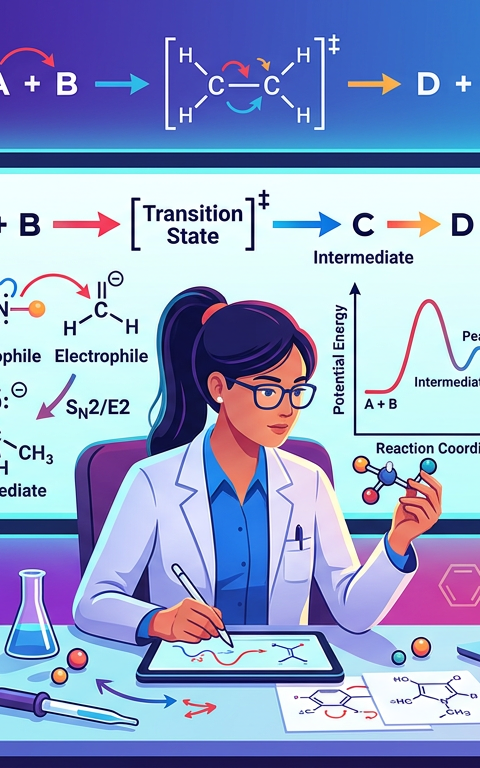
An MCAT reaction mechanism is a step-by-step description of the path that reactants take to become products, detailing the movement of electrons and the formation of short-lived intermediates.
In organic chemistry, we use curved arrows to track electron flow—always moving from an electron-rich nucleophile (lone pairs or pi bonds) to an electron-poor electrophile. Key concepts you must master include:
- The Rate-Determining Step (RDS): The slowest step in a multi-step reaction which dictates the overall reaction rate.
- Intermediates vs. Transition States: Intermediates are local minima on an energy coordinate diagram and can sometimes be isolated, while transition states are high-energy maxima representing the exact moment of bond breaking/forming.
- Nucleophilic Substitution: Including (two steps, carbocation intermediate) and (one step, backside attack).
- Elimination Reactions: and mechanisms that result in the formation of double bonds.
To excel, students should apply retrieval practice for STEM subjects by drawing mechanisms from memory rather than just looking at them. For more background on the chemical principles involved, you can consult resources like LibreTexts Chemistry or Khan Academy.
Solved Examples
Example 1: Mechanism
Predict the product and describe the mechanism for the reaction of (S)-2-bromobutane with sodium hydroxide ().
- Identify the nucleophile () and the electrophile (the chiral carbon attached to bromine).
- The performs a backside attack on the electrophilic carbon.
- Simultaneously, the bond breaks (concerted step).
- The stereochemistry undergoes inversion, resulting in (R)-butan-2-ol.
Example 2: Acid-Catalyzed Hydration
Describe the mechanism for the addition of water to ethene in the presence of sulfuric acid.
- Protonation: The pi bond of ethene attacks a proton () from the acid, forming a carbocation.
- Nucleophilic Attack: A water molecule attacks the carbocation.
- Deprotonation: Another water molecule removes a proton from the oxonium ion to yield ethanol and regenerate the acid catalyst.
Example 3: Nucleophilic Acyl Substitution
Explain the mechanism of ester saponification using .
- The hydroxide ion attacks the carbonyl carbon, forming a tetrahedral intermediate.
- The carbonyl reforms, kicking out the alkoxide leaving group ().
- The alkoxide deprotonates the resulting carboxylic acid to form a carboxylate salt and an alcohol.
Practice Questions
1. In a two-step reaction where the first step is the slow step, what happens to the overall reaction rate if the concentration of a reactant involved only in the second step is doubled?
2. Which of the following species is most likely to act as a nucleophile in a polar aprotic solvent?
3. Consider the reaction of 2-chloro-2-methylpropane with methanol. What is the primary mechanism and the major product?
Don’t just reread. Train for recall.
Use Bevinzey’s active recall and retrieval practice tools to improve long-term memory and MCAT performance.
Try Active Recall Free4. Draw the reaction coordinate diagram for an reaction. How many transition states and intermediates are present?
5. Why do tertiary alkyl halides typically undergo or reactions rather than reactions?
6. In the nitration of benzene, what is the active electrophile generated by the mixture of and ?
7. A reaction has a rate law of . If this is a multi-step mechanism, what can be inferred about the rate-determining step?
8. What is the role of a Lewis acid in a Friedel-Crafts alkylation mechanism?
9. Rank the following in order of increasing leaving group ability: .
10. During the formation of an acetal from an aldehyde and two equivalents of alcohol, what is the name of the intermediate formed after the first equivalent of alcohol adds?
Answers & Explanations
1. Answer: The rate remains unchanged.
Since the first step is the slow (rate-determining) step, the overall rate depends only on the reactants involved in that step. Changes in the concentration of species involved in subsequent fast steps do not affect the kinetic rate of the overall process.
2. Answer:
In polar aprotic solvents (like DMSO or acetone), nucleophilicity correlates with basicity. Since is the strongest base among the halides, it is the most nucleophilic. In contrast, in polar protic solvents, would be the best nucleophile due to its size and lower solvation energy.
3. Answer: ; 2-methoxy-2-methylpropane.
The substrate is a tertiary alkyl halide, which is too sterically hindered for . Methanol is a weak nucleophile/protic solvent, favoring the dissociation of the leaving group to form a stable tertiary carbocation ( mechanism).
4. Answer: Two transition states and one intermediate.
An reaction involves two steps: (1) formation of the carbocation (slow) and (2) nucleophilic attack (fast). Each step has its own transition state, with the carbocation intermediate sitting in the energy well between them.
5. Answer: Steric Hindrance.
reactions require a backside attack. In a tertiary halide, the three bulky alkyl groups block the path of the incoming nucleophile, making the transition state energy prohibitively high.
6. Answer: The nitronium ion ().
Sulfuric acid protonates nitric acid, leading to the loss of water and the generation of the highly electrophilic nitronium ion, which then reacts with the benzene ring.
7. Answer: The RDS involves a collision between two molecules of A.
The rate law exponents match the coefficients of the reactants in the rate-determining step. A second-order dependence on [A] suggests two molecules of A are involved in the slow step.
8. Answer: To generate a strong electrophile.
The Lewis acid (like ) coordinates with the alkyl halide, weakening the bond or removing the chloride entirely to create a carbocation or a strong electrophilic complex.
9. Answer: .
Leaving group ability is inversely related to basicity. Since is the strongest acid, is the weakest base and thus the best leaving group. This is a great topic to review using retrieval practice for medical students to ensure long-term retention of periodic trends.
10. Answer: Hemiacetal.
A hemiacetal contains one group and one group attached to the same carbon. Addition of the second equivalent of alcohol under acidic conditions replaces the with another to form the acetal.
1. Which of the following is a characteristic of an \( S_N2 \) reaction?
Frequently Asked Questions
What is the difference between an intermediate and a transition state?
An intermediate is a distinct chemical species with a finite lifetime that exists at a local energy minimum, whereas a transition state is a fleeting, high-energy arrangement of atoms at an energy maximum that cannot be isolated.
How do I identify the rate-determining step in a mechanism?
The rate-determining step is the step with the highest activation energy on a reaction coordinate diagram, effectively acting as the "bottleneck" for the overall reaction speed.
What makes a good leaving group for MCAT reactions?
Good leaving groups are weak bases, which are the conjugate bases of strong acids (like , , or ), because they can stably carry the electron pair after departing.
Does the MCAT require memorizing every organic mechanism?
No, the MCAT tests your ability to apply general principles of electron flow and stability; focus on understanding nucleophile/electrophile interactions and steric/electronic effects rather than rote memorization.
How does a catalyst affect a reaction mechanism?
A catalyst provides an alternative mechanistic pathway with a lower activation energy, increasing the reaction rate without being consumed in the overall process.
Why is stereochemistry important in mechanisms?
Stereochemistry provides evidence for specific mechanisms, such as the inversion of configuration in or the racemization observed in reactions due to planar carbocation intermediates.
For more strategies on how to master complex scientific concepts, check out our guide on retrieval practice and evidence-based study methods.
Don’t just reread. Train for recall.
Use Bevinzey’s active recall and retrieval practice tools to improve long-term memory and MCAT performance.
Try Active Recall FreeReviewed by
Michael Danquah, MS, PhD
Dr. Michael Danquah is a professor of pharmaceutical sciences and founder of several educational technology platforms focused on improving student learning and performance.
Enjoyed this article?
Share it with others who might find it helpful.
Related Articles

Hard MCAT Reaction Mechanism Practice Questions
Hard MCAT Reaction Mechanism Practice Questions
May 11, 2026
Medium MCAT Reaction Mechanism Practice Questions
Medium MCAT Reaction Mechanism Practice Questions
May 11, 2026

Easy MCAT Reaction Mechanism Practice Questions
Easy MCAT Reaction Mechanism Practice Questions
May 11, 2026

Predicting O-Chem Reaction Outcomes on the MCAT
MCAT Organic Chemistry Practice Questions with Answers
May 10, 2026

Hard MCAT Philosophy Passage Practice Questions
Master Hard MCAT Philosophy Passage Practice Questions with our comprehensive guide featuring solved examples, practice questions, and expert explanations.
May 17, 2026

Hard MCAT Humanities Passage Practice Questions
Master Hard MCAT Humanities Passage Practice Questions with our comprehensive guide featuring solved examples, practice questions, and expert strategies.
May 17, 2026

Hard MCAT Critical Analysis Practice Questions
Hard MCAT Critical Analysis Practice Questions
May 17, 2026

Hard MCAT Reading Comprehension Practice Questions
Hard MCAT Reading Comprehension Practice Questions
May 17, 2026