Hard MCAT Reaction Mechanism Practice Questions
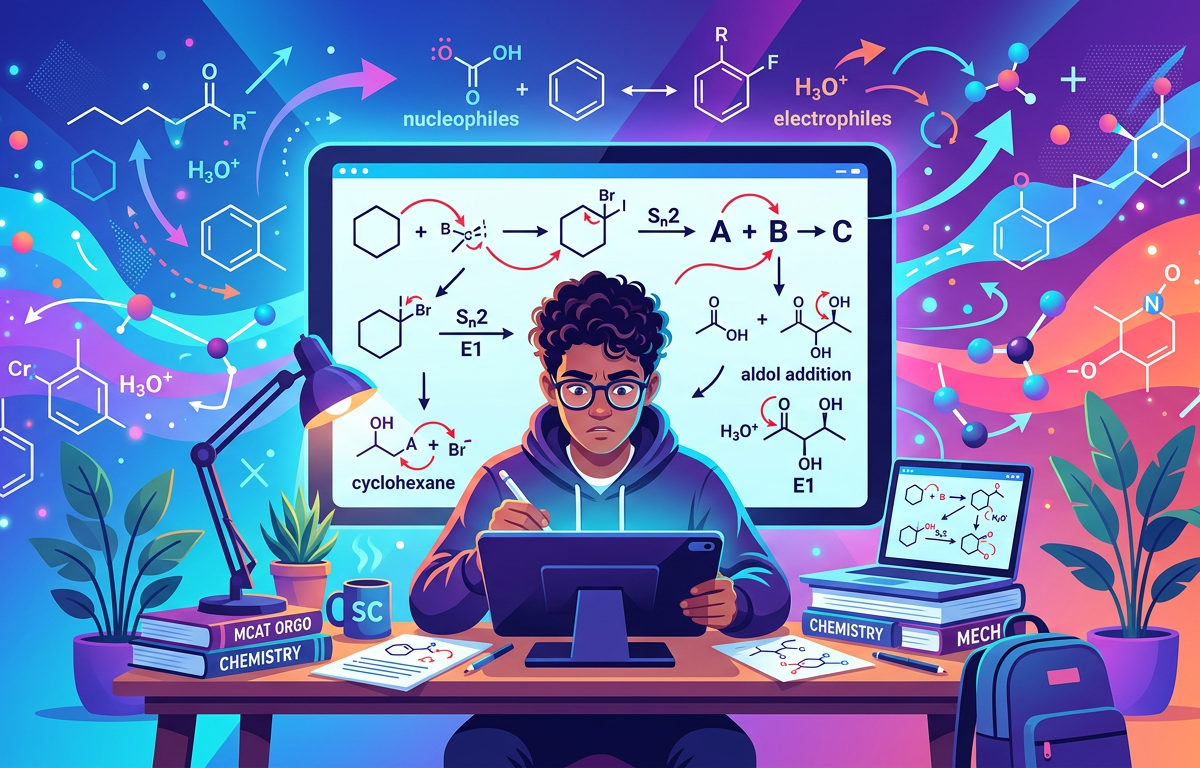
Concept Explanation
An MCAT reaction mechanism is the step-by-step sequence of elementary reactions by which overall chemical change occurs, illustrating the movement of electrons and the formation of intermediates. Understanding these pathways requires a deep grasp of nucleophilicity, electrophilicity, and the stability of transition states. On the MCAT, you must be able to predict how a molecule will behave based on its functional groups and the reaction conditions provided. For instance, the difference between an and pathway often hinges on the substitution of the substrate and the strength of the nucleophile. Mastering these concepts is essential for the Chemical and Physical Foundations of Biological Systems section. To improve your retention of these complex steps, many students find that mastering retrieval practice is the most effective way to internalize organic chemistry patterns. By actively recalling the mechanism of a carbonyl addition or an acyl substitution rather than just rereading a textbook, you build stronger neural pathways for the actual exam day.
Key factors influencing an MCAT reaction mechanism include:
- Steric Hindrance: Bulky groups can block nucleophilic attack, favoring unimolecular pathways.
- Solvent Effects: Protic solvents stabilize ions through hydrogen bonding, while aprotic solvents can enhance nucleophile strength.
- Resonance and Induction: These electronic effects determine the stability of carbocations or carbanions formed during the reaction.
Solved Examples
The following examples demonstrate how to approach complex organic mechanisms by identifying the role of each reactant.
- Example 1: Nucleophilic Acyl Substitution
Predict the mechanism for the reaction of an ester with a strong base like .
- The hydroxide ion acts as a nucleophile and attacks the electrophilic carbonyl carbon.
- A tetrahedral intermediate is formed where the carbonyl oxygen carries a negative charge.
- The intermediate collapses, reforming the double bond and kicking out the alkoxide leaving group.
- The resulting carboxylic acid is deprotonated by the alkoxide to form a carboxylate salt and an alcohol.
- Example 2: Electrophilic Addition to Alkenes
Explain the mechanism of the hydration of 2-methyl-2-butene in an acidic medium.
- The alkene pi bond attacks a proton () from the acid catalyst.
- Following Markovnikov's rule, the proton adds to the less substituted carbon to form the more stable tertiary carbocation.
- Water acts as a nucleophile and attacks the tertiary carbocation.
- A final deprotonation step by another water molecule yields the final product, 2-methyl-2-butanol.
- Example 3: Aldol Condensation
Describe the formation of a -hydroxy aldehyde from acetaldehyde.
- A base removes an -hydrogen from one acetaldehyde molecule to form a resonance-stabilized enolate.
- The enolate nucleophile attacks the carbonyl carbon of a second, neutral acetaldehyde molecule.
- The resulting alkoxide intermediate is protonated by the solvent (water or alcohol).
- The final product is 3-hydroxybutanal.
Practice Questions
Test your knowledge with these hard MCAT reaction mechanism practice questions. Use evidence-based study methods to maximize your score.
- A secondary alkyl halide is treated with a bulkier base like potassium tert-butoxide () in tert-butanol. Which mechanism is most likely to dominate, and what is the primary product?
- In the Strecker synthesis of amino acids, what is the specific role of the ammonium chloride () in the first step of the reaction with an aldehyde?
- Consider the reaction of a ketone with a primary amine. Draw the mechanism and identify the specific intermediate that undergoes dehydration to form the imine.
Study smarter for the MCAT.
Turn practice into performance with AI-powered MCAT tools designed to help students retain more and score higher.
Start Learning Free- An unknown compound undergoes an reaction. If the starting material is a pure enantiomer at a chiral center, why does the product usually show a slight preference for inversion over retention, rather than a perfect 50/50 racemic mix?
- During the mechanism of the Wittig reaction, a phosphorus ylide reacts with a carbonyl. Identify the four-membered ring intermediate formed during this process.
- In a Michael addition, a nucleophile attacks a -carbon of an -unsaturated carbonyl. Why is the -carbon electrophilic despite being separated from the oxygen by a double bond?
- Predict the outcome when a carboxylic acid is treated with . What is the driving force for this reaction?
- Why does the Friedel-Crafts alkylation of benzene with n-propyl chloride primarily yield isopropylbenzene instead of n-propylbenzene?
- Describe the mechanism of the Gabriel synthesis. Why is this method preferred over direct alkylation of ammonia for producing primary amines?
- In the context of enzyme kinetics, how does the formation of a covalent intermediate in a reaction mechanism affect the shape of a Michaelis-Menten plot?
Answers & Explanations
- E2 Mechanism; Hofmann Product: Because is a bulky, hindered base, it cannot easily access the more substituted -hydrogens. Therefore, it removes a proton from the least hindered carbon, leading to the less substituted alkene (the Hofmann product) via a concerted E2 mechanism.
- Formation of an Imine: The provides a source of ammonia () and an acid catalyst. The ammonia attacks the aldehyde to form a hemiaminal, which then dehydrates to form an imine. This imine is the electrophile for the subsequent cyanide attack.
- Carbinolamine Intermediate: The amine attacks the carbonyl carbon to form a dipolar intermediate, which then undergoes proton transfer to form a carbinolamine (). Dehydration of this carbinolamine yields the imine.
- Ion Pair Formation: In an pathway, the leaving group departs to form a carbocation. However, for a brief moment, the leaving group remains closely associated with the cation as an "intimate ion pair." This partially blocks the side from which it left, making nucleophilic attack from the opposite side slightly more frequent.
- Oxaphosphetane: The phosphorus ylide and the carbonyl undergo a [2+2] cycloaddition to form a four-membered ring called an oxaphosphetane. The high affinity of phosphorus for oxygen drives the subsequent collapse of this ring into an alkene and triphenylphosphine oxide.
- Resonance Stabilization: The -carbon is electrophilic because of resonance. The pi electrons of the -double bond can shift toward the carbonyl carbon, which in turn shifts the carbonyl pi electrons to the oxygen. This places a formal positive charge on the -carbon in one resonance contributor.
- Acyl Chloride Formation: The carboxylic acid is converted to an acyl chloride. The driving force is the production of gas and gas, which escape the reaction mixture, driving the equilibrium forward according to Le Chatelier's principle.
- Carbocation Rearrangement: The reaction proceeds through a carbocation intermediate. The initial n-propyl cation is primary and unstable; it undergoes a 1,2-hydride shift to form the more stable secondary isopropyl cation before reacting with the benzene ring.
- Phthalimide Rearrangement: Gabriel synthesis uses potassium phthalimide as a protected nitrogen source. It is preferred because the bulky phthalimide group prevents polyalkylation, ensuring that only a single alkyl group is added to the nitrogen.
- Vmax and Km Changes: While the mechanism itself doesn't change the "shape" (it remains hyperbolic), the presence of a stable covalent intermediate can decrease the turnover number (), thereby lowering the of the reaction.
1. Which of the following best describes the rate-determining step in an Sn1 reaction?
Frequently Asked Questions
What is the difference between a transition state and an intermediate?
A transition state is a high-energy, unstable arrangement of atoms at the peak of an energy barrier that cannot be isolated. An intermediate is a distinct species with a finite lifetime that sits in a local energy minimum during a multi-step reaction.
How does the MCAT test reaction mechanisms?
The MCAT typically tests mechanisms by asking you to predict products, identify the most stable intermediate, or determine how changing a reactant (like a solvent or base) would affect the reaction rate. It often embeds these questions within passages about biological processes or drug synthesis.
Why is the Sn2 reaction called "bimolecular"?
The term bimolecular refers to the fact that the rate-determining step involves the collision of two distinct particles: the nucleophile and the substrate. Consequently, the rate law depends on the concentration of both species.
What makes a good leaving group in organic chemistry?
A good leaving group is a weak base that can stably carry a negative charge once it departs. This is why conjugate bases of strong acids, such as halides () or tosylates, are excellent leaving groups. You can learn more about these chemical properties on high-authority sites like LibreTexts Chemistry.
How do polar protic solvents affect Sn2 reactions?
Polar protic solvents slow down reactions because they form strong hydrogen bonds with the nucleophile. This "solvation shell" must be broken before the nucleophile can attack the substrate, increasing the activation energy of the reaction. For more on solvent effects, check out resources from Khan Academy.
Study smarter for the MCAT.
Turn practice into performance with AI-powered MCAT tools designed to help students retain more and score higher.
Start Learning FreeReviewed by
Michael Danquah, MS, PhD
Dr. Michael Danquah is a professor of pharmaceutical sciences and founder of several educational technology platforms focused on improving student learning and performance.
Enjoyed this article?
Share it with others who might find it helpful.
Related Articles
Medium MCAT Reaction Mechanism Practice Questions
Medium MCAT Reaction Mechanism Practice Questions
May 11, 2026

Easy MCAT Reaction Mechanism Practice Questions
Easy MCAT Reaction Mechanism Practice Questions
May 11, 2026
MCAT Reaction Mechanism Practice Questions with Answers
MCAT Reaction Mechanism Practice Questions with Answers
May 10, 2026

Predicting O-Chem Reaction Outcomes on the MCAT
MCAT Organic Chemistry Practice Questions with Answers
May 10, 2026

Hard MCAT Philosophy Passage Practice Questions
Master Hard MCAT Philosophy Passage Practice Questions with our comprehensive guide featuring solved examples, practice questions, and expert explanations.
May 17, 2026

Hard MCAT Humanities Passage Practice Questions
Master Hard MCAT Humanities Passage Practice Questions with our comprehensive guide featuring solved examples, practice questions, and expert strategies.
May 17, 2026

Hard MCAT Critical Analysis Practice Questions
Hard MCAT Critical Analysis Practice Questions
May 17, 2026

Hard MCAT Reading Comprehension Practice Questions
Hard MCAT Reading Comprehension Practice Questions
May 17, 2026