Medium MCAT Reaction Mechanism Practice Questions
1. Concept Explanation
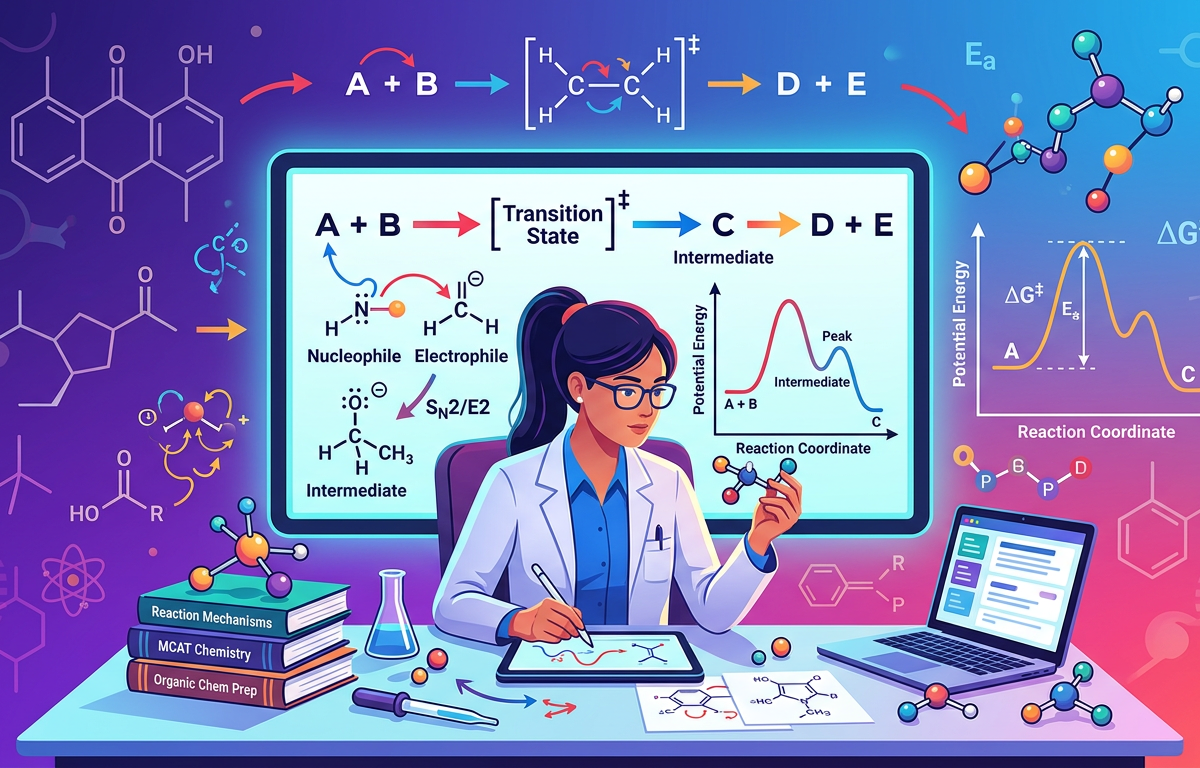
An MCAT reaction mechanism is a step-by-step description of the path taken by reactants as they are converted into products, detailing the movement of electrons and the formation of intermediate species. Understanding these pathways is essential because the Medical College Admission Test (MCAT) frequently tests your ability to predict products, identify the rate-determining step, and recognize the stability of reactive intermediates like carbocations or carbanions. Mastery of this topic requires a strong grasp of nucleophiles, electrophiles, and the use of curved arrows to represent electron flow. By applying retrieval practice, students can better memorize the specific conditions under which certain mechanisms, such as vs. , occur. According to LibreTexts Chemistry, mechanisms provide the microscopic detail that explains macroscopic chemical observations. Key concepts include the Hammond Postulate, which relates transition state structure to the energy of intermediates, and the role of steric hindrance in determining reaction rates. When studying, it is helpful to use retrieval practice for medical students to ensure these complex organic chemistry steps are committed to long-term memory for test day.
2. Solved Examples
Below are fully worked examples involving common mechanisms found on the MCAT, such as nucleophilic substitution and carbonyl chemistry.
- Example 1: Nucleophilic Substitution ()
Describe the mechanism for the reaction between 1-bromopropane and sodium hydroxide in a polar aprotic solvent.
- Identify the nucleophile () and the electrophile (the carbon attached to the bromine).
- The hydroxide ion performs a backside attack on the electrophilic carbon.
- Simultaneously, the C-Br bond breaks as the C-OH bond forms.
- The reaction proceeds through a single pentacoordinate transition state.
- Result: Propan-1-ol is formed with inversion of configuration (though not visible in this achiral molecule).
- Example 2: Electrophilic Addition to Alkenes
Explain the mechanism of the addition of to 2-methylpropene.
- The pi bond of the alkene acts as a nucleophile and attacks the proton () of .
- The proton adds to the less substituted carbon to form the more stable tertiary carbocation (Markovnikov's rule).
- The bromide ion () then acts as a nucleophile and attacks the carbocation.
- Final product: 2-bromo-2-methylpropane.
- Example 3: Nucleophilic Acyl Substitution
Outline the steps for the base-catalyzed hydrolysis of an ester (saponification).
- The hydroxide ion attacks the carbonyl carbon, forming a tetrahedral intermediate.
- The carbonyl reforms, and the alkoxide group () is kicked out as a leaving group.
- The resulting carboxylic acid is immediately deprotonated by the alkoxide or hydroxide to form a carboxylate salt.
- Final products: A carboxylate ion and an alcohol.
3. Practice Questions
Test your knowledge with these medium-difficulty MCAT reaction mechanism practice questions. Use retrieval practice examples to check your recall before looking at the answers.
- Which of the following describes the rate-determining step in an reaction?
- In the acid-catalyzed hydration of an alkene, what is the first species formed after the pi bond attacks the hydronium ion?
- How does a polar protic solvent affect the rate of an reaction compared to a polar aprotic solvent?
- Predict the major product of the reaction between 2-pentanol and .
- In a Michael addition reaction, what is the role of the -unsaturated carbonyl compound?
- What intermediate is formed during the acid-catalyzed formation of an acetal from an aldehyde and excess alcohol?
- Which factor most significantly stabilizes the transition state of an reaction?
- Compare the nucleophilicity of and in a polar protic solvent.
- Describe the movement of electrons in the first step of a Grignard reaction with a ketone.
- Why are tertiary halides virtually unreactive in mechanisms?
Study smarter for the MCAT.
Turn practice into performance with AI-powered MCAT tools designed to help students retain more and score higher.
Start Learning Free4. Answers & Explanations
- Answer: The loss of the leaving group to form a carbocation. In , the slow step is the unimolecular dissociation of the substrate. This creates a planar carbocation intermediate.
- Answer: A carbocation. The pi electrons pick up a proton, and the charge resides on the more substituted carbon to maximize stability via inductive effects and hyperconjugation.
- Answer: It decreases the rate. Polar protic solvents hydrogen-bond with the nucleophile, creating a "solvent shell" that stabilizes the nucleophile and increases the activation energy required for it to attack the electrophile.
- Answer: 2-bromopentane (with inversion). converts alcohols to alkyl bromides via an -like mechanism on the phosphorus-activated intermediate, leading to inversion of stereochemistry.
- Answer: Electrophile. The -unsaturated carbonyl undergoes 1,4-addition (conjugate addition) where the nucleophile attacks the -carbon.
- Answer: A hemiacetal. The first stage involves one equivalent of alcohol adding to the carbonyl to form a hemiacetal (one , one group), which is then protonated and attacked by a second equivalent of alcohol.
- Answer: Carbocation stability. Since the mechanism involves the formation of a carbocation in the rate-determining step, factors that stabilize this intermediate (like substitution) also lower the transition state energy.
- Answer: is a better nucleophile. In protic solvents, smaller ions like are tightly solvated, making them less reactive. Larger ions like are less solvated and more polarizable.
- Answer: The nucleophilic carbanion of the Grignard reagent () attacks the electrophilic carbonyl carbon. This breaks the carbon-oxygen pi bond, moving the electrons onto the oxygen.
- Answer: Steric hindrance. The bulky groups surrounding the tertiary carbon block the nucleophile's backside attack, making the transition state energy prohibitively high.
1. Which intermediate is characteristic of an SN1 reaction?
6. Frequently Asked Questions
What is the difference between an intermediate and a transition state?
An intermediate is a short-lived, detectable species found at a local energy minimum on a reaction coordinate, while a transition state is a high-energy arrangement of atoms at an energy maximum that cannot be isolated. Intermediates have fully formed bonds, whereas transition states represent the breaking and forming of bonds.
How do I identify a nucleophile in a reaction mechanism?
A nucleophile is an electron-rich species that seeks an electron-poor site; look for lone pairs, pi bonds, or negative charges. Common examples include hydroxide (), cyanide (), and water ().
Why does the MCAT focus so much on carbonyl mechanisms?
Carbonyl groups are central to biological chemistry, including the structure of proteins, lipids, and carbohydrates. Understanding nucleophilic addition and substitution at the carbonyl carbon is vital for grasping metabolic pathways like the Citric Acid Cycle and peptide bond formation.
What makes a good leaving group?
Good leaving groups are weak bases that can stable the negative charge they carry away, often because they are the conjugate bases of strong acids. Examples include halides like and , or resonance-stabilized ions like tosylate.
Does temperature affect reaction mechanisms?
Yes, increasing temperature generally favors elimination () over substitution () because elimination increases the number of particles in the system, leading to a more favorable entropy change (). This relationship is often used by chemists to control product distribution.
Study smarter for the MCAT.
Turn practice into performance with AI-powered MCAT tools designed to help students retain more and score higher.
Start Learning FreeReviewed by
Michael Danquah, MS, PhD
Dr. Michael Danquah is a professor of pharmaceutical sciences and founder of several educational technology platforms focused on improving student learning and performance.
Enjoyed this article?
Share it with others who might find it helpful.
Related Articles

Hard MCAT Reaction Mechanism Practice Questions
Hard MCAT Reaction Mechanism Practice Questions
May 11, 2026

Easy MCAT Reaction Mechanism Practice Questions
Easy MCAT Reaction Mechanism Practice Questions
May 11, 2026
MCAT Reaction Mechanism Practice Questions with Answers
MCAT Reaction Mechanism Practice Questions with Answers
May 10, 2026

Predicting O-Chem Reaction Outcomes on the MCAT
MCAT Organic Chemistry Practice Questions with Answers
May 10, 2026

Hard MCAT Philosophy Passage Practice Questions
Master Hard MCAT Philosophy Passage Practice Questions with our comprehensive guide featuring solved examples, practice questions, and expert explanations.
May 17, 2026

Hard MCAT Humanities Passage Practice Questions
Master Hard MCAT Humanities Passage Practice Questions with our comprehensive guide featuring solved examples, practice questions, and expert strategies.
May 17, 2026

Hard MCAT Critical Analysis Practice Questions
Hard MCAT Critical Analysis Practice Questions
May 17, 2026

Hard MCAT Reading Comprehension Practice Questions
Hard MCAT Reading Comprehension Practice Questions
May 17, 2026