Easy MCAT Reaction Mechanism Practice Questions

Concept Explanation
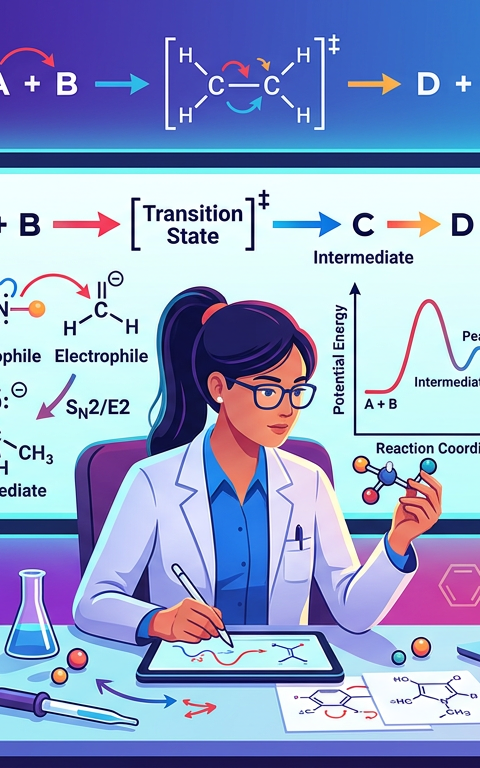
An MCAT reaction mechanism is the step-by-step sequence of elementary reactions by which overall chemical change occurs, illustrating the movement of electrons and the formation of intermediates. Understanding these pathways is essential for predicting the products of organic and inorganic reactions encountered on the exam. Most mechanisms involve the movement of electrons from a nucleophile (electron-rich species) to an electrophile (electron-poor species), often represented by curved arrows. Key concepts include identifying the rate-determining step, which is the slowest step in a multi-step process, and recognizing the difference between intermediates (species formed and then consumed) and transition states (high-energy, fleeting configurations). Mastering these basics helps students avoid common pitfalls, such as misidentifying the order of operations in STEM subjects like organic chemistry.
Solved Examples
Reviewing these worked examples will help you visualize how to track electron flow and identify reaction components.
- Example 1: Nucleophilic Substitution ()
Predict the mechanism for the reaction between hydroxide () and methyl chloride ().
- Identify the nucleophile: The hydroxide ion () has lone pairs and a negative charge.
- Identify the electrophile: The carbon in is partially positive () due to the electronegativity of chlorine.
- Draw the arrow: A curved arrow starts from the oxygen lone pair and points to the carbon atom.
- Simultaneous bond breaking: As the bond forms, the bond breaks, with the electrons moving onto the chlorine.
- Result: A single-step transition state leads to methanol () and a chloride ion ().
- Example 2: Electrophilic Addition to Alkenes
Describe the mechanism for the addition of to ethene ().
- The bond of the alkene acts as a nucleophile, attacking the hydrogen of .
- The bond breaks, leaving bromide () and forming a carbocation intermediate on one of the carbons.
- The bromide ion then acts as a nucleophile, attacking the positively charged carbocation.
- The final product is bromoethane ().
- Example 3: Acid-Catalyzed Esterification
Identify the role of the acid catalyst in the reaction between a carboxylic acid and an alcohol.
- The acid () protonates the carbonyl oxygen of the carboxylic acid.
- This increases the electrophilicity of the carbonyl carbon, making it more susceptible to attack by the weak nucleophile (alcohol).
- The alcohol attacks, forming a tetrahedral intermediate.
- After proton transfers and the loss of water, the ester product is formed and the catalyst is regenerated.
Practice Questions
- In a generic two-step reaction where Step 1 is slow and Step 2 is fast, which step determines the overall rate law?
- Identify the nucleophile and electrophile in the reaction: .
- Explain why a tertiary carbocation is more stable than a primary carbocation in an mechanism.
Study smarter for the MCAT.
Turn practice into performance with AI-powered MCAT tools designed to help students retain more and score higher.
Start Learning Free- What is the molecularity of an elementary step where two molecules collide to form a single product?
- Draw the curved arrow mechanism for the deprotonation of acetic acid by sodium hydroxide.
- In an elimination reaction, what is the required spatial relationship between the leaving group and the -hydrogen?
- Define a "reaction intermediate" and distinguish it from a "transition state" using a potential energy diagram.
- How does increasing the concentration of the nucleophile affect the rate of an reaction?
- Which species is the Lewis acid in the reaction between and ?
- Predict the major product of the addition of to 2-methyl-2-butene using Markovnikov's rule.
Answers & Explanations
- Step 1. The rate-determining step is always the slowest step in a mechanism. Because Step 1 is slow, the overall reaction cannot proceed faster than this bottleneck.
- Nucleophile: ; Electrophile: . Ammonia has a lone pair on the nitrogen, making it electron-rich. The carbon in methyl bromide is electron-poor due to the inductive effect of the bromine atom.
- Hyperconjugation and Inductive effects. Tertiary carbocations are stabilized by the electron-donating alkyl groups surrounding the positive charge. This is a foundational concept often reinforced through retrieval practice in medical education.
- Bimolecular. Molecularity refers to the number of reactant species involved in an elementary step. Two species colliding is a bimolecular process.
- Mechanism: The lone pair on the oxygen attacks the acidic hydrogen of the group. The bond between the hydrogen and the oxygen in the carboxylic acid breaks, with the electrons moving to the oxygen. Result: and acetate ion.
- Anti-periplanar. For an mechanism, the -hydrogen and the leaving group must be in the same plane but on opposite sides (180 degrees apart) to allow for proper orbital overlap during the transition state.
- Intermediate vs. Transition State: An intermediate is a local energy minimum on a potential energy diagram and has a finite lifetime. A transition state is an energy maximum (the peak) representing the highest energy point of an elementary step.
- No effect. The rate law for an reaction is . The nucleophile is not involved in the rate-determining step (the formation of the carbocation).
- . A Lewis acid is an electron-pair acceptor. Aluminum in has an incomplete octet and accepts a lone pair from the chloride ion.
- 2-chloro-2-methylbutane. According to Markovnikov's rule, the hydrogen adds to the carbon with more hydrogens, and the halide adds to the more substituted carbon to form the more stable carbocation intermediate.
1. Which of the following best describes a catalyst in a reaction mechanism?
Frequently Asked Questions
What is a nucleophile in an MCAT reaction mechanism?
A nucleophile is an "electron-loving" species that donates an electron pair to form a chemical bond. These are typically anions or neutral molecules with lone pairs, such as hydroxide or ammonia.
How do I identify the rate-determining step?
The rate-determining step is the slowest elementary step in a reaction mechanism. On a reaction coordinate diagram, it is represented by the transition state with the highest activation energy relative to the reactants.
What is the difference between and ?
is a two-step unimolecular substitution involving a carbocation intermediate, while is a one-step bimolecular substitution involving a backside attack and inversion of configuration.
Do catalysts appear in the overall chemical equation?
No, catalysts do not appear in the balanced overall chemical equation because they are consumed in one step and regenerated in a subsequent step. They are often written above the reaction arrow to indicate their presence.
How can I improve my speed in solving mechanism questions?
Using evidence-based study methods like active recall and spaced repetition helps you internalize common patterns. Consistently drawing out mechanisms from memory rather than just looking at them is the most effective way to build speed.
Study smarter for the MCAT.
Turn practice into performance with AI-powered MCAT tools designed to help students retain more and score higher.
Start Learning FreeReviewed by
Michael Danquah, MS, PhD
Dr. Michael Danquah is a professor of pharmaceutical sciences and founder of several educational technology platforms focused on improving student learning and performance.
Enjoyed this article?
Share it with others who might find it helpful.
Related Articles

Hard MCAT Reaction Mechanism Practice Questions
Hard MCAT Reaction Mechanism Practice Questions
May 11, 2026
Medium MCAT Reaction Mechanism Practice Questions
Medium MCAT Reaction Mechanism Practice Questions
May 11, 2026

MCAT Reaction Mechanism Practice Questions with Answers
MCAT Reaction Mechanism Practice Questions with Answers
May 10, 2026

Predicting O-Chem Reaction Outcomes on the MCAT
MCAT Organic Chemistry Practice Questions with Answers
May 10, 2026

Hard MCAT Philosophy Passage Practice Questions
Master Hard MCAT Philosophy Passage Practice Questions with our comprehensive guide featuring solved examples, practice questions, and expert explanations.
May 17, 2026

Hard MCAT Humanities Passage Practice Questions
Master Hard MCAT Humanities Passage Practice Questions with our comprehensive guide featuring solved examples, practice questions, and expert strategies.
May 17, 2026

Hard MCAT Critical Analysis Practice Questions
Hard MCAT Critical Analysis Practice Questions
May 17, 2026

Hard MCAT Reading Comprehension Practice Questions
Hard MCAT Reading Comprehension Practice Questions
May 17, 2026