Hard pOH Calculation Practice Questions
Concept Explanation
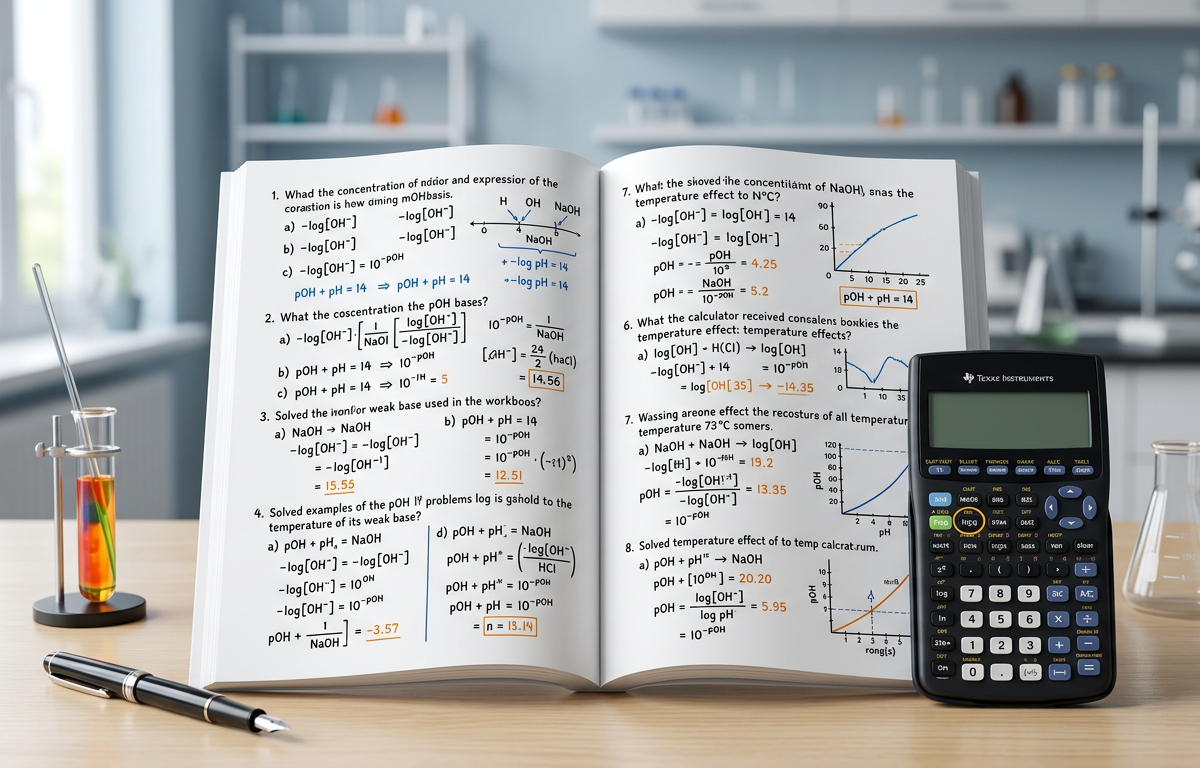
pOH is a measure of the hydroxide ion concentration ([OH⁻]) in an aqueous solution, defined mathematically as the negative logarithm (base 10) of the molar concentration of hydroxide ions. While pH focuses on the acidity of a solution by measuring hydronium ions, pOH provides a direct look at the alkalinity. For any aqueous solution at 25°C, the sum of pH and pOH always equals 14.00, a relationship derived from the self-ionization constant of water (Kw).
Calculating pOH for complex or "hard" scenarios often requires more than just a simple log calculation. You may need to account for multi-step dilutions, the dissociation of weak bases using the Kb constant, or the temperature dependence of Kw. In advanced chemistry, understanding the difference between strong and weak electrolytes is crucial because strong bases dissociate completely, whereas weak bases reach an equilibrium. To solve these problems effectively, you must be comfortable converting between [H⁺], [OH⁻], pH, and pOH using the following formulas:
pOH = -log[OH⁻]
[OH⁻] = 10^-pOH
pH + pOH = 14.00 (at 25°C)
Kw = [H⁺][OH⁻] = 1.0 x 10^-14 (at 25°C)
Solved Examples
Review these detailed solutions to master the logic behind complex pOH problems.
Example 1: Weak Base Dissociation. Calculate the pOH of a 0.25 M solution of ammonia (NH₃) given that the Kb for ammonia is 1.8 x 10⁻⁵.
Set up the equilibrium expression: Kb = [NH₄⁺][OH⁻] / [NH₃].
Let x = [OH⁻]. Since the dissociation is small, we assume 0.25 - x ≈ 0.25.
1.8 x 10⁻⁵ = x² / 0.25.
x² = 4.5 x 10⁻⁶.
x = [OH⁻] = 2.12 x 10⁻³ M.
pOH = -log(2.12 x 10⁻³) = 2.67.
Example 2: Strong Base Dilution. A 10.0 mL sample of 0.50 M Ba(OH)₂ is diluted to a total volume of 500.0 mL. What is the final pOH?
Calculate the initial moles of OH⁻: Ba(OH)₂ produces 2 moles of OH⁻ per mole of base. Moles OH⁻ = 0.010 L * 0.50 M * 2 = 0.010 moles.
Calculate the new concentration: [OH⁻] = 0.010 moles / 0.500 L = 0.020 M.
pOH = -log(0.020) = 1.70.
Example 3: pOH from pH at Non-Standard Temperature. At 50°C, the Kw of water is 5.48 x 10⁻¹⁴. If a solution has a pH of 6.50 at this temperature, what is its pOH?
Calculate pKw: pKw = -log(5.48 x 10⁻¹⁴) = 13.26.
Use the relationship pKw = pH + pOH.
pOH = 13.26 - 6.50 = 6.76.
Practice Questions
Calculate the pOH of a solution prepared by dissolving 0.045 grams of NaOH in enough water to make 2.50 L of solution.
Find the pOH of a 0.0015 M Ca(OH)₂ solution, assuming complete dissociation.
A solution has a pH of 11.45. What is the hydroxide ion concentration [OH⁻]?
Want unlimited practice questions like these?
Generate AI-powered questions with step-by-step solutions on any topic.
Try Question Generator Free →Calculate the pOH of a 0.12 M solution of methylamine (CH₃NH₂), which has a Kb of 4.4 x 10⁻⁴.
What is the pOH of a solution where the hydronium ion concentration [H₃O⁺] is 4.5 x 10⁻⁹ M?
A 50.0 mL sample of 0.10 M KOH is mixed with 50.0 mL of 0.05 M HCl. Calculate the pOH of the resulting mixture.
Calculate the pOH of a buffer solution containing 0.30 M NH₃ and 0.20 M NH₄Cl (Kb for NH₃ = 1.8 x 10⁻⁵). (Hint: You may find Henderson-Hasselbalch practice helpful here).
If the pOH of a solution is 3.22, what is the concentration of hydrogen ions [H⁺]?
Calculate the pOH of a 1.0 x 10⁻⁸ M NaOH solution. (Caution: Consider the autoionization of water).
A solution is created by mixing 200 mL of 0.01 M Ba(OH)₂ and 300 mL of 0.02 M NaOH. What is the pOH of the final 500 mL solution?
Answers & Explanations
pOH = 3.35. First, find moles of NaOH: 0.045 g / 40.00 g/mol = 0.001125 mol. Molarity [OH⁻] = 0.001125 mol / 2.50 L = 4.5 x 10⁻⁴ M. pOH = -log(4.5 x 10⁻⁴) = 3.35.
pOH = 2.52. Ca(OH)₂ is a strong base that releases 2 OH⁻ per unit. [OH⁻] = 0.0015 M * 2 = 0.0030 M. pOH = -log(0.0030) = 2.52.
[OH⁻] = 2.82 x 10⁻³ M. pOH = 14.00 - 11.45 = 2.55. [OH⁻] = 10^-2.55 = 0.00282 M.
pOH = 2.14. Kb = x² / (0.12 - x). x² ≈ (4.4 x 10⁻⁴)(0.12) = 5.28 x 10⁻⁵. x = [OH⁻] = 0.00727 M. pOH = -log(0.00727) = 2.14.
pOH = 5.65. pH = -log(4.5 x 10⁻⁹) = 8.35. pOH = 14.00 - 8.35 = 5.65.
pOH = 1.60. Moles OH⁻ = 0.050 L * 0.10 M = 0.005 mol. Moles H⁺ = 0.050 L * 0.05 M = 0.0025 mol. Excess OH⁻ = 0.005 - 0.0025 = 0.0025 mol. Total volume = 0.100 L. [OH⁻] = 0.0025 / 0.100 = 0.025 M. pOH = -log(0.025) = 1.60.
pOH = 4.57. pKb = -log(1.8 x 10⁻⁵) = 4.74. pOH = pKb + log([salt]/[base]) = 4.74 + log(0.20 / 0.30) = 4.74 - 0.176 = 4.564. Rounded to 4.57.
[H⁺] = 1.66 x 10⁻¹¹ M. pH = 14.00 - 3.22 = 10.78. [H⁺] = 10^-10.78 = 1.66 x 10⁻¹¹ M.
pOH = 6.96. At such low concentrations, the 1.0 x 10⁻⁷ M OH⁻ from water is significant. Total [OH⁻] ≈ 1.1 x 10⁻⁷ M. pOH = -log(1.1 x 10⁻⁷) = 6.96. (Using the quadratic system for exactness yields 6.98).
pOH = 2.00. Moles OH⁻ from Ba(OH)₂ = 0.200 L * 0.01 M * 2 = 0.004 mol. Moles OH⁻ from NaOH = 0.300 L * 0.02 M = 0.006 mol. Total moles = 0.010 mol. Total volume = 0.500 L. [OH⁻] = 0.010 / 0.500 = 0.02 M. pOH = -log(0.02) = 1.70. (Correction: log(0.02) is 1.698). Final answer 1.70.
1. If a solution has a pOH of 4.0, what is the concentration of hydroxide ions?
Frequently Asked Questions
What is the relationship between pH and pOH?
In aqueous solutions at standard temperature (25°C), the sum of pH and pOH is always 14.0. This allows chemists to easily convert between the two values to describe a solution's acidity or alkalinity.
Can pOH be negative?
Yes, pOH can be negative if the concentration of hydroxide ions is greater than 1.0 M. For example, a 2.0 M NaOH solution has a pOH of approximately -0.30.
Does temperature affect pOH calculations?
Temperature significantly affects the self-ionization constant of water (Kw), which in turn changes the neutral pOH value. While neutral pOH is 7.0 at 25°C, it decreases as temperature increases because the dissociation of water is endothermic.
How do you calculate pOH for a weak base?
To calculate the pOH of a weak base, you must use the base dissociation constant (Kb) and an ICE table to find the equilibrium concentration of hydroxide ions. Once [OH⁻] is determined, apply the negative logarithm to find the pOH.
Why is pOH used less frequently than pH?
pH is the standard convention in biology and clinical medicine because most biological systems are sensitive to hydronium ion activity. However, pOH is essential in industrial chemistry and engineering when working with high-molarity caustic solutions.
Want unlimited practice questions like these?
Generate AI-powered questions with step-by-step solutions on any topic.
Try Question Generator Free →
Want unlimited practice questions like these?
Generate AI-powered questions with step-by-step solutions on any topic.
Try Question Generator Free →Enjoyed this article?
Share it with others who might find it helpful.
Related Articles
Hard Le Chatelier’s Principle Practice Questions
Master Hard Le Chatelier’s Principle Practice Questions with our comprehensive guide featuring solved examples, practice problems, and detailed explanations.
Mar 30, 2026
Hard Reaction Quotient (Q) Practice Questions
Hard Reaction Quotient (Q) Practice Questions
Mar 30, 2026
Grams to Moles Practice Questions with Answers
Master grams to moles conversions with our comprehensive guide. Includes step-by-step examples, practice questions, and detailed answers for chemistry students.
Mar 26, 2026
Avogadro’s Number Practice Questions with Answers
Master the mole concept with our Avogadro’s Number practice questions. Includes step-by-step solved examples, a quick quiz, and detailed explanations.
Mar 26, 2026
Empirical Formulas: Solving Ratios from Mass and Percent Data
Master empirical formula calculations with 10 practice questions, worked answers, and a free step-by-step calculator for mass, percentage, and combustion problems.
Mar 26, 2026