Hard pKa and pKb Practice Questions
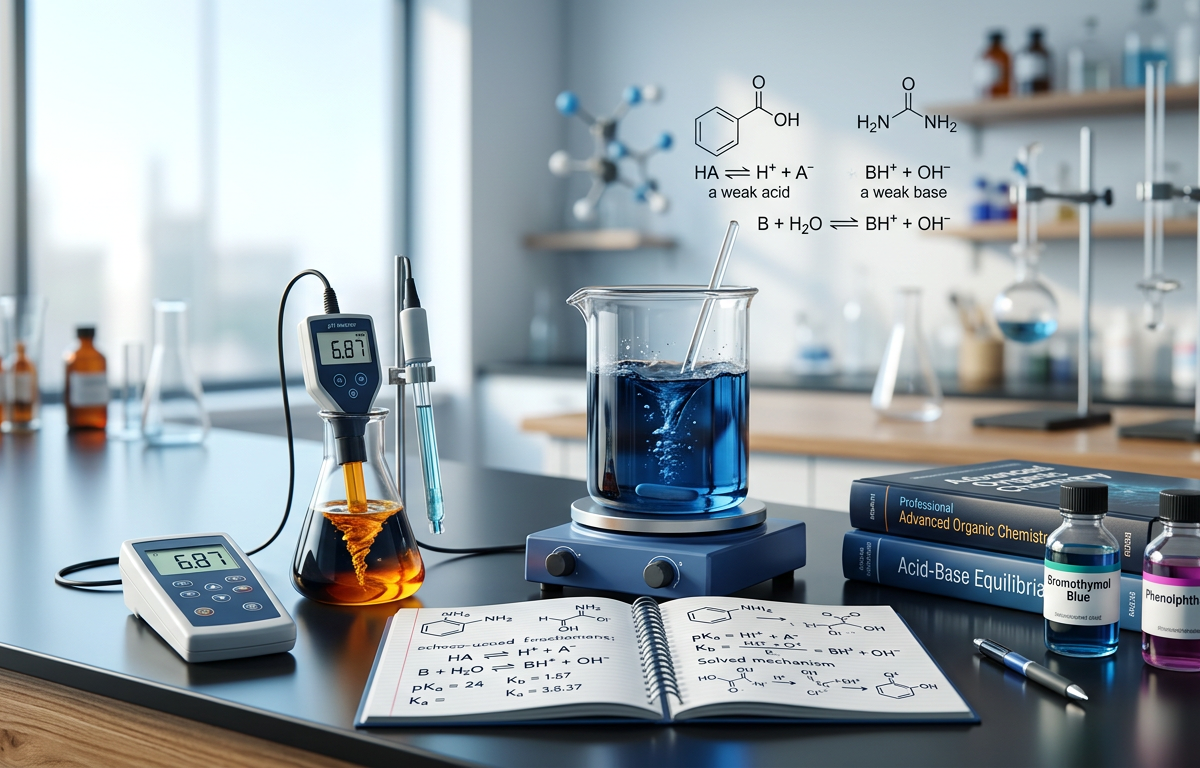
Concept Explanation
The pKa and pKb of a substance are the negative logarithms of the acid dissociation constant (Ka) and base dissociation constant (Kb), respectively, serving as quantitative measures of the strength of acids and bases in solution.
In aqueous chemistry, these values are critical for predicting the behavior of molecules in various environments, such as biological systems or industrial chemical reactions. A smaller pKa value indicates a stronger acid, meaning the substance more readily donates a proton. Conversely, a smaller pKb value indicates a stronger base. These constants are related through the water autoionization constant (Kw). At 25°C, the relationship is defined by the equation: pKa + pKb = 14.00. This inverse relationship means that the conjugate base of a strong acid will be an exceptionally weak base, and vice versa.
Understanding these concepts requires a solid grasp of logarithmic scales. Because the scale is logarithmic, a difference of one pKa unit represents a tenfold difference in acidity. For advanced calculations, one must often use the Henderson-Hasselbalch equation to determine the pH of buffer systems or the ionization state of polyprotic acids. According to Wikipedia's guide on acid dissociation constants, pKa is also affected by temperature and the dielectric constant of the solvent, which is why standard values are usually cited at 25°C.
Solved Examples
Calculating pKb from Ka: A specific weak acid has a Ka of 4.5 × 10⁻⁴. Calculate the pKb of its conjugate base at 25°C.
First, find the pKa by taking the negative log: pKa = -log(4.5 × 10⁻⁴) = 3.35.
Use the relationship pKa + pKb = 14.00.
pKb = 14.00 - 3.35 = 10.65.
Determining pH from pKa and Concentration: Calculate the pH of a 0.15 M solution of acetic acid (pKa = 4.76).
Convert pKa to Ka: Ka = 10⁻⁴.⁷⁶ = 1.74 × 10⁻⁵.
Set up the equilibrium expression: Ka = [H+][A-] / [HA]. Let [H+] = x.
1.74 × 10⁻⁵ = x² / 0.15 (assuming x is small relative to 0.15).
x² = 2.61 × 10⁻⁶ → x = 1.62 × 10⁻³ M.
pH = -log(1.62 × 10⁻³) = 2.79.
Comparing Base Strengths: Base A has a pKb of 9.2, and Base B has a pKb of 4.8. Which is the stronger base, and what are their respective conjugate acid pKa values?
The base with the lower pKb is stronger. Therefore, Base B is stronger than Base A.
For Base A: pKa = 14 - 9.2 = 4.8.
For Base B: pKa = 14 - 4.8 = 9.2.
Practice Questions
1. A 0.25 M solution of a monoprotic weak acid has a pH of 3.45. Calculate the pKa of the acid.
2. Morphine is a weak base with a pKb of 5.79. Calculate the pKa of its conjugate acid and the Ka value.
3. You have a 0.10 M solution of a weak base with a pKb of 4.20. What is the pH of this solution?
Want unlimited practice questions like these?
Generate AI-powered questions with step-by-step solutions on any topic.
Try Question Generator Free →4. Calculate the percent ionization of a 0.050 M solution of hydrocyanic acid (HCN), given its pKa is 9.21.
5. An unknown base has a 0.20 M solution with a pOH of 2.85. Calculate the pKb of this base.
6. Arrange the following acids in order of increasing acidity: Acid X (pKa = 3.2), Acid Y (Ka = 1.2 × 10⁻⁵), Acid Z (pKa = 4.8).
7. If the pKb of ammonia is 4.75, calculate the Ka of the ammonium ion (NH₄⁺).
8. A buffer is prepared with 0.50 M of a weak acid (pKa = 6.4) and 0.25 M of its conjugate base. What is the pH of the buffer?
9. Calculate the pKa of a substance if its conjugate base has a Kb of 2.5 × 10⁻⁹.
10. A 0.010 M solution of a weak acid is 2.5% ionized. Calculate the pKa of the acid.
Answers & Explanations
pKa = 6.30. First, find [H+] = 10⁻³·⁴⁵ = 3.55 × 10⁻⁴ M. Use Ka = [H+]² / [HA] = (3.55 × 10⁻⁴)² / 0.25 = 5.04 × 10⁻⁷. Then, pKa = -log(5.04 × 10⁻⁷) = 6.30.
pKa = 8.21, Ka = 6.17 × 10⁻⁹. pKa = 14 - 5.79 = 8.21. Ka = 10⁻⁸·²¹ = 6.17 × 10⁻⁹. This relationship is a fundamental concept in Ka and Kb calculations.
pH = 11.40. Kb = 10⁻⁴·² = 6.31 × 10⁻⁵. [OH⁻] = √(Kb × C) = √(6.31 × 10⁻⁵ × 0.10) = 2.51 × 10⁻³ M. pOH = -log(2.51 × 10⁻³) = 2.60. pH = 14 - 2.60 = 11.40.
0.011%. Ka = 10⁻⁹·²¹ = 6.17 × 10⁻¹⁰. [H+] = √(6.17 × 10⁻¹⁰ × 0.050) = 5.55 × 10⁻⁶. Percent ionization = (5.55 × 10⁻⁶ / 0.050) × 100 = 0.011%.
pKb = 5.40. [OH⁻] = 10⁻²·⁸⁵ = 1.41 × 10⁻³ M. Kb = [OH⁻]² / [Base] = (1.41 × 10⁻³)² / 0.20 = 9.94 × 10⁻⁶. pKb = -log(9.94 × 10⁻⁶) = 5.00. (Correction: (1.41e-3)^2 / 0.2 = 9.94e-6; -log(9.94e-6) ≈ 5.00).
Z < Y < X. Acid Z pKa = 4.8. Acid Y pKa = -log(1.2 × 10⁻⁵) = 4.92. Acid X pKa = 3.2. Order of increasing acidity (highest pKa to lowest pKa): Y (4.92) < Z (4.8) < X (3.2).
5.62 × 10⁻¹⁰. pKa = 14 - 4.75 = 9.25. Ka = 10⁻⁹·²&sup5; = 5.62 × 10⁻¹⁰.
pH = 6.1. Using the Henderson-Hasselbalch equation: pH = pKa + log([Base]/[Acid]) = 6.4 + log(0.25/0.50) = 6.4 + (-0.301) = 6.1.
pKa = 5.40. pKb = -log(2.5 × 10⁻⁹) = 8.60. pKa = 14 - 8.60 = 5.40.
pKa = 5.20. [H+] = 0.010 × 0.025 = 2.5 × 10⁻⁴ M. Ka = (2.5 × 10⁻⁴)² / (0.010 - 2.5 × 10⁻⁴) ≈ 6.25 × 10⁻⁸ / 0.01 = 6.25 × 10⁻⁶. pKa = -log(6.25 × 10⁻⁶) = 5.20. Detailed pKa and pKb practice can help master these multi-step problems.
1. Which pKa value represents the strongest acid?
Frequently Asked Questions
What is the difference between Ka and pKa?
Ka is the acid dissociation constant that measures the equilibrium of an acid's ionization, while pKa is the negative logarithm of that constant. Using pKa makes it easier to compare acid strengths on a simple numerical scale rather than using scientific notation.
How does temperature affect pKa and pKb values?
Since the dissociation of acids and bases is an equilibrium process, it is temperature-dependent according to Le Chatelier's principle. For most systems, increasing the temperature increases the dissociation constant, which results in a lower pKa or pKb value.
Can pKa be negative?
Yes, extremely strong acids like hydrochloric acid (HCl) or sulfuric acid (H2SO4) have pKa values less than zero. This indicates that the acid dissociates almost completely in aqueous solution, as noted in resources from Khan Academy's chemistry modules.
Why is the sum of pKa and pKb always 14?
The sum equals 14 because it is derived from the ion product of water (Kw), which is 1.0 × 10⁻¹⁴ at 25°C. Taking the negative log of the equation Ka × Kb = Kw yields the pKa + pKb = 14 relationship.
How do I calculate pKa from a titration curve?
On a titration curve of a weak acid with a strong base, the pKa is equal to the pH at the half-equivalence point. At this point, the concentrations of the weak acid and its conjugate base are equal, simplifying the Henderson-Hasselbalch equation.
Want unlimited practice questions like these?
Generate AI-powered questions with step-by-step solutions on any topic.
Try Question Generator Free →
Want unlimited practice questions like these?
Generate AI-powered questions with step-by-step solutions on any topic.
Try Question Generator Free →Enjoyed this article?
Share it with others who might find it helpful.
Related Articles
Easy pKa and pKb Practice Questions
Master acid-base chemistry with these easy pKa and pKb practice questions. Learn to calculate dissociation constants and understand conjugate pair relationships.
Mar 29, 2026
Medium pKa and pKb Practice Questions
Medium pKa and pKb Practice Questions
Mar 29, 2026

Calculating High-Stakes Meds: BSA Mosteller Formula Practice
Master hard body surface area-based dosage calculations with our comprehensive guide, solved examples, and practice questions for healthcare students.
May 17, 2026

Solving High-Stakes IV Titrations and Weight-Based Infusions
Master advanced IV flow rate calculations with these hard practice questions. Covers weight-based dosing, titrations, and dimensional analysis for nurses.
May 17, 2026

Solving Weight-Based Dosing: The 2.2 Conversion and Rounding Logic
Weight-Based Dosage Calculations Practice Questions with Answers
May 17, 2026
Predicting Periodic Anomalies: Beyond Basic Trend Rules
Hard Periodic Trends Practice Questions
Apr 4, 2026
Hard Electron Configuration Practice Questions
Hard Electron Configuration Practice Questions
Apr 4, 2026
Medium Electron Configuration Practice Questions
Master medium-level electron configuration with our comprehensive guide, including solved examples, stability exceptions, and practice questions with answers.
Apr 4, 2026