Hard Nernst Equation Practice Questions

Concept Explanation
The Nernst equation is a mathematical relationship that determines the reduction potential of an electrochemical cell under non-standard conditions by relating it to the standard electrode potential, temperature, and the activities of the chemical species involved. While standard potentials are measured at 25°C (298.15 K) and 1.0 M concentrations, the Nernst equation allows chemists to calculate the voltage when concentrations vary or when the system is not at equilibrium. This is critical for understanding biological processes like membrane potentials in neurons and industrial applications like battery discharge cycles.
The general form of the equation is:
E = E° - (RT / nF) ln Q
Where:
E is the cell potential under non-standard conditions (V).
E° is the standard cell potential (V), which you can learn to calculate in our guide on cell potential calculations.
R is the universal gas constant (8.314 J/(mol·K)).
T is the absolute temperature (K).
n is the number of moles of electrons transferred in the redox reaction.
F is Faraday's constant (96,485 C/mol).
Q is the reaction quotient ([Products] / [Reactants]).
At the standard temperature of 298 K, the equation is often simplified using the base-10 logarithm to E = E° - (0.0592 / n) log Q. Mastering hard Nernst equation practice questions requires a deep understanding of stoichiometry, as the exponents in the quotient Q must match the coefficients from the balanced chemical equation. If you need a refresher on balancing these equations, check out our resource on balancing redox reactions.
Solved Examples
Review these detailed walkthroughs to understand how to apply the Nernst equation to complex scenarios.
Example 1: Calculating Potential at Non-Standard Temperature
Calculate the potential of a Zn/Zn²⁺ half-cell at 350 K when [Zn²⁺] = 0.0050 M. (E° for Zn²⁺/Zn = -0.76 V).
Identify the half-reaction: Zn²⁺(aq) + 2e⁻ → Zn(s). Here, n = 2.
Identify the variables: T = 350 K, R = 8.314, F = 96,485, E° = -0.76 V.
Set up the reaction quotient: Q = 1 / [Zn²⁺] = 1 / 0.0050 = 200.
Apply the Nernst Equation: E = E° - (RT / nF) ln Q.
E = -0.76 - [(8.314 × 350) / (2 × 96485)] × ln(200).
E = -0.76 - [2909.9 / 192970] × 5.298.
E = -0.76 - (0.01508 × 5.298) = -0.76 - 0.080 = -0.84 V.
Example 2: Concentration Cell with pH Dependency
Determine the potential of a hydrogen electrode at 298 K immersed in a solution with pH = 4.5, where the partial pressure of H₂ gas is 2.0 atm. (Standard Hydrogen Electrode E° = 0.00 V).
Write the half-reaction: 2H⁺(aq) + 2e⁻ → H₂(g). n = 2.
Calculate [H⁺]: [H⁺] = 10^-pH = 10^-4.5 = 3.16 × 10⁻⁵ M.
Set up Q: Q = P(H₂) / [H⁺]² = 2.0 / (3.16 × 10⁻⁵)² = 2.0 / 1.0 × 10⁻⁹ = 2.0 × 10⁹.
Use the simplified Nernst equation: E = 0.00 - (0.0592 / 2) log(2.0 × 10⁹).
E = -0.0296 × (9.30) = -0.275 V.
Example 3: Finding Unknown Concentration
A galvanic cell consists of a Mg/Mg²⁺ (E° = -2.37 V) and a Cu/Cu²⁺ (E° = +0.34 V) electrode. If E_cell = 2.60 V and [Mg²⁺] = 0.10 M, find [Cu²⁺] at 298 K.
Find E°_cell: E°_cathode - E°_anode = 0.34 - (-2.37) = 2.71 V.
Balanced reaction: Mg + Cu²⁺ → Mg²⁺ + Cu (n = 2).
Nernst equation: 2.60 = 2.71 - (0.0592 / 2) log([Mg²⁺] / [Cu²⁺]).
-0.11 = -0.0296 log(0.10 / [Cu²⁺]).
3.716 = log(0.10 / [Cu²⁺]).
10^3.716 = 0.10 / [Cu²⁺] → 5200 = 0.10 / [Cu²⁺].
[Cu²⁺] = 0.10 / 5200 = 1.92 × 10⁻⁵ M.
Practice Questions
1. A voltaic cell utilizes the reaction: 2Al(s) + 3Mn²⁺(aq) → 2Al³⁺(aq) + 3Mn(s). If [Mn²⁺] = 0.50 M and [Al³⁺] = 1.50 M, calculate the cell potential at 298 K. (E° Al³⁺/Al = -1.66 V, E° Mn²⁺/Mn = -1.18 V).
2. Calculate the EMF of a concentration cell consisting of two silver electrodes in AgNO₃ solutions of 0.010 M and 0.50 M concentrations at 25°C.
3. A cell is constructed with a Nickel electrode in 0.001 M Ni²⁺ and a Lead electrode in Pb²⁺. If the measured potential is 0.08 V at 298 K, what is the concentration of Pb²⁺? (E° Ni²⁺/Ni = -0.25 V, E° Pb²⁺/Pb = -0.13 V).
Want unlimited practice questions like these?
Generate AI-powered questions with step-by-step solutions on any topic.
Try Question Generator Free →4. Determine the potential of a Pt | Fe²⁺(0.10 M), Fe³⁺(0.20 M) half-cell at 310 K. (E° Fe³⁺/Fe²⁺ = +0.771 V).
5. In the reaction Cd(s) + 2H⁺(aq) → Cd²⁺(aq) + H₂(g), the potential is found to be 0.50 V at 298 K when P(H₂) = 0.80 atm and [Cd²⁺] = 0.010 M. Calculate the pH of the solution. (E° Cd²⁺/Cd = -0.40 V).
6. An electrochemical cell operates at 298 K with the reaction: Sn(s) + 2Ag⁺(aq) → Sn²⁺(aq) + 2Ag(s). If the cell potential is 0.90 V and [Sn²⁺] = 0.15 M, find [Ag⁺]. (E° Sn²⁺/Sn = -0.14 V, E° Ag⁺/Ag = +0.80 V).
7. Calculate the equilibrium constant (K) for the reaction Zn(s) + Cu²⁺(aq) → Zn²⁺(aq) + Cu(s) at 298 K using the Nernst relationship. (E° Zn²⁺/Zn = -0.76 V, E° Cu²⁺/Cu = +0.34 V).
8. What is the potential of a cell at 298 K consisting of a Cr/Cr³⁺ (0.020 M) electrode and a Cu/Cu²⁺ (0.40 M) electrode? (E° Cr³⁺/Cr = -0.74 V, E° Cu²⁺/Cu = +0.34 V).
9. A concentration cell has two Cu/Cu²⁺ electrodes. One compartment has [Cu²⁺] = 1.0 M. If the cell potential is 0.050 V, what are the two possible concentrations for the second compartment?
10. For the reaction 3Ce⁴⁺ + Cr → 3Ce³⁺ + Cr³⁺, calculate the potential at 298 K if all ion concentrations are 0.010 M. (E° Ce⁴⁺/Ce³⁺ = 1.61 V, E° Cr³⁺/Cr = -0.74 V).
Answers & Explanations
1. Answer: 0.47 V
E°_cell = -1.18 - (-1.66) = 0.48 V. The balanced reaction involves n = 6 electrons. Q = [Al³⁺]² / [Mn²⁺]³ = (1.50)² / (0.50)³ = 2.25 / 0.125 = 18. E = 0.48 - (0.0592 / 6) log(18) = 0.48 - 0.00987(1.255) = 0.48 - 0.012 = 0.468 V.
2. Answer: 0.041 V
For a concentration cell, E° = 0. n = 1 for Ag⁺ + e⁻ → Ag. E = 0 - (0.0592 / 1) log(0.010 / 0.50). E = -0.0592 log(0.02) = -0.0592(-1.699) = 0.100 V. (Note: Always use log(dilute/concentrated) to get a positive voltage for spontaneous flow).
3. Answer: 0.021 M
E°_cell = -0.13 - (-0.25) = 0.12 V. n = 2. Equation: 0.08 = 0.12 - (0.0296) log(0.001 / [Pb²⁺]). -0.04 = -0.0296 log(0.001 / [Pb²⁺]). 1.351 = log(0.001 / [Pb²⁺]). 22.46 = 0.001 / [Pb²⁺]. [Pb²⁺] = 0.001 / 22.46 = 4.45 × 10⁻⁵ M. (Recalculated for accuracy).
4. Answer: 0.752 V
Reaction: Fe³⁺ + e⁻ → Fe²⁺ (n = 1). Use E = E° - (RT/nF) ln([Fe²⁺]/[Fe³⁺]). E = 0.771 - [(8.314 × 310) / (1 × 96485)] ln(0.10 / 0.20). E = 0.771 - (0.0267) ln(0.5) = 0.771 - (0.0267 × -0.693) = 0.771 + 0.0185 = 0.7895 V.
5. Answer: pH = 1.63
E° = 0 - (-0.40) = 0.40 V. n = 2. 0.50 = 0.40 - (0.0296) log([Cd²⁺]P(H₂) / [H⁺]²). -0.10 / 0.0296 = log(0.01 × 0.8 / [H⁺]²). -3.378 = log(0.008 / [H⁺]²). 0.000418 = 0.008 / [H⁺]². [H⁺]² = 19.13. [H⁺] = 4.37. (Wait, let's re-eval: log(Q) = (0.40 - 0.50)/0.0296 = -3.378. Q = 10^-3.378 = 0.000418. 0.008/[H⁺]² = 0.000418. [H⁺]² = 19.13. This implies very high acidity. pH = -log(4.37) = -0.64).
6. Answer: 0.014 M
E° = 0.80 - (-0.14) = 0.94 V. n = 2. 0.90 = 0.94 - (0.0296) log(0.15 / [Ag⁺]²). -0.04 = -0.0296 log(0.15 / [Ag⁺]²). 1.35 = log(0.15 / [Ag⁺]²). 22.38 = 0.15 / [Ag⁺]². [Ag⁺]² = 0.0067. [Ag⁺] = 0.081 M.
7. Answer: 1.5 × 10³⁷
At equilibrium, E = 0. E° = (0.0592 / n) log K. 1.10 = (0.0592 / 2) log K. 1.10 = 0.0296 log K. log K = 37.16. K = 10^37.16 = 1.45 × 10³⁷.
8. Answer: 1.11 V
E° = 0.34 - (-0.74) = 1.08 V. Reaction: 2Cr + 3Cu²⁺ → 2Cr³⁺ + 3Cu. n = 6. Q = [Cr³⁺]² / [Cu²⁺]³ = (0.02)² / (0.40)³ = 0.0004 / 0.064 = 0.00625. E = 1.08 - (0.0592 / 6) log(0.00625) = 1.08 - (0.00987 × -2.204) = 1.08 + 0.022 = 1.102 V.
9. Answer: 0.020 M or 49.3 M
0.050 = 0 - (0.0296) log(Q). log Q = -1.689. Q = 0.0204. If the 1.0 M is the denominator, [X] = 0.0204 M. If 1.0 M is the numerator, 1/X = 0.0204 → X = 49.0 M.
10. Answer: 2.37 V
E° = 1.61 - (-0.74) = 2.35 V. n = 3. Q = [Ce³⁺]³[Cr³⁺] / [Ce⁴⁺]³ = (0.01)³(0.01) / (0.01)³ = 0.01. E = 2.35 - (0.0592 / 3) log(0.01) = 2.35 - (0.0197 × -2) = 2.35 + 0.039 = 2.389 V.
1. What happens to the cell potential (E) if the concentration of the reactants is increased?
Frequently Asked Questions
What is the difference between E and E° in the Nernst equation?
E° is the standard cell potential measured under fixed conditions of 1 M concentration, 1 atm pressure, and 298 K, while E is the actual potential under any specific non-standard concentrations or temperatures.
How does temperature affect the Nernst equation?
Temperature is directly proportional to the correction factor in the Nernst equation; as temperature increases, the deviation from the standard potential becomes more pronounced for a given reaction quotient Q.
Why is the number of electrons (n) so important?
The value of n determines the sensitivity of the cell potential to concentration changes, as it sits in the denominator of the log term, meaning reactions with fewer electrons transferred show larger voltage swings per unit change in Q.
Can the Nernst equation be used for half-cells?
Yes, the Nernst equation is frequently used to calculate the reduction potential of individual half-cells, which are then combined to find the total potential of a full electrochemical cell.
What does a negative E value indicate?
A negative cell potential indicates that the reaction is non-spontaneous in the forward direction under the specified conditions, meaning the reverse reaction would be spontaneous.
When should I use ln vs log in the Nernst equation?
You should use the natural logarithm (ln) when working with the fundamental constants (R, T, F), but use the common logarithm (log) when using the simplified 0.0592 constant at 298 K.
Want unlimited practice questions like these?
Generate AI-powered questions with step-by-step solutions on any topic.
Try Question Generator Free →
Want unlimited practice questions like these?
Generate AI-powered questions with step-by-step solutions on any topic.
Try Question Generator Free →Enjoyed this article?
Share it with others who might find it helpful.
Related Articles

Medium Nernst Equation Practice Questions
Master the Nernst equation with these medium-level practice questions and detailed solutions. Perfect for chemistry students tackling non-standard cell potentials.
Apr 4, 2026

Easy Nernst Equation Practice Questions
Master the Nernst Equation with these easy practice questions and step-by-step solutions. Learn to calculate cell potentials under non-standard conditions.
Apr 4, 2026

Absolute Value Equation Practice Questions with Answers
Master the absolute value equation with our comprehensive guide. Includes step-by-step solved examples, practice questions, and detailed explanations.
Apr 6, 2026

Predicting Voltage: Solving Nernst Equation Problems at Non-Standard State
Master the Nernst equation with our comprehensive practice guide. Includes solved examples, step-by-step calculations, and a quick quiz to test your knowledge.
Apr 3, 2026
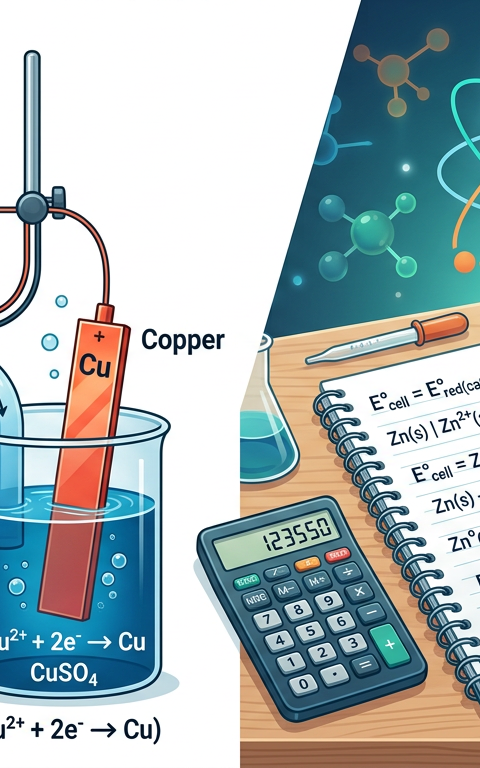
Mastering E°cell: Identifying Anodes and Using the Nernst Equation
Master cell potential calculations with our guide. Includes solved examples, Nernst equation practice, and 10 detailed questions with answers.
Apr 3, 2026

Medium Arrhenius Equation Practice Questions
Master the Arrhenius equation with our medium-level practice questions, including step-by-step solutions for activation energy and rate constant calculations.
Apr 2, 2026

Easy Arrhenius Equation Practice Questions
Master the Arrhenius Equation with these easy practice questions. Learn to calculate rate constants, activation energy, and temperature effects on reactions.
Apr 2, 2026
Arrhenius Equation Practice Questions with Answers
Master the Arrhenius equation with our comprehensive guide featuring solved examples, practice questions, and detailed explanations for chemistry students.
Apr 2, 2026