Hard Ka and Kb Calculations Practice Questions
Concept Explanation
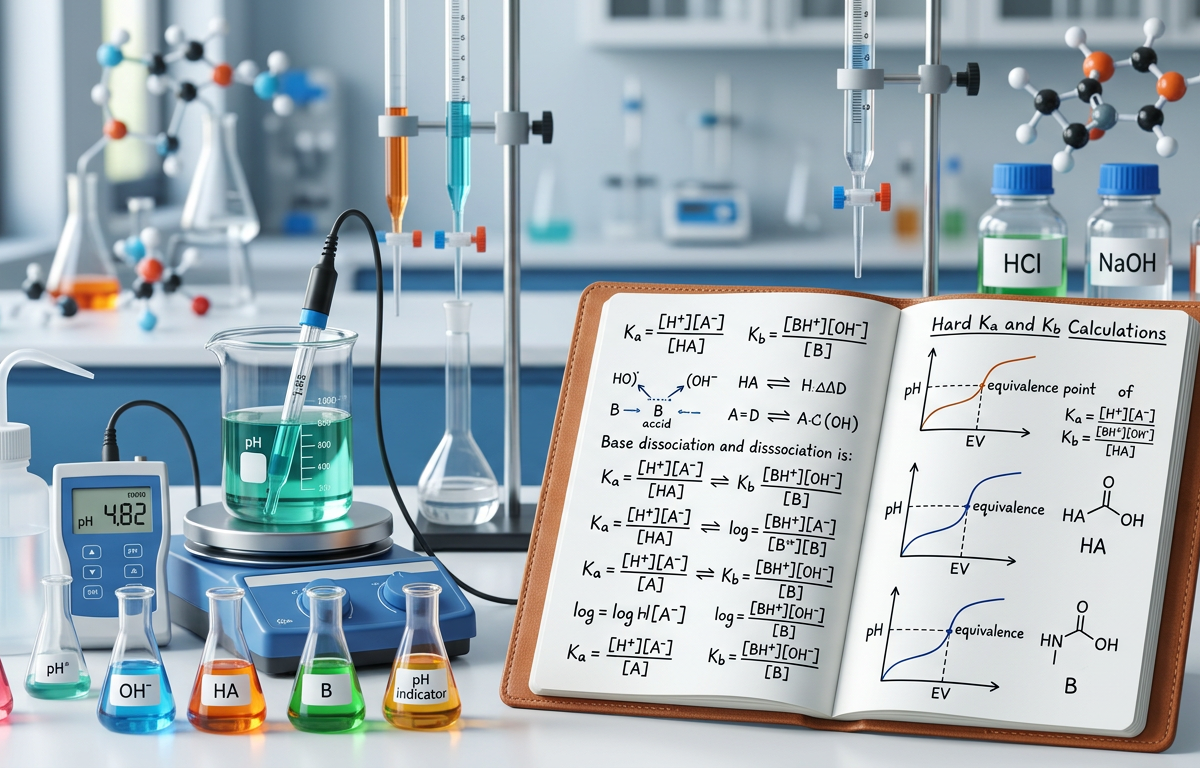
Hard Ka and Kb calculations involve determining the acid or base dissociation constants for weak electrolytes, often requiring the use of the quadratic formula, handling polyprotic acids, or accounting for the common ion effect. These calculations quantify the extent to which a weak acid (HA) or a weak base (B) ionizes in aqueous solution. The equilibrium constants are defined by the expressions Ka = [H+][A-]/[HA] and Kb = [OH-][HB+]/[B]. In advanced chemistry, we cannot always assume that the change in initial concentration is negligible, especially when the initial concentration is low or the dissociation constant is relatively large. For more foundational concepts, you might want to review Ka and Kb Calculations Practice Questions with Answers.
According to the Brønsted–Lowry theory, the strength of an acid is its tendency to donate a proton. In complex scenarios, such as diprotic acids (e.g., H2SO4 or H2CO3), multiple Ka values exist, and the total [H+] is the sum of contributions from all dissociation steps. Additionally, the relationship Kw = Ka × Kb (where Kw = 1.0 × 10⁻¹⁴ at 25°C) allows us to convert between the strengths of conjugate acid-base pairs. Mastery of these calculations is essential for understanding buffer solution behavior and complex titration curves.
Solved Examples
Below are fully worked examples demonstrating how to approach complex equilibrium problems without making simplifying assumptions.
Example 1: Using the Quadratic Formula
Calculate the pH of a 0.010 M solution of chloric(III) acid (HClO2), given Ka = 1.1 × 10⁻².
Solution:Set up the ICE table: [H+] = x, [ClO2-] = x, [HClO2] = 0.010 - x.
Equation: 1.1 × 10⁻² = x² / (0.010 - x).
Rearrange to quadratic form: x² + 0.011x - 0.00011 = 0.
Apply quadratic formula: x = [-0.011 + √(0.011² - 4(1)(-0.00011))] / 2.
x = 0.0064 M. Since x is a significant fraction of 0.010, the approximation would have failed.
pH = -log(0.0064) = 2.19.
Example 2: Kb from Percent Ionization
A 0.15 M solution of a weak base is 4.5% ionized. Calculate the Kb of the base.
Solution:Calculate [OH-]: 0.15 M × 0.045 = 0.00675 M.
At equilibrium: [OH-] = 0.00675, [HB+] = 0.00675, [B] = 0.15 - 0.00675 = 0.14325.
Kb = (0.00675)² / 0.14325.
Kb = 3.18 × 10⁻⁴.
Example 3: Diprotic Acid pH
Calculate the [CO3²⁻] in a 0.050 M H2CO3 solution. (Ka1 = 4.3 × 10⁻⁷, Ka2 = 5.6 × 10⁻¹¹).
Solution:Step 1 dissociation: Ka1 = [H+][HCO3-] / [H2CO3]. Since Ka1 is small, [H+] ≈ √(0.050 × 4.3 × 10⁻⁷) = 1.47 × 10⁻⁴ M.
Step 2 dissociation: Ka2 = [H+][CO3²⁻] / [HCO3-].
Because [H+] and [HCO3-] are produced in equal amounts in the first step, they cancel out in the Ka2 expression.
Therefore, [CO3²⁻] ≈ Ka2 = 5.6 × 10⁻¹¹ M.
Practice Questions
Calculate the pH of a 1.5 × 10⁻³ M solution of nitrous acid (HNO2), given Ka = 4.5 × 10⁻⁴. (Note: The 5% rule does not apply here).
A 0.10 M solution of a weak acid HA is 12% dissociated. Calculate the Ka for this acid.
Calculate the concentration of OH⁻ and the pOH of a 0.0025 M solution of methylamine (CH3NH2), given Kb = 4.4 × 10⁻⁴.
Want unlimited practice questions like these?
Generate AI-powered questions with step-by-step solutions on any topic.
Try Question Generator Free →Find the Ka of a weak acid if a 0.25 M solution has a pH of 3.45.
Calculate the pH of a 0.050 M solution of Ethylamine (C2H5NH2) which has a pKb of 3.25.
Ascorbic acid (Vitamin C) is a diprotic acid with Ka1 = 8.0 × 10⁻⁵ and Ka2 = 1.6 × 10⁻¹². Calculate the pH of a 0.10 M solution.
A specific weak base has a Kb of 1.8 × 10⁻⁵. At what initial concentration will the base be 10% ionized?
Calculate the pH of a 0.20 M solution of Sodium Cyanide (NaCN). The Ka for HCN is 4.9 × 10⁻¹⁰.
Determine the percent ionization of a 0.010 M solution of Hydrofluoric acid (HF), Ka = 6.6 × 10⁻⁴.
Calculate the [H+] in a 0.015 M solution of Selenous acid (H2SeO3), where Ka1 = 2.3 × 10⁻³ and Ka2 = 5.3 × 10⁻⁹.
Answers & Explanations
pH = 3.12: Since Ka is large relative to concentration, use x² + (4.5 × 10⁻⁴)x - (6.75 × 10⁻⁷) = 0. Solving the quadratic gives x = [H+] = 6.2 × 10⁻⁴ M. pH = -log(6.2 × 10⁻⁴).
Ka = 1.64 × 10⁻³: [H+] = [A-] = 0.12 × 0.10 = 0.012 M. [HA] = 0.10 - 0.012 = 0.088 M. Ka = (0.012)² / 0.088 = 0.001636.
[OH-] = 8.5 × 10⁻⁴ M, pOH = 3.07: Use quadratic formula for 4.4 × 10⁻⁴ = x² / (0.0025 - x). x = 8.5 × 10⁻⁴.
Ka = 5.0 × 10⁻⁷: [H+] = 10⁻³·⁴⁵ = 3.55 × 10⁻⁴ M. Ka = (3.55 × 10⁻⁴)² / (0.25 - 3.55 × 10⁻⁴).
pH = 11.72: Kb = 10⁻³.²⁵ = 5.62 × 10⁻⁴. [OH-] = √(0.050 × 5.62 × 10⁻⁴) = 0.0053 M. pOH = 2.28, pH = 14 - 2.28.
pH = 2.55: Only Ka1 significantly affects pH. [H+] = √(0.10 × 8.0 × 10⁻⁵) = 2.83 × 10⁻³ M. pH = -log(0.00283).
Concentration = 1.62 × 10⁻³ M: 0.10 = x / C, so x = 0.10C. Kb = (0.10C)² / (C - 0.10C) = 0.01C² / 0.90C = 0.0111C. 1.8 × 10⁻⁵ = 0.0111C.
pH = 11.31: CN⁻ is a base. Kb = Kw / Ka = 10⁻¹⁴ / 4.9 × 10⁻¹⁰ = 2.04 × 10⁻⁵. [OH-] = √(0.20 × 2.04 × 10⁻⁵) = 0.00202 M. pOH = 2.69.
Percent Ionization = 22.5%: Use quadratic for Ka = x² / (0.010 - x). x = 0.00225 M. (0.00225 / 0.010) × 100.
[H+] = 4.8 × 10⁻³ M: Using Ka1 and quadratic formula: x² + (2.3 × 10⁻³)x - (3.45 × 10⁻⁵) = 0. x = 0.0048. Ka2 is too small to contribute significantly.
1. Which of the following conditions mandates the use of the quadratic formula in Ka calculations?
Frequently Asked Questions
What is the "5% rule" in acid-base equilibrium?
The 5% rule suggests that if the change in concentration (x) is less than 5% of the initial concentration, it can be neglected in the denominator of the equilibrium expression to simplify the math. If x exceeds 5%, the quadratic formula must be used for accuracy.
How do you calculate Kb if you only have the Ka of the conjugate acid?
You can calculate Kb by dividing the ion-product constant of water (Kw = 1.0 × 10⁻¹⁴) by the Ka of the conjugate acid. This is based on the inverse relationship between the strengths of conjugate pairs.
Why does the common ion effect decrease percent ionization?
According to Le Chatelier’s Principle, adding a product ion (like the conjugate base) shifts the equilibrium to the left toward the undissociated acid. This reduces the amount of acid that ionizes compared to a pure water solution.
Can pKa be negative?
Yes, very strong acids like HCl or HClO4 have negative pKa values because their Ka is much greater than 1. This indicates virtually 100% dissociation in water.
What is the difference between Ka and pKa?
Ka is the equilibrium constant for acid dissociation, while pKa is the negative base-10 logarithm of Ka. Smaller pKa values correspond to larger Ka values and stronger acids, making it easier to compare acidities on a linear scale. For practice with these conversions, see our pKa and pKb Practice Questions.
How do polyprotic acids differ in their Ka calculations?
Polyprotic acids have multiple dissociation constants (Ka1, Ka2, etc.) for each proton they can donate. Generally, Ka1 is significantly larger than subsequent constants, meaning the first dissociation step dominates the determination of the solution's pH. For more on pH, check out pH Calculation Practice Questions with Answers.
Want unlimited practice questions like these?
Generate AI-powered questions with step-by-step solutions on any topic.
Try Question Generator Free →
Want unlimited practice questions like these?
Generate AI-powered questions with step-by-step solutions on any topic.
Try Question Generator Free →Enjoyed this article?
Share it with others who might find it helpful.
Related Articles
Hard Le Chatelier’s Principle Practice Questions
Master Hard Le Chatelier’s Principle Practice Questions with our comprehensive guide featuring solved examples, practice problems, and detailed explanations.
Mar 30, 2026
Hard Reaction Quotient (Q) Practice Questions
Hard Reaction Quotient (Q) Practice Questions
Mar 30, 2026
Grams to Moles Practice Questions with Answers
Master grams to moles conversions with our comprehensive guide. Includes step-by-step examples, practice questions, and detailed answers for chemistry students.
Mar 26, 2026
Avogadro’s Number Practice Questions with Answers
Master the mole concept with our Avogadro’s Number practice questions. Includes step-by-step solved examples, a quick quiz, and detailed explanations.
Mar 26, 2026
Empirical Formulas: Solving Ratios from Mass and Percent Data
Master empirical formula calculations with 10 practice questions, worked answers, and a free step-by-step calculator for mass, percentage, and combustion problems.
Mar 26, 2026