Hard Isomer Identification Practice Questions
Concept Explanation
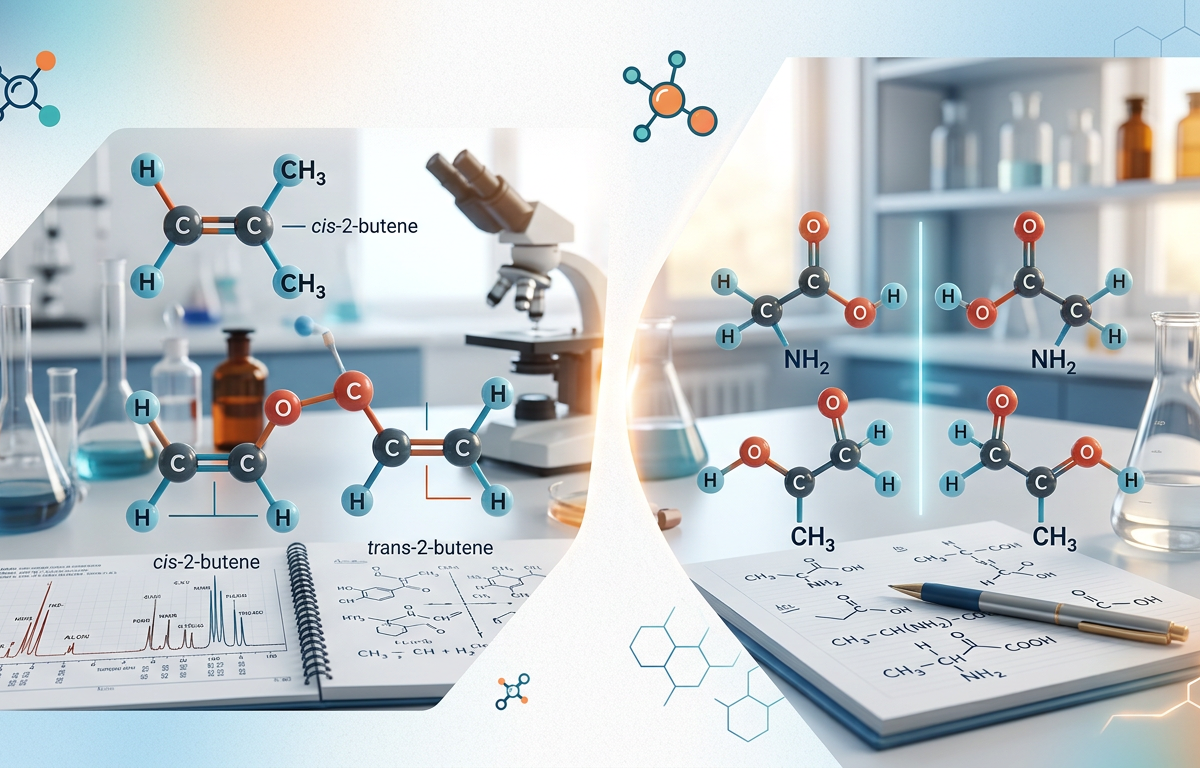
Isomers are distinct chemical species that share the same molecular formula but differ in the arrangement of atoms in space or the connectivity of those atoms. Mastery of Hard Isomer Identification Practice Questions requires a deep understanding of the sub-classifications of isomerism: structural (constitutional) isomers and stereoisomers. Structural isomers differ in the literal bonding sequence of atoms, whereas stereoisomers possess the same connectivity but differ in their 3D orientation. Stereoisomers are further divided into enantiomers (non-superimposable mirror images) and diastereomers (non-mirror image stereoisomers, including cis/trans and E/Z isomers). To identify these correctly, one must often calculate the degree of unsaturation (Index of Hydrogen Deficiency) and assign R/S configurations using Cahn-Ingold-Prelog priority rules. Advanced identification often involves integrating data from NMR interpretation and IR spectroscopy to distinguish between functional group isomers or positional isomers.
Solved Examples
Reviewing these solved problems will help you navigate the complexities of Hard Isomer Identification Practice Questions by applying systematic rules.
Example 1: Identifying Relationships between C4H9Cl Isomers
Determine the relationship between (R)-2-chlorobutane and (S)-2-chlorobutane.
Identify the molecular formula: Both are C4H9Cl.
Check connectivity: Both have a chlorine atom on the second carbon of a butane chain. They are not constitutional isomers.
Check stereochemistry: One is (R) and the other is (S). Since they are mirror images of each other at the only chiral center, they are enantiomers.
Example 2: Distinguishing Diastereomers in Cyclic Systems
Compare cis-1,2-dimethylcyclohexane and trans-1,3-dimethylcyclohexane.
Check connectivity: The first has substituents at positions 1 and 2; the second has them at 1 and 3.
Conclusion: Because the connectivity (the numbering of the attachment points) is different, these are constitutional isomers, specifically positional isomers.
Example 3: Determining Meso Status
Is (2R, 3S)-2,3-dibromobutane chiral or achiral?
Identify chiral centers: Carbons 2 and 3 are both chiral.
Look for symmetry: The molecule has a symmetrical substitution pattern (both ends are -CH3, both centers have -H and -Br).
Analyze configurations: Since one center is R and the other is S in a symmetrical molecule, there is an internal plane of symmetry. This is a meso compound and is achiral.
Practice Questions
These Hard Isomer Identification Practice Questions are designed to challenge your ability to distinguish between subtle stereochemical and structural differences.
1. How many total stereoisomers exist for 2,3,4-trichloropentane? Note that some may be meso compounds.
2. Determine the relationship between (2R, 3R)-tartaric acid and (2S, 3S)-tartaric acid.
3. A compound with the formula C4H8 possesses a double bond. Draw all possible isomers, including stereoisomers, and identify which pair are diastereomers.
Want unlimited practice questions like these?
Generate AI-powered questions with step-by-step solutions on any topic.
Try Question Generator Free →4. Identify the relationship between (E)-hex-3-ene and (Z)-hex-3-ene.
5. Calculate the total number of constitutional isomers for the formula C3H6O, including alcohols, ethers, and carbonyls.
6. Compare (1R, 2R)-1,2-dichlorocyclopropane and (1S, 2S)-1,2-dichlorocyclopropane. Are they enantiomers, diastereomers, or the same molecule?
7. Given 2,3-dichlorobutane, identify which specific stereoisomer is optically inactive due to internal compensation.
8. How many chiral centers are present in cholesterol (C27H46O)? Use a standard molecular reference if necessary.
9. Determine if 1,1-dichlorocyclohexane and 1,2-dichlorocyclohexane are isomers, and if so, what type?
10. If a molecule has 3 non-identical chiral centers, how many possible stereoisomers can it form according to the 2^n rule?
Answers & Explanations
1. 4 Stereoisomers. The molecule has two identical chiral centers (C2 and C4) and a pseudo-asymmetric center (C3). The combinations are (2R, 4R), (2S, 4S), and two meso forms (2R, 3r, 4S) and (2R, 3s, 4S). Identifying meso forms is a common hurdle in Hard Isomer Identification Practice Questions.
2. Enantiomers. Both chiral centers have their configurations inverted (R,R to S,S). Since there is no plane of symmetry in these specific forms, they are non-superimposable mirror images.
3. 4 Isomers. The isomers are 1-butene, 2-methylpropene, cis-2-butene, and trans-2-butene. The pair of cis-2-butene and trans-2-butene are diastereomers (specifically geometric isomers).
4. Diastereomers. E/Z isomers (or cis/trans) are stereoisomers that are not mirror images of each other, fitting the definition of diastereomers perfectly.
5. 9 Isomers. These include propanal, acetone (propanone), allyl alcohol (prop-2-en-1-ol), methyl vinyl ether, cyclopropanol, oxetane, methyl oxirane, and others. This requires checking for rings and double bonds using the degree of unsaturation (C3H6O has 1 degree).
6. Enantiomers. Both centers are inverted in a molecule that lacks an internal plane of symmetry in these configurations. For more on 3D arrangements, see Isomer Identification Practice Questions with Answers.
7. (2R, 3S)-2,3-dichlorobutane. This is the meso compound. It is optically inactive because the rotation of light by one half of the molecule is canceled by the other half.
8. 8 Chiral Centers. Cholesterol is a complex tetracyclic molecule. Identifying these requires looking for carbons bonded to four different groups, often at ring junctions. For help with complex structures, refer to Naming Organic Compounds.
9. Constitutional (Positional) Isomers. They share the same formula but the chlorine atoms are attached to different carbon atoms in the ring.
10. 8 Stereoisomers. Using the formula 2^n where n=3, we get 2^3 = 8. Since the centers are non-identical, no meso compounds will reduce this number.
1. Which of the following is a requirement for a molecule to be a meso compound?
Frequently Asked Questions
What is the easiest way to distinguish between enantiomers and diastereomers?
Enantiomers have opposite configurations at every single chiral center, while diastereomers have opposite configurations at some, but not all, chiral centers. Enantiomers are mirror images, whereas diastereomers are not.
Can a molecule with chiral centers be achiral?
Yes, such molecules are called meso compounds, which contain an internal plane of symmetry that cancels out the optical activity. This occurs when the molecule is superimposable on its own mirror image despite having stereocenters.
How does the degree of unsaturation help in isomer identification?
The degree of unsaturation indicates the total number of rings and pi bonds in a molecule. By calculating this value first, you can narrow down whether your isomers should include double bonds, triple bonds, or cyclic structures.
Are cis-trans isomers considered enantiomers?
No, cis-trans isomers are a type of diastereomer because they have the same connectivity but different spatial arrangements and are not mirror images of one another. They often have different physical properties like boiling points and solubilities.
Do constitutional isomers have the same physical properties?
No, constitutional isomers typically have very different physical and chemical properties because their atoms are bonded in different sequences. This leads to different functional groups or different carbon skeletons, affecting intermolecular forces.
What are conformational isomers?
Conformational isomers, or conformers, are different spatial arrangements of the same molecule produced by rotation about single (sigma) bonds. Unlike other isomers, they are generally interconvertible at room temperature and are not distinct stable compounds.
Want unlimited practice questions like these?
Generate AI-powered questions with step-by-step solutions on any topic.
Try Question Generator Free →
Want unlimited practice questions like these?
Generate AI-powered questions with step-by-step solutions on any topic.
Try Question Generator Free →Enjoyed this article?
Share it with others who might find it helpful.
Related Articles
Hard Le Chatelier’s Principle Practice Questions
Master Hard Le Chatelier’s Principle Practice Questions with our comprehensive guide featuring solved examples, practice problems, and detailed explanations.
Mar 30, 2026
Hard Reaction Quotient (Q) Practice Questions
Hard Reaction Quotient (Q) Practice Questions
Mar 30, 2026
Grams to Moles Practice Questions with Answers
Master grams to moles conversions with our comprehensive guide. Includes step-by-step examples, practice questions, and detailed answers for chemistry students.
Mar 26, 2026
Avogadro’s Number Practice Questions with Answers
Master the mole concept with our Avogadro’s Number practice questions. Includes step-by-step solved examples, a quick quiz, and detailed explanations.
Mar 26, 2026
Empirical Formulas: Solving Ratios from Mass and Percent Data
Master empirical formula calculations with 10 practice questions, worked answers, and a free step-by-step calculator for mass, percentage, and combustion problems.
Mar 26, 2026