Solve Isomer ID Problems: Distinguishing Formula from Connectivity
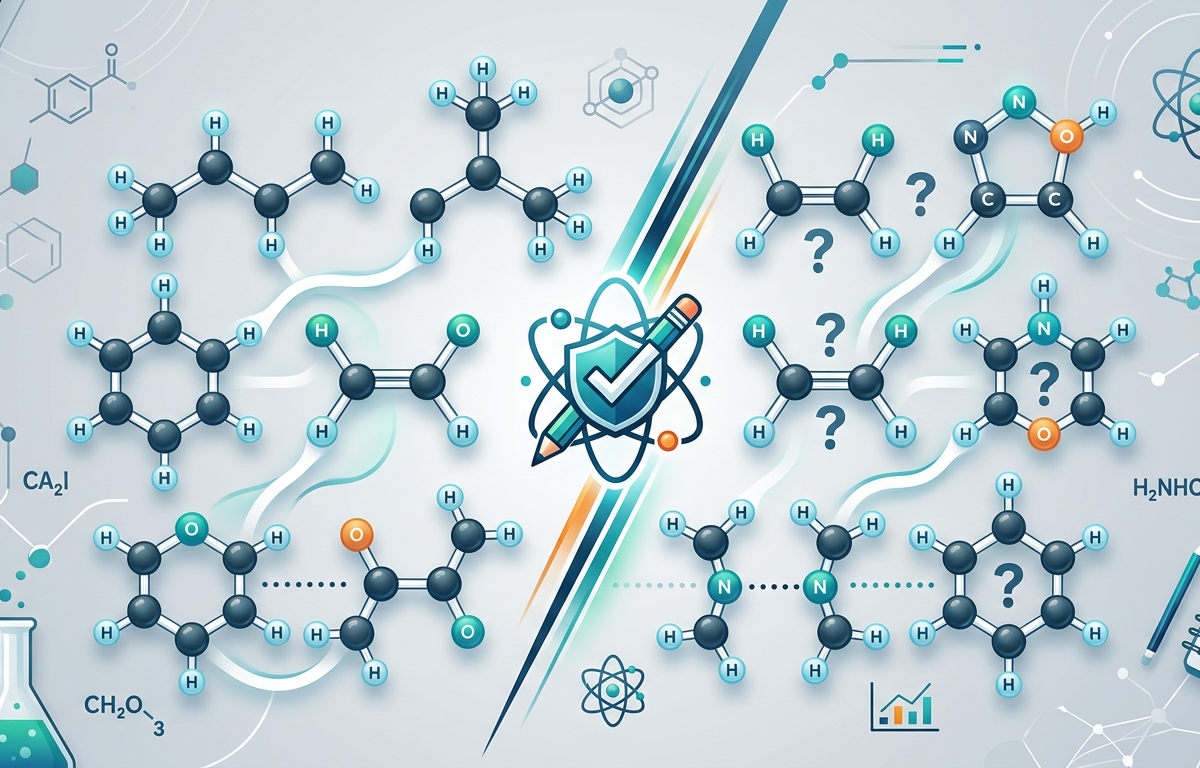
When you encounter two molecules like ethanol and dimethyl ether, both sharing the molecular formula C2H6O, the mistake is looking for differences in the atom count. The atoms are identical, yet one is a liquid you can drink and the other is a gaseous anesthetic. The critical reasoning step students often skip is the connectivity check. If you cannot name both structures using IUPAC rules and get two distinct parent chains or functional group placements, you are not looking at different isomers; you are likely just looking at the same molecule flipped or rotated on the page.
Successful identification requires a systematic filter. First, confirm the degrees of unsaturation to ensure the formulas actually match. If the formulas align, you must then determine if the atoms are bonded in a different order, creating structural isomers, or if the difference lies solely in 3D orientation, creating stereoisomers. This set of practice questions focuses on the nuances of chirality and functional group shifts that often appear on organic chemistry exams.
The Logic of Molecular Relationships
Isomer identification is the process of distinguishing between molecules that share the same molecular formula but possess different structural arrangements or spatial orientations. This fundamental concept in organic chemistry allows scientists to understand why two substances with identical atoms, such as ethanol and dimethyl ether (C2H6O), exhibit vastly different physical and chemical properties. To master this topic, one must categorize isomers into two primary groups: structural (constitutional) isomers and stereoisomers.
Structural isomers differ in the connectivity of their atoms. For instance, in skeletal isomers, the carbon backbone changes (e.g., butane vs. isobutane), while in functional isomers, the atoms are rearranged into different functional groups. Understanding Lewis Structure Practice Questions with Answers can help visualize these connectivity differences. Stereoisomers, on the other hand, have the same connectivity but differ in how their atoms are oriented in three-dimensional space. This category includes enantiomers (non-superimposable mirror images) and diastereomers (non-mirror image stereoisomers, such as cis-trans isomers).
When identifying isomers, the first step is always to verify the molecular formula. If the formulas differ, they are not isomers; they are different compounds. If they are the same, you must check the IUPAC names. If the names (excluding stereodescriptors like R/S or cis/trans) are different, they are structural isomers. If the names are identical, you are likely looking at stereoisomers or perhaps the same molecule rotated in space. Tools like Wikipedia's overview of isomerism provide excellent visual hierarchies for these relationships.
Isomer Type Key Characteristic Example Pair Constitutional Different atom connectivity Propan-1-ol and Propan-2-ol Enantiomers Mirror images, non-superimposable (R)-Lactic acid and (S)-Lactic acid Diastereomers Non-mirror image stereoisomers cis-2-butene and trans-2-butene
Solved Examples
Review these worked examples to understand the logic used in isomer identification.
Example 1: Identifying Constitutional Isomers
Determine the relationship between Pentane and 2-Methylbutane.Count the atoms: Pentane is C5H12. 2-Methylbutane is also C5H12.
Check connectivity: Pentane is a straight chain of five carbons. 2-Methylbutane has a four-carbon chain with a branch.
Conclusion: Since they have the same formula but different connectivity, they are constitutional isomers.
Example 2: Identifying Geometric Isomers
Compare cis-1,2-dichloroethene and trans-1,2-dichloroethene.Check connectivity: In both molecules, the chlorines are attached to carbons 1 and 2 of an ethene double bond.
Check spatial arrangement: In the "cis" form, chlorines are on the same side. In "trans", they are on opposite sides.
Conclusion: They are diastereomers, specifically geometric isomers.
Example 3: Identifying Enantiomers
Analyze a pair of molecules where one is (R)-2-chlorobutane and the other is (S)-2-chlorobutane.Identify the chiral center: Carbon 2 is attached to H, Cl, Methyl, and Ethyl.
Compare configurations: R and S denote opposite configurations at the chiral center.
Conclusion: They are non-superimposable mirror images, making them enantiomers.
Practice Questions
Identify the relationship between 1-butanol and diethyl ether.
Are 2-pentanone and 3-pentanone isomers? If so, what type?
Compare (2R, 3R)-tartaric acid and (2S, 3S)-tartaric acid. What is their relationship?
Want unlimited practice questions like these?
Generate AI-powered questions with step-by-step solutions on any topic.
Try Question Generator Free →Define the relationship between cyclohexane and 1-hexene.
Determine if (2R, 3S)-2,3-dibromobutane and (2S, 3R)-2,3-dibromobutane are enantiomers or the same molecule (meso).
Identify the relationship between propyl acetate and methyl butyrate.
Are o-xylene (1,2-dimethylbenzene) and m-xylene (1,3-dimethylbenzene) isomers?
Compare propanal and propanone. What category of isomerism do they represent?
Analyze a pair of molecules: trans-1,3-dimethylcyclohexane and cis-1,3-dimethylcyclohexane.
Does C3H8 have any structural isomers?
Answers & Explanations
Functional Isomers: Both have the molecular formula C4H10O. However, 1-butanol is an alcohol (-OH group), while diethyl ether is an ether (C-O-C bond). Since the functional groups differ, they are constitutional (functional) isomers.
Positional Isomers: Both are C5H10O ketones. The only difference is the position of the carbonyl (C=O) group (on carbon 2 vs. carbon 3). This makes them constitutional isomers, specifically positional isomers.
Enantiomers: These molecules have the same connectivity but opposite configurations at every chiral center. They are mirror images of each other that cannot be superimposed.
Constitutional Isomers: Both have the formula C6H12. One is a cyclic alkane, and the other is an alkene. Their connectivity is entirely different.
Identical (Meso Compound): For 2,3-dibromobutane, the (2R, 3S) and (2S, 3R) configurations are identical because the molecule has an internal plane of symmetry. This is a "meso" compound.
Constitutional Isomers: Both are esters with the formula C5H10O2. They differ in the length of the carbon chains on either side of the ester group.
Positional Isomers: Yes, they are isomers. Both are dimethyl-substituted benzenes (C8H10), but the methyl groups are at different relative positions (1,2 vs 1,3).
Functional Isomers: Both share the formula C3H6O. Propanal is an aldehyde, whereas propanone (acetone) is a ketone.
Diastereomers: These are stereoisomers that are not mirror images. Changing the orientation of one methyl group relative to the other on a ring creates a diastereomeric relationship.
No: Propane (C3H8) only has one possible arrangement of carbons (a straight chain). Isomerism in alkanes begins at butane (C4).
1. Which type of isomers have the same molecular formula but different functional groups?
Frequently Asked Questions
What is the easiest way to tell if two molecules are isomers?
The easiest way is to first calculate the molecular formula for both structures; if the formulas are identical but the structures look different, they are isomers. If the formulas are different, they are not isomers.
Can two isomers have different physical properties?
Yes, structural isomers and diastereomers almost always have different boiling points, melting points, and solubilities. Enantiomers, however, share identical physical properties except for how they rotate plane-polarized light.
What makes a molecule a "meso" compound?
A meso compound contains chiral centers but is achiral overall due to an internal plane of symmetry. This causes the molecule to be superimposable on its mirror image, meaning it does not have an enantiomer.
How is isomerism related to VSEPR theory?
While VSEPR theory predicts the shape of individual centers, isomerism deals with the global arrangement of those centers. Understanding VSEPR Geometry Practice Questions with Answers helps in visualizing the 3D shapes necessary to identify stereoisomers.
Do all alkenes show cis-trans isomerism?
No, an alkene only shows cis-trans isomerism if each carbon in the double bond is attached to two different groups. If one carbon is attached to two identical groups (like two hydrogens), cis-trans isomerism is impossible.
Are conformational isomers considered true isomers?
Conformational isomers (conformers) are different spatial arrangements produced by rotation about single bonds. Because they interconvert rapidly at room temperature, they are usually considered different states of the same molecule rather than distinct isomers.
Want unlimited practice questions like these?
Generate AI-powered questions with step-by-step solutions on any topic.
Try Question Generator Free →
Want unlimited practice questions like these?
Generate AI-powered questions with step-by-step solutions on any topic.
Try Question Generator Free →Enjoyed this article?
Share it with others who might find it helpful.
Related Articles
Hard Le Chatelier’s Principle Practice Questions
Master Hard Le Chatelier’s Principle Practice Questions with our comprehensive guide featuring solved examples, practice problems, and detailed explanations.
Mar 30, 2026
Hard Reaction Quotient (Q) Practice Questions
Hard Reaction Quotient (Q) Practice Questions
Mar 30, 2026
Grams to Moles Practice Questions with Answers
Master grams to moles conversions with our comprehensive guide. Includes step-by-step examples, practice questions, and detailed answers for chemistry students.
Mar 26, 2026
Avogadro’s Number Practice Questions with Answers
Master the mole concept with our Avogadro’s Number practice questions. Includes step-by-step solved examples, a quick quiz, and detailed explanations.
Mar 26, 2026

Empirical Formulas: Solving Ratios from Mass and Percent Data
Master empirical formula calculations with 10 practice questions, worked answers, and a free step-by-step calculator for mass, percentage, and combustion problems.
Mar 26, 2026