Naming Organic Compounds (IUPAC) Practice Questions with Answers
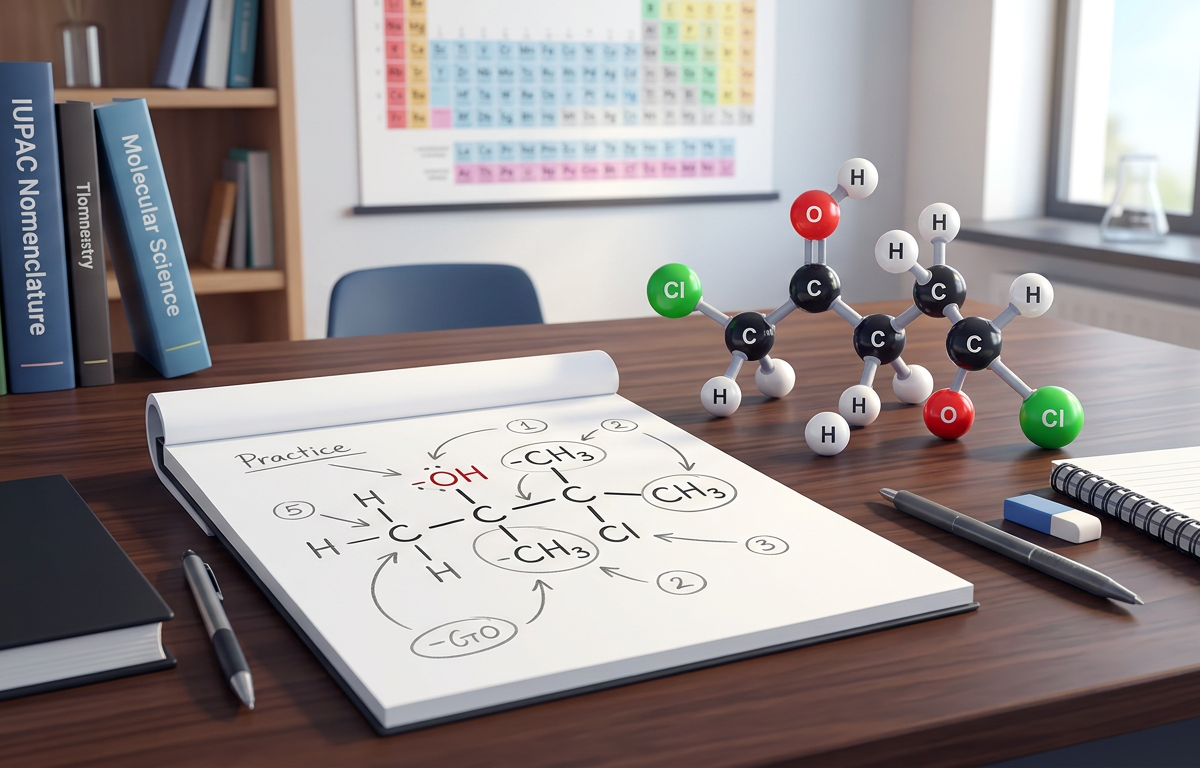
Naming Organic Compounds (IUPAC) Practice Questions with Answers
Mastering the art of naming organic compounds (IUPAC) involves learning a systematic set of rules developed by the International Union of Pure and Applied Chemistry to ensure every unique molecule has a unique name. Whether you are identifying a simple alkane or a complex polyfunctional molecule, the IUPAC system provides a logical framework that allows scientists worldwide to communicate without ambiguity. This guide provides a comprehensive review of nomenclature rules followed by rigorous practice to help you build confidence in organic chemistry.
Concept Explanation
Naming organic compounds (IUPAC) is the process of assigning a systematic name to a chemical structure based on its longest carbon chain, functional groups, and substituent positions. The core philosophy of IUPAC nomenclature is that the name should allow a chemist to draw the exact structure of the molecule without confusion. This system is essential because common names, like "acetone" or "acetic acid," do not scale well as molecules become more complex. Understanding this system often requires a solid grasp of molecular geometry, which you can explore further in our VSEPR Geometry Practice Questions with Answers.
The systematic name of an organic compound is generally built from four parts:
Locants: Numbers that indicate where substituents or functional groups are located on the main chain.
Prefixes: Identify the types and quantities of substituents (e.g., methyl, ethyl, chloro, di-, tri-).
Parent: Represents the number of carbon atoms in the longest continuous chain containing the principal functional group.
Suffix: Identifies the primary functional group (e.g., -ane for alkanes, -ol for alcohols, -one for ketones).
To name a molecule, you must first identify the highest-priority functional group according to the IUPAC official priority list. Carboxylic acids sit at the top of this hierarchy, followed by esters, amides, nitriles, aldehydes, ketones, and alcohols. Once the principal group is identified, you number the longest carbon chain to give that group the lowest possible locant. For molecules involving complex bonding patterns, understanding the orbital overlap is helpful; see our Hybridization Practice Questions with Answers for more on carbon bonding.
Solved Examples
Review these step-by-step solutions to understand how the IUPAC rules are applied in real-world scenarios.
Example 1: Naming a Branched Alkane
Structure: CH3-CH(CH3)-CH2-CH2-CH3
Identify the longest continuous carbon chain. In this case, it is a 5-carbon chain, which gives the parent name "pentane."
Number the chain from the end closest to the branch. Numbering from left to right puts the methyl group at carbon 2.
Identify the substituent. It is a one-carbon group, known as a "methyl" group.
Combine the parts: The name is 2-methylpentane.
Example 2: Naming an Alcohol with Multiple Branches
Structure: CH3-CH(OH)-CH(CH2CH3)-CH3
Identify the longest chain containing the -OH group. The longest chain is 4 carbons long, but we must ensure the alcohol gets the lowest number.
Numbering from the left gives the alcohol carbon 2. Numbering from the right gives it carbon 3. We choose the left.
The parent name for 4 carbons is butane. Since it is an alcohol, it becomes "butan-2-ol."
Identify the substituent at carbon 3. It is an ethyl group? No, look closer—the chain is actually 5 carbons long if we go through the ethyl group. Let's re-evaluate.
Correct Longest Chain: CH3-CH(OH)-CH(CH3)-CH2-CH3. This is a 5-carbon chain (pentane).
The alcohol is at C2, and a methyl group is at C3.
The final name is 3-methylpentan-2-ol.
Example 3: Naming an Alkene with Halogens
Structure: Br-CH2-CH=CH-CH3
Identify the parent chain containing the double bond. It is 4 carbons long: "butene."
Number the chain to give the double bond the lowest number. Starting from the right: C2. Starting from the left: C2.
Since the double bond is equidistant, number to give the substituent (Bromine) the lower number. We start from the left.
The double bond starts at C2, and Bromine is at C1.
The final name is 1-bromobut-2-ene.
Practice Questions
Test your knowledge with these practice questions. They range from simple alkanes to complex molecules with multiple functional groups.
1. Provide the IUPAC name for: CH3-CH2-CH(CH3)-CH2-CH2-CH3
2. Name the following compound: CH3-C(CH3)2-CH2-CH2-OH
3. What is the systematic name for CH2=CH-CH(Cl)-CH3?
Want unlimited practice questions like these?
Generate AI-powered questions with step-by-step solutions on any topic.
Try Question Generator Free →4. Name the compound: CH3-CO-CH2-CH2-CH3
5. Provide the IUPAC name for: CH3-CH2-O-CH2-CH3
6. Name this cyclic compound: A cyclohexane ring with a methyl group and an ethyl group on adjacent carbons (assume ethyl is at C1).
7. What is the name of the carboxylic acid with the formula CH3-CH(CH3)-COOH?
8. Name the following: CH3-CH2-NH-CH3
9. Provide the name for: CH3-CH=C(CH3)2
10. Name the compound: Cl-CH2-CH2-CH2-Br
Answers & Explanations
Use these explanations to check your work and understand the logic behind each IUPAC name.
1. 3-methylhexane: The longest chain has 6 carbons. Numbering from the left puts the methyl group at carbon 3. If numbered from the right, it would be at carbon 4. We choose 3.
2. 3,3-dimethylbutan-1-ol: The longest chain containing the alcohol group has 4 carbons. The alcohol is at C1. There are two methyl groups on C3. Note that we number to give the -OH group priority over the methyl groups.
3. 3-chlorobut-1-ene: The double bond takes priority over the halogen for numbering. The chain is 4 carbons long. The double bond starts at C1, and the chlorine is at C3.
4. Pentan-2-one: This is a ketone with a 5-carbon chain. Numbering from the left puts the carbonyl group at C2, which is lower than C4 (from the right).
5. Ethoxyethane: This is an ether. In IUPAC, ethers are named as alkoxy-alkanes. Since both sides of the oxygen have 2 carbons (ethyl groups), it is ethoxyethane (commonly known as diethyl ether).
6. 1-ethyl-2-methylcyclohexane: Substituents on a ring are listed alphabetically. "Ethyl" comes before "methyl," so the ethyl group is assigned C1 and the methyl group C2.
7. 2-methylpropanoic acid: The longest chain containing the carboxyl group is 3 carbons long (propanoic acid). The carbon in the -COOH group is always C1. A methyl group is attached to C2.
8. N-methylethanamine: This is a secondary amine. The longest carbon chain attached to the nitrogen is 2 carbons (ethanamine). The smaller 1-carbon group is treated as a substituent on the nitrogen, indicated by "N-methyl."
9. 2-methylbut-2-ene: The longest chain with the double bond is 4 carbons. Numbering from the right puts the double bond at C2 and the methyl group at C2. (From the left, the methyl would be at C3).
10. 1-bromo-3-chloropropane: The chain is 3 carbons long. Substituents are listed alphabetically (bromo before chloro). We number from the end that gives the first substituent the lowest number. Since 1,3 is the same from both ends, alphabetization dictates C1 goes to Bromine.
1. Which functional group has the highest priority in IUPAC nomenclature?
Frequently Asked Questions
What is the difference between a common name and an IUPAC name?
Common names are traditional or historical names like "formaldehyde" or "toluene," whereas IUPAC names are systematic and based on the molecule's specific structural features. IUPAC names provide a standardized way to describe any molecule, no matter how complex, ensuring global scientific clarity.
How do you handle priority when multiple functional groups are present?
IUPAC provides a hierarchy where one group is designated as the principal functional group (suffix), and all others are treated as substituents (prefixes). For example, in a molecule with both an alcohol and a ketone, the ketone takes priority as the suffix (-one), and the alcohol is named as a "hydroxy" prefix.
Why must the longest carbon chain include the functional group?
The parent chain is defined by the most important functional group to ensure the name reflects the molecule's chemical reactivity and properties. Even if a longer carbon chain exists elsewhere in the molecule, the parent name must be derived from the chain containing the principal group.
What are locants in organic chemistry nomenclature?
Locants are numbers used to identify the position of functional groups, double/triple bonds, or substituents along the parent carbon chain. They are assigned by numbering the chain from the end that gives the principal functional group or the first substituent the lowest possible number.
How do you name cyclic organic compounds?
Cyclic compounds use the prefix "cyclo-" before the parent alkane name, such as cyclohexane for a six-carbon ring. If substituents are present, the ring is numbered to give the substituents the lowest possible locants, often following alphabetical order for priority if the numbers are otherwise identical.
Can a molecule have more than one valid IUPAC name?
While IUPAC rules are designed to produce a single "preferred" name (PIN), some molecules may have older systematic names that are still considered acceptable. However, following the most recent IUPAC Blue Book recommendations ensures you are using the most current and globally recognized nomenclature.
Want unlimited practice questions like these?
Generate AI-powered questions with step-by-step solutions on any topic.
Try Question Generator Free →
Want unlimited practice questions like these?
Generate AI-powered questions with step-by-step solutions on any topic.
Try Question Generator Free →Enjoyed this article?
Share it with others who might find it helpful.
Related Articles
Hard Le Chatelier’s Principle Practice Questions
Master Hard Le Chatelier’s Principle Practice Questions with our comprehensive guide featuring solved examples, practice problems, and detailed explanations.
Mar 30, 2026

Hard Reaction Quotient (Q) Practice Questions
Hard Reaction Quotient (Q) Practice Questions
Mar 30, 2026

Grams to Moles Practice Questions with Answers
Master grams to moles conversions with our comprehensive guide. Includes step-by-step examples, practice questions, and detailed answers for chemistry students.
Mar 26, 2026
Avogadro’s Number Practice Questions with Answers
Master the mole concept with our Avogadro’s Number practice questions. Includes step-by-step solved examples, a quick quiz, and detailed explanations.
Mar 26, 2026

Empirical Formulas: Solving Ratios from Mass and Percent Data
Master empirical formula calculations with 10 practice questions, worked answers, and a free step-by-step calculator for mass, percentage, and combustion problems.
Mar 26, 2026