Hard Ideal Gas Law (PV = nRT) Practice Questions

Concept Explanation
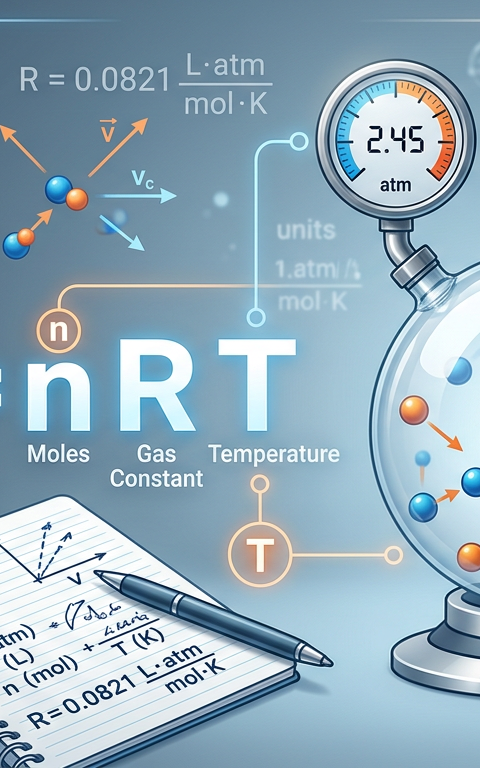
The Ideal Gas Law (PV = nRT) is a mathematical equation of state that describes the behavior of a hypothetical ideal gas by relating its pressure, volume, temperature, and amount in moles. This law serves as the foundation for modern thermodynamics and chemical engineering, combining the individual observations of Boyle’s Law, Charles’s Law, and Avogadro's hypothesis. In this equation, P represents pressure, V is volume, n is the number of moles, R is the universal gas constant, and T is the absolute temperature in Kelvin.
The Variables and Units
To master hard Ideal Gas Law practice questions, you must be meticulous with units. Small errors in conversion lead to significantly incorrect answers. The universal gas constant (R) changes depending on the units of pressure and volume used:
R = 0.08206 L·atm/(mol·K): Use this when pressure is in atmospheres (atm) and volume is in liters (L).
R = 8.314 J/(mol·K): Use this when working with SI units (Pressure in Pascals, Volume in m³).
R = 62.36 L·torr/(mol·K): Use this when pressure is in torr or mmHg.
Assumptions of Ideal Behavior
The law assumes that gas particles have negligible volume and exert no intermolecular forces on each other. While real gases deviate from this behavior at extremely high pressures or very low temperatures, the PV = nRT model remains highly accurate for most gases under standard conditions. When you are studying for engineering exams, you will often encounter modifications like the Van der Waals equation to account for these deviations, but for most chemistry applications, the ideal model is the primary tool.
Solved Examples
Review these fully worked examples to understand how to manipulate the Ideal Gas Law for complex scenarios involving density, molar mass, and stoichiometry.
Example 1: Calculating Molar Mass from Density
A sample of an unknown gas has a density of 1.45 g/L at 25°C and 0.950 atm. Determine the molar mass of the gas.
Identify the formula relating density (d) to the Ideal Gas Law: PV = nRT. Since n = mass(m)/Molar Mass(M) and d = m/V, we can derive M = dRT/P.
Convert temperature to Kelvin: T = 25 + 273.15 = 298.15 K.
Substitute the values into the derived equation: M = (1.45 g/L * 0.08206 L·atm/mol·K * 298.15 K) / 0.950 atm.
Calculate the result: M = 35.45 / 0.950 = 37.32 g/mol.
Example 2: Volume of Gas in a Chemical Reaction
How many liters of oxygen gas (O₂) at 350 K and 2.5 atm are required to completely react with 50.0 g of glucose (C₆H₁₂O₆) in a combustion reaction?
Write the balanced equation: C₆H₁₂O₆ + 6O₂ → 6CO₂ + 6H₂O.
Find the moles of glucose: 50.0 g / 180.16 g/mol = 0.2775 moles C₆H₁₂O₆.
Use stoichiometry to find moles of O₂: 0.2775 mol C₆H₁₂O₆ * 6 = 1.665 moles O₂.
Apply PV = nRT to find Volume: V = nRT / P.
V = (1.665 mol * 0.08206 L·atm/mol·K * 350 K) / 2.5 atm = 19.13 L.
Example 3: Partial Pressure and Total Pressure
A 10.0 L flask contains 0.50 moles of Nitrogen and 0.80 moles of Helium at 27°C. Calculate the total pressure in the flask.
Convert temperature: T = 27 + 273 = 300 K.
Calculate total moles (n_total): 0.50 + 0.80 = 1.30 moles.
Use the Ideal Gas Law for total pressure: P_total = n_totalRT / V.
P_total = (1.30 mol * 0.08206 L·atm/mol·K * 300 K) / 10.0 L = 3.20 atm.
Practice Questions
1. A 5.00 L cylinder contains 0.250 moles of Argon gas at 300 K. If the pressure is increased to 3.00 atm by adding more Argon while keeping temperature and volume constant, how many additional grams of Argon were added?
2. Calculate the density of Sulfur Hexafluoride (SF₆) gas at a pressure of 720 torr and a temperature of 45°C. Express your answer in g/L.
3. A mixture of 2.00 g of H₂ and 16.00 g of O₂ is placed in a 5.00 L container at 298 K. What is the total pressure of the system, and what is the mole fraction of Hydrogen?
Start Learning Smarter Today
Join thousands of students using AI-powered study tools to achieve better results.
Get Started Free4. An unknown noble gas has a density of 5.89 g/L at STP (Standard Temperature and Pressure). Identify the gas by calculating its molar mass.
5. A rigid 2.0 L container contains gas at 1.5 atm and 25°C. If the container is heated to 150°C, and the pressure exceeds 2.5 atm, the container will explode. Does the container explode? Support your answer with calculations.
6. How many grams of Sodium Azide (NaN₃) are required to produce 65.0 L of Nitrogen gas (N₂) at 25°C and 1.05 atm for an automobile airbag? (Reaction: 2NaN₃(s) → 2Na(s) + 3N₂(g))
7. A sample of gas occupies 450 mL at 1.2 atm and 310 K. If the gas weighs 0.622 g, what is the molar mass of the gas?
8. A 1.50 L bulb containing He at 150 torr is connected by a valve to a 2.50 L bulb containing Ne at 550 torr. Both are at the same temperature. What is the final pressure when the valve is opened?
Answers & Explanations
1. Answer: 14.34 g of Ar.
First, find the total moles needed for 3.00 atm: n = PV/RT = (3.00 * 5.00) / (0.08206 * 300) = 0.609 moles. The initial moles were 0.250. Moles added = 0.609 - 0.250 = 0.359 moles. Mass added = 0.359 mol * 39.95 g/mol = 14.34 g.
2. Answer: 5.28 g/L.
Convert pressure to atm: 720 / 760 = 0.947 atm. Convert temp to Kelvin: 45 + 273.15 = 318.15 K. Molar mass of SF₆ = 146.06 g/mol. Density d = MP/RT = (146.06 * 0.947) / (0.08206 * 318.15) = 5.28 g/L.
3. Answer: P_total = 7.34 atm; X_H₂ = 0.667.
Moles H₂ = 2.00 / 2.016 = 0.992 mol. Moles O₂ = 16.00 / 32.00 = 0.500 mol. Total moles = 1.492. P = (1.492 * 0.08206 * 298) / 5.00 = 7.34 atm. Mole fraction X_H₂ = 0.992 / 1.492 = 0.665 (approx 2/3).
4. Answer: Xenon (Xe).
At STP, P = 1 atm and T = 273.15 K. M = dRT/P = (5.89 * 0.08206 * 273.15) / 1 = 132.0 g/mol. Checking the Periodic Table, this molar mass corresponds to Xenon.
5. Answer: No, it does not explode.
Since volume and moles are constant, use P₁/T₁ = P₂/T₂. P₂ = P₁T₂ / T₁ = (1.5 atm * 423.15 K) / 298.15 K = 2.13 atm. Since 2.13 atm < 2.5 atm, it remains intact.
6. Answer: 121.1 g NaN₃.
Find moles of N₂: n = PV/RT = (1.05 * 65.0) / (0.08206 * 298.15) = 2.79 moles N₂. Stoichiometry: 2.79 mol N₂ * (2 mol NaN₃ / 3 mol N₂) = 1.86 moles NaN₃. Mass = 1.86 * 65.01 g/mol = 121.1 g.
7. Answer: 29.4 g/mol.
Convert volume to L: 0.450 L. n = PV/RT = (1.2 * 0.450) / (0.08206 * 310) = 0.0212 moles. Molar mass = mass / moles = 0.622 g / 0.0212 mol = 29.4 g/mol.
8. Answer: 400 torr.
This uses Dalton’s Law. Final volume = 1.50 + 2.50 = 4.00 L. P_final = (P₁V₁ + P₂V₂) / V_total = (150 * 1.50 + 550 * 2.50) / 4.00 = (225 + 1375) / 4.00 = 400 torr.
1. Which of the following conditions would cause a real gas to deviate most significantly from the Ideal Gas Law?
Frequently Asked Questions
What is the difference between an ideal gas and a real gas?
An ideal gas is a theoretical model where particles have no volume and no attractions, whereas real gas particles have physical size and intermolecular forces. Real gases behave most ideally at low pressures and high temperatures where these factors are minimized.
Why must temperature always be in Kelvin for gas law calculations?
Kelvin is an absolute temperature scale where zero represents the absence of thermal energy, preventing negative values in the denominator of the gas laws. Using Celsius or Fahrenheit would result in mathematically impossible volumes or pressures.
How do you find the density of a gas using PV = nRT?
By substituting the relationship n = m/M (moles = mass / molar mass) into the ideal gas law, you can rearrange the formula to Density (d) = PM / RT. This allows you to calculate density directly from pressure, molar mass, and temperature.
What is considered Standard Temperature and Pressure (STP)?
According to the IUPAC, STP is defined as a temperature of 273.15 K (0°C) and an absolute pressure of 100 kPa (0.987 atm), though many textbooks still use 1 atm. Under these conditions, one mole of an ideal gas occupies approximately 22.4 to 22.7 liters.
Can the Ideal Gas Law be used for liquid or solid substances?
No, the Ideal Gas Law only applies to substances in the gaseous state because it relies on the assumption of high compressibility and random particle motion. Liquids and solids have fixed volumes and strong intermolecular forces that do not follow the PV = nRT relationship.
How does the gas constant R change with different units?
The numerical value of R is a proportionality constant that balances the units of P, V, n, and T; therefore, it must match the units provided in the problem. For example, if you use kPa, R is 8.314 L·kPa/(mol·K), which is equivalent to 8.314 J/(mol·K) because 1 J = 1 kPa·L.
Start Learning Smarter Today
Join thousands of students using AI-powered study tools to achieve better results.
Get Started FreeEnjoyed this article?
Share it with others who might find it helpful.
Related Articles
Medium Ideal Gas Law (PV = nRT) Practice Questions
Master the Ideal Gas Law (PV = nRT) with these medium-level practice questions, solved examples, and a quick quiz to boost your chemistry exam scores.
Apr 2, 2026

Ideal Gas Law (PV = nRT) Practice Questions with Answers
Ideal Gas Law (PV = nRT) Practice Questions with Answers
Apr 2, 2026

Calculating High-Stakes Meds: BSA Mosteller Formula Practice
Master hard body surface area-based dosage calculations with our comprehensive guide, solved examples, and practice questions for healthcare students.
May 17, 2026

Solving High-Stakes IV Titrations and Weight-Based Infusions
Master advanced IV flow rate calculations with these hard practice questions. Covers weight-based dosing, titrations, and dimensional analysis for nurses.
May 17, 2026

Solving Weight-Based Dosing: The 2.2 Conversion and Rounding Logic
Weight-Based Dosage Calculations Practice Questions with Answers
May 17, 2026

Predicting Periodic Anomalies: Beyond Basic Trend Rules
Hard Periodic Trends Practice Questions
Apr 4, 2026

Hard Electron Configuration Practice Questions
Hard Electron Configuration Practice Questions
Apr 4, 2026
Medium Electron Configuration Practice Questions
Master medium-level electron configuration with our comprehensive guide, including solved examples, stability exceptions, and practice questions with answers.
Apr 4, 2026