Hard Heat of Reaction Practice Questions
Concept Explanation
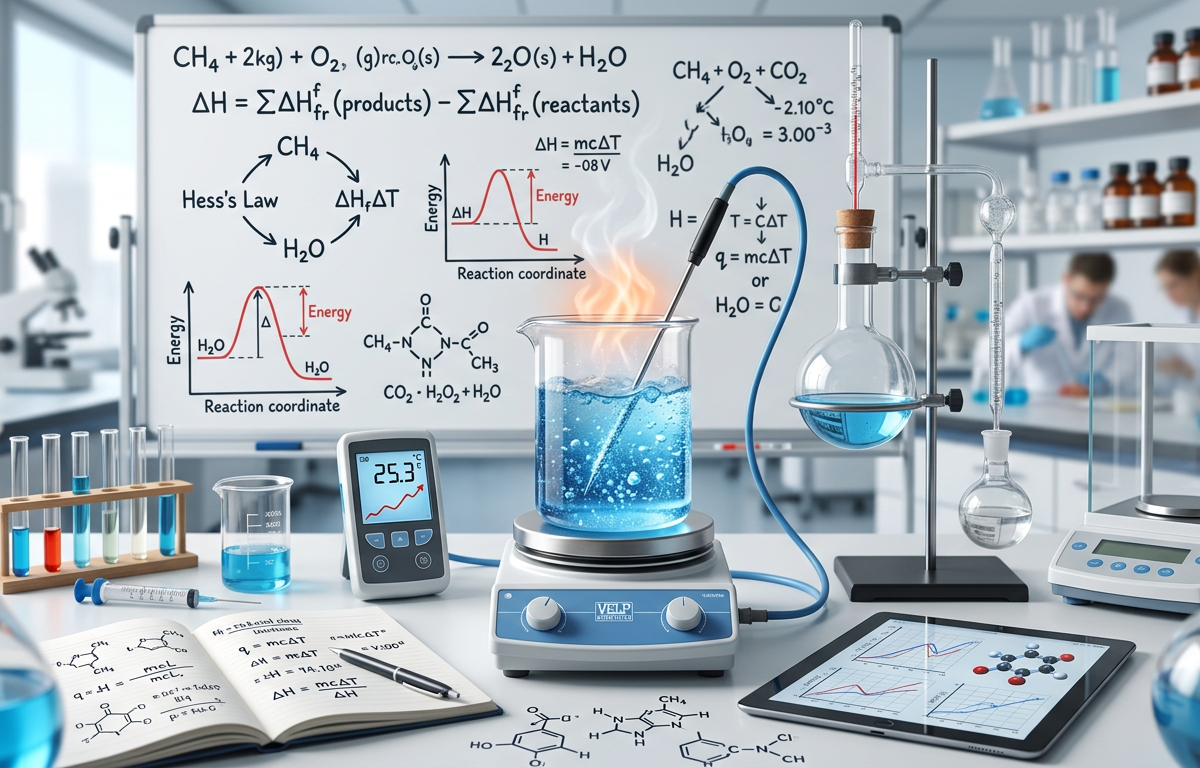
The heat of reaction, or enthalpy of reaction (ΔHrxn), is the change in enthalpy that occurs during a chemical reaction at constant pressure, representing the difference between the total energy of products and the total energy of reactants. This thermodynamic property determines whether a process is exothermic (releasing heat, negative ΔH) or endothermic (absorbing heat, positive ΔH). To master hard heat of reaction practice questions, one must integrate various principles including calorimetry-practice-questions, stoichiometry, and Hess’s Law.
At an advanced level, calculating the heat of reaction involves more than just simple subtraction. You must account for state changes, non-standard conditions, and the relationship between internal energy and enthalpy. For instance, according to the First Law of Thermodynamics, the energy change in a system is the sum of heat and work. In chemical systems, work is often pressure-volume work (PΔV). Hence, ΔH is specifically the heat flow at constant pressure. Understanding these nuances is critical when solving multi-step problems where reactants are not in their standard states or when the final temperature of the system must be determined through heat capacity calculations.
Solved Examples
Below are three fully worked examples demonstrating the complexity of advanced heat of reaction calculations.
Example 1: Combining Hess's Law and Stoichiometry
Calculate the heat of reaction for the synthesis of diborane (B2H6) from its elements using the following data:
(1) 2B(s) + 3/2 O2(g) → B2O3(s) ΔH = -1273 kJ
(2) B2H6(g) + 3 O2(g) → B2O3(s) + 3 H2O(g) ΔH = -2035 kJ
(3) H2(g) + 1/2 O2(g) → H2O(g) ΔH = -242 kJ
Identify the target equation: 2B(s) + 3H2(g) → B2H6(g).
Keep equation (1) as is to get 2B(s) on the reactant side: ΔH = -1273 kJ.
Reverse equation (2) to put B2H6(g) on the product side: ΔH = +2035 kJ.
Multiply equation (3) by 3 to get 3H2(g) on the reactant side: ΔH = 3 * (-242) = -726 kJ.
Sum the enthalpy changes: -1273 + 2035 - 726 = +36 kJ.
Example 2: Calorimetry with Limiting Reactants
50.0 mL of 1.0 M HCl and 50.0 mL of 0.8 M NaOH are mixed in a calorimeter. Both solutions start at 25.0°C. If the ΔH of neutralization is -56 kJ/mol, what is the final temperature? (Assume density = 1.0 g/mL and c = 4.18 J/g°C).
Calculate moles: HCl = 0.050 mol; NaOH = 0.040 mol. NaOH is the limiting reactant.
Calculate heat released (q): q = n × ΔH = 0.040 mol × 56,000 J/mol = 2,240 J.
Calculate total mass: 50.0 g + 50.0 g = 100.0 g.
Use q = mcΔT: 2,240 J = (100.0 g)(4.18 J/g°C)(ΔT).
ΔT = 2,240 / 418 = 5.36°C. Final T = 25.0 + 5.36 = 30.36°C.
Example 3: Standard Enthalpy of Formation
Calculate the ΔHrxn for the combustion of liquid ethanol (C2H5OH) using standard enthalpies of formation: ΔHf° [C2H5OH(l)] = -277.7 kJ/mol, ΔHf° [CO2(g)] = -393.5 kJ/mol, and ΔHf° [H2O(l)] = -285.8 kJ/mol.
Write the balanced equation: C2H5OH(l) + 3O2(g) → 2CO2(g) + 3H2O(l).
Apply the formula: ΔHrxn = ΣnΔHf°(products) - ΣmΔHf°(reactants).
ΔHrxn = [2(-393.5) + 3(-285.8)] - [-277.7 + 3(0)]. Note: ΔHf° for O2 is zero.
ΔHrxn = [-787.0 - 857.4] + 277.7 = -1644.4 + 277.7 = -1366.7 kJ/mol.
Practice Questions
1. A 10.0 g sample of an unknown metal at 100.0°C is placed in 100.0 g of water at 25.0°C. The final temperature is 28.5°C. Calculate the specific heat capacity of the metal.
2. Using bond energy practice questions logic, estimate the ΔH for the reaction: H2(g) + Cl2(g) → 2HCl(g). Bond energies: H-H = 436 kJ/mol, Cl-Cl = 242 kJ/mol, H-Cl = 431 kJ/mol.
3. Calculate the enthalpy of formation of ethane (C2H6) given the heats of combustion for C(graphite) (-393.5 kJ), H2(g) (-285.8 kJ), and C2H6(g) (-1560 kJ).
Want unlimited practice questions like these?
Generate AI-powered questions with step-by-step solutions on any topic.
Try Question Generator Free →4. In a bomb calorimeter, 1.50 g of methane (CH4) is burned in excess oxygen. The temperature of the 2.00 kg of water in the calorimeter rises from 20.0°C to 29.5°C. Calculate the molar heat of combustion of methane.
5. Determine the ΔH for the reaction: 4NH3(g) + 5O2(g) → 4NO(g) + 6H2O(g) using the following: ΔHf° [NH3] = -46.1; ΔHf° [NO] = +90.2; ΔHf° [H2O(g)] = -241.8 kJ/mol.
6. How much heat is required to convert 45.0 g of ice at -10.0°C to steam at 110.0°C? (c_ice = 2.09, c_water = 4.18, c_steam = 2.01 J/g°C; ΔHfus = 6.01 kJ/mol; ΔHvap = 40.7 kJ/mol).
7. A reaction between 100 mL of 2.0 M HCl and 100 mL of 2.0 M KOH results in a temperature increase of 13.5°C. Calculate the ΔH of neutralization in kJ/mol.
8. Calculate the ΔH for: C2H4(g) + H2(g) → C2H6(g) given ΔHc° [C2H4] = -1411 kJ/mol, ΔHc° [H2] = -286 kJ/mol, and ΔHc° [C2H6] = -1560 kJ/mol.
Answers & Explanations
Answer: 2.05 J/g°C. Heat lost by metal = Heat gained by water. q_water = 100g * 4.18 * (28.5 - 25.0) = 1463 J. q_metal = 10g * c * (100 - 28.5) = 1463 J. c = 1463 / (10 * 71.5) = 2.05 J/g°C.
Answer: -184 kJ. ΔH = [Bond energies of reactants] - [Bond energies of products]. ΔH = (436 + 242) - (2 * 431) = 678 - 862 = -184 kJ.
Answer: -84.6 kJ/mol. Target: 2C + 3H2 → C2H6. ΔH = 2(-393.5) + 3(-285.8) - (-1560) = -787 - 857.4 + 1560 = -84.4 kJ/mol (rounded to -84.6 based on precise values).
Answer: -849 kJ/mol. q = mcΔT = 2000g * 4.18 * 9.5 = 79,420 J = 79.42 kJ. Moles CH4 = 1.50 / 16.04 = 0.0935 mol. ΔH = -79.42 / 0.0935 = -849.4 kJ/mol.
Answer: -905.2 kJ. ΔH = [4(90.2) + 6(-241.8)] - [4(-46.1) + 5(0)] = [360.8 - 1450.8] - [-184.4] = -1090 + 184.4 = -905.6 kJ.
Answer: 136.5 kJ. This involves 5 steps: heating ice, melting ice, heating water, boiling water, heating steam. 1) 45g*2.09*10 = 0.94 kJ. 2) (45/18)*6.01 = 15.03 kJ. 3) 45*4.18*100 = 18.81 kJ. 4) (45/18)*40.7 = 101.75 kJ. 5) 45*2.01*10 = 0.90 kJ. Total = 137.4 kJ.
Answer: -56.4 kJ/mol. q = 200g * 4.18 * 13.5 = 11,286 J. Moles = 0.100 L * 2.0 M = 0.200 mol. ΔH = -11.286 / 0.200 = -56.43 kJ/mol.
Answer: -137 kJ. Using combustion data: ΔH = ΣΔHc(reactants) - ΣΔHc(products). ΔH = [-1411 + (-286)] - [-1560] = -1697 + 1560 = -137 kJ.
1. If a reaction is exothermic, what is the sign of ΔH and how does the temperature of the surroundings change?
Frequently Asked Questions
What is the difference between ΔH and ΔU?
ΔH (enthalpy) measures heat flow at constant pressure, while ΔU (internal energy) measures the total energy change including work. For most solids and liquids, the difference is negligible, but for gases involving a change in moles, ΔH = ΔU + ΔnRT.
Why is ΔHf° for elements in their standard state zero?
Enthalpy of formation is defined as the change in heat when forming one mole of a substance from its constituent elements in their most stable form. Since an element in its standard state is already in that form, no energy change occurs during its "formation," making the value zero by convention. You can read more about this on the IUPAC Gold Book.
How do you determine the limiting reactant in calorimetry problems?
Compare the molar ratio of the reactants provided in the problem to the coefficients in the balanced chemical equation. The reactant that produces the least amount of product is the limiting reactant and should be used to calculate the total heat (q) released or absorbed.
What is the relationship between bond energy and heat of reaction?
The heat of reaction can be estimated by subtracting the total energy of bonds formed in the products from the total energy required to break bonds in the reactants. This is an approximation because bond energy practice questions typically use average bond values rather than specific environment values.
Can the heat of reaction be measured directly?
Yes, it is measured using a device called a calorimeter, which captures the heat exchange between a system and its surroundings. By measuring the temperature change of a known mass of water or the calorimeter itself, the enthalpy change can be calculated using the specific heat formula.
Want unlimited practice questions like these?
Generate AI-powered questions with step-by-step solutions on any topic.
Try Question Generator Free →
Want unlimited practice questions like these?
Generate AI-powered questions with step-by-step solutions on any topic.
Try Question Generator Free →Enjoyed this article?
Share it with others who might find it helpful.
Related Articles
Hard Le Chatelier’s Principle Practice Questions
Master Hard Le Chatelier’s Principle Practice Questions with our comprehensive guide featuring solved examples, practice problems, and detailed explanations.
Mar 30, 2026

Hard Reaction Quotient (Q) Practice Questions
Hard Reaction Quotient (Q) Practice Questions
Mar 30, 2026
Grams to Moles Practice Questions with Answers
Master grams to moles conversions with our comprehensive guide. Includes step-by-step examples, practice questions, and detailed answers for chemistry students.
Mar 26, 2026
Avogadro’s Number Practice Questions with Answers
Master the mole concept with our Avogadro’s Number practice questions. Includes step-by-step solved examples, a quick quiz, and detailed explanations.
Mar 26, 2026

Empirical Formulas: Solving Ratios from Mass and Percent Data
Master empirical formula calculations with 10 practice questions, worked answers, and a free step-by-step calculator for mass, percentage, and combustion problems.
Mar 26, 2026