Hard Buffer Solution Practice Questions
Concept Explanation
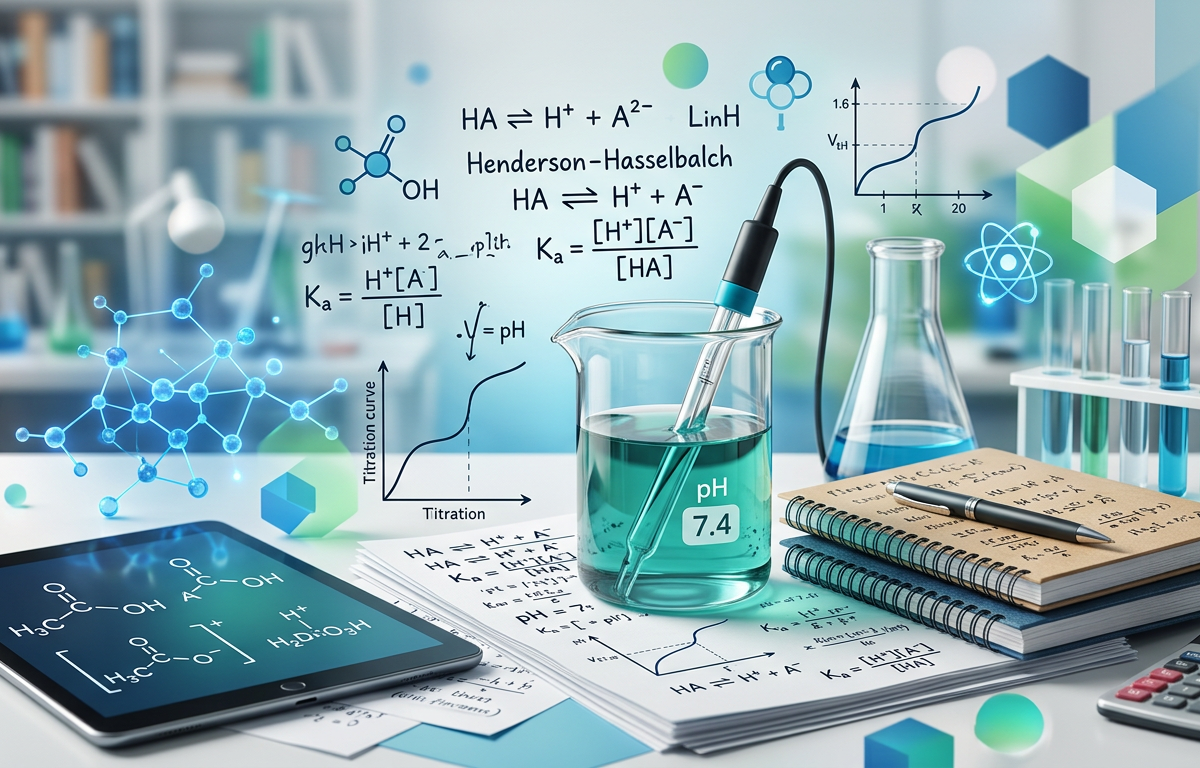
A buffer solution is a chemical system consisting of a weak acid and its conjugate base (or a weak base and its conjugate acid) that resists changes in pH when small amounts of a strong acid or base are added. These solutions work through the Le Chatelier's Principle, where the acid component neutralizes added hydroxide ions and the base component neutralizes added hydronium ions. For most calculations involving these systems, the Henderson-Hasselbalch equation is the primary tool used to relate pH, pKa, and the concentrations of the species involved.
At an advanced level, buffer problems often involve determining the buffer capacity, which is the amount of acid or base a buffer can neutralize before the pH begins to change significantly. This capacity is highest when the pH equals the pKa of the weak acid. Understanding the relationship between pKa and pKb is critical when dealing with basic buffers. According to Wikipedia, the effectiveness of a buffer is governed by the ratio of the salt to the acid; as this ratio deviates further from 1:1, the buffer becomes less effective at resisting changes in one direction.
Solved Examples
Example 1: Calculating pH after adding a strong base
A 1.0 L buffer solution contains 0.50 M acetic acid (CH₃COOH) and 0.50 M sodium acetate (CH₃COONa). Calculate the pH after 0.05 moles of NaOH are added. (Ka of acetic acid = 1.8 × 10⁻⁵).
Calculate pKa: pKa = -log(1.8 × 10⁻⁵) = 4.74.
Identify the reaction: NaOH reacts with the acid (CH₃COOH). CH₃COOH + OH⁻ → CH₃COO⁻ + H₂O.
Determine new concentrations: Acid = 0.50 - 0.05 = 0.45 M; Base = 0.50 + 0.05 = 0.55 M.
Apply Henderson-Hasselbalch: pH = 4.74 + log(0.55 / 0.45) = 4.74 + 0.087 = 4.83.
Example 2: Preparing a buffer of specific pH
How many grams of NaNO₂ (molar mass = 69.0 g/mol) must be added to 500 mL of 0.20 M HNO₂ (Ka = 4.5 × 10⁻⁴) to create a buffer with a pH of 3.50?
Find pKa: pKa = -log(4.5 × 10⁻⁴) = 3.35.
Use Henderson-Hasselbalch: 3.50 = 3.35 + log([NO₂⁻]/0.20).
Solve for [NO₂⁻]: 0.15 = log([NO₂⁻]/0.20) → 10^0.15 = [NO₂⁻]/0.20 → 1.41 = [NO₂⁻]/0.20 → [NO₂⁻] = 0.282 M.
Calculate mass: 0.282 mol/L × 0.500 L × 69.0 g/mol = 9.73 g.
Example 3: Buffer Capacity and Dilution
A buffer is made by mixing 100 mL of 1.0 M NH₃ and 100 mL of 1.0 M NH₄Cl. If the solution is diluted to 1.0 L, what is the new pH? (Kb for NH₃ = 1.8 × 10⁻⁵).
Note that dilution changes concentrations but not the ratio of base to acid.
Find pKb: pKb = 4.74. Since [NH₃] = [NH₄Cl], pOH = pKb = 4.74.
Calculate pH: pH = 14 - 4.74 = 9.26. Dilution does not change the pH of a buffer as long as the species concentrations remain significantly higher than Kw.
Practice Questions
1. Calculate the pH of a buffer solution prepared by mixing 250 mL of 0.40 M HF and 150 mL of 0.60 M NaF. (Ka for HF = 7.2 × 10⁻⁴).
2. A buffer solution is 0.25 M in formic acid (HCOOH) and 0.35 M in sodium formate (HCOONa). If 10.0 mL of 1.0 M HCl is added to 500 mL of this buffer, what is the final pH? (Ka = 1.8 × 10⁻⁴).
3. Determine the ratio of [CH₃COO⁻] to [CH₃COOH] required to create a buffer with a pH of 5.00 using acetic acid (pKa = 4.74).
Want unlimited practice questions like these?
Generate AI-powered questions with step-by-step solutions on any topic.
Try Question Generator Free →4. You need to prepare a pH 9.50 buffer using ammonia (NH₃) and ammonium chloride (NH₄Cl). If the concentration of NH₃ is 0.50 M, what must the concentration of NH₄Cl be? (Kb = 1.8 × 10⁻⁵).
5. Calculate the change in pH (ΔpH) when 0.02 moles of gaseous HCl are dissolved in 1.0 L of a buffer containing 0.10 M NH₃ and 0.10 M NH₄Cl.
6. A 500 mL solution is 0.15 M in a weak acid HA (Ka = 1.0 × 10⁻⁶). How many moles of NaA must be added to make the pH 6.30?
7. Which of the following buffer systems would be most effective for maintaining a pH of 4.50: (a) HCOOH/HCOONa (pKa = 3.74), (b) CH₃COOH/CH₃COONa (pKa = 4.74), or (c) HNO₂/NaNO₂ (pKa = 3.35)? Explain.
8. Calculate the pH of a solution formed by mixing 50.0 mL of 0.20 M NaOH with 150.0 mL of 0.30 M propanoic acid (HC₃H₅O₂, Ka = 1.3 × 10⁻⁵).
9. A buffer solution is prepared using a weak base B (Kb = 4.0 × 10⁻⁶). If the pH of the buffer is 8.50, what is the ratio of [BH⁺]/[B]?
10. An engineer needs to prepare 2.0 L of a buffer with pH 7.40 using 0.25 M NaH₂PO₄ and 0.25 M Na₂HPO₄. (For H₃PO₄, pKa₁ = 2.12, pKa₂ = 7.21, pKa₃ = 12.32). What volumes of each stock solution are required?
Answers & Explanations
1. Answer: 3.10
First, calculate moles: n(HF) = 0.250 L × 0.40 M = 0.10 mol; n(NaF) = 0.150 L × 0.60 M = 0.09 mol. pKa = -log(7.2 × 10⁻⁴) = 3.14. pH = 3.14 + log(0.09 / 0.10) = 3.14 - 0.04 = 3.10.
2. Answer: 3.82
Initial moles: n(Acid) = 0.5 L × 0.25 M = 0.125; n(Base) = 0.5 L × 0.35 M = 0.175. Added HCl = 0.01 L × 1.0 M = 0.01 mol. Reaction: Base + H⁺ → Acid. New Acid = 0.125 + 0.01 = 0.135; New Base = 0.175 - 0.01 = 0.165. pKa = 3.74. pH = 3.74 + log(0.165 / 0.135) = 3.82.
3. Answer: 1.82
Using pH = pKa + log([Base]/[Acid]): 5.00 = 4.74 + log(ratio). 0.26 = log(ratio). ratio = 10^0.26 = 1.82.
4. Answer: 0.28 M
pOH = 14 - 9.50 = 4.50. pKb = 4.74. 4.50 = 4.74 + log([NH₄⁺]/0.50). -0.24 = log([NH₄⁺]/0.50). 10^-0.24 = [NH₄⁺]/0.50. 0.575 = [NH₄⁺]/0.50. [NH₄⁺] = 0.2875 M.
5. Answer: -0.18
Initial pH: pKb = 4.74, pOH = 4.74, pH = 9.26. After HCl: n(NH₃) = 0.10 - 0.02 = 0.08; n(NH₄⁺) = 0.10 + 0.02 = 0.12. New pOH = 4.74 + log(0.12 / 0.08) = 4.74 + 0.176 = 4.916. New pH = 14 - 4.916 = 9.08. ΔpH = 9.08 - 9.26 = -0.18.
6. Answer: 0.15 moles
pH = pKa + log([A⁻]/[HA]). 6.30 = 6.0 + log([A⁻]/0.15). 0.30 = log([A⁻]/0.15). 10^0.30 = [A⁻]/0.15. 2.0 = [A⁻]/0.15. [A⁻] = 0.30 M. Moles = 0.30 M × 0.500 L = 0.15 moles.
7. Answer: (b) CH₃COOH/CH₃COONa
A buffer is most effective when the desired pH is within ±1 unit of the pKa. 4.50 is closest to 4.74 (difference of 0.24) compared to the others.
8. Answer: 4.54
Moles NaOH = 0.01; Moles Acid = 0.045. Reaction consumes all NaOH. Remaining Acid = 0.045 - 0.01 = 0.035. Formed Base = 0.01. pKa = -log(1.3 × 10⁻⁵) = 4.886. pH = 4.886 + log(0.01 / 0.035) = 4.886 - 0.544 = 4.34. (Correction: log(0.01/0.035) is -0.54, so pH = 4.34. Re-calculating: 4.886 + (-0.544) = 4.342).
9. Answer: 1.58
pOH = 14 - 8.50 = 5.50. pKb = -log(4.0 × 10⁻⁶) = 5.40. 5.50 = 5.40 + log([BH⁺]/[B]). 0.10 = log([BH⁺]/[B]). Ratio = 10^0.10 = 1.26.
10. Answer: 1.21 L of Na₂HPO₄ and 0.79 L of NaH₂PO₄
Using pKa₂ = 7.21. 7.40 = 7.21 + log([Base]/[Acid]). 0.19 = log(B/A). B/A = 1.548. Since total volume is 2.0 L and concentrations are equal, V_base + V_acid = 2.0 and V_base / V_acid = 1.548. V_base = 1.548 * V_acid. 2.548 * V_acid = 2.0 → V_acid = 0.785 L. V_base = 1.215 L.
1. What happens to the pH of a buffer solution when it is diluted slightly with distilled water?
Frequently Asked Questions
What is the buffer range of a solution?
The buffer range is the pH interval over which a buffer effectively resists changes, typically defined as pH = pKa ± 1. Outside of this range, the concentration of one component becomes too low to neutralize additional acid or base effectively.
Can a strong acid and its conjugate base form a buffer?
No, a strong acid cannot form a buffer because its conjugate base is too weak to react with added H⁺ ions. Buffers require a weak species and its conjugate to maintain an equilibrium that can shift in both directions.
How does temperature affect buffer solutions?
Temperature affects the Ka or Kb value of the weak acid or base, which in turn changes the pKa and the resulting pH of the buffer. For precise biological or chemical work, buffers must be calibrated at the specific temperature at which they will be used, as noted by Sigma-Aldrich resources.
What is the difference between pH and pKa in a buffer?
pKa is a constant property of the weak acid representing the pH at which the acid is 50% dissociated. pH is a measure of the actual hydronium ion concentration in the solution, which depends on the ratio of conjugate base to acid present.
Why is blood considered a biological buffer?
Blood uses the bicarbonate/carbonic acid system to maintain a stable pH around 7.4, which is vital for enzyme function and oxygen transport. This system allows the body to neutralize metabolic acids and bases through respiratory and renal regulation.
Want unlimited practice questions like these?
Generate AI-powered questions with step-by-step solutions on any topic.
Try Question Generator Free →
Want unlimited practice questions like these?
Generate AI-powered questions with step-by-step solutions on any topic.
Try Question Generator Free →Enjoyed this article?
Share it with others who might find it helpful.
Related Articles
Hard Le Chatelier’s Principle Practice Questions
Master Hard Le Chatelier’s Principle Practice Questions with our comprehensive guide featuring solved examples, practice problems, and detailed explanations.
Mar 30, 2026
Hard Reaction Quotient (Q) Practice Questions
Hard Reaction Quotient (Q) Practice Questions
Mar 30, 2026
Grams to Moles Practice Questions with Answers
Master grams to moles conversions with our comprehensive guide. Includes step-by-step examples, practice questions, and detailed answers for chemistry students.
Mar 26, 2026
Avogadro’s Number Practice Questions with Answers
Master the mole concept with our Avogadro’s Number practice questions. Includes step-by-step solved examples, a quick quiz, and detailed explanations.
Mar 26, 2026
Empirical Formulas: Solving Ratios from Mass and Percent Data
Master empirical formula calculations with 10 practice questions, worked answers, and a free step-by-step calculator for mass, percentage, and combustion problems.
Mar 26, 2026