Easy SAT Mixture Practice Questions
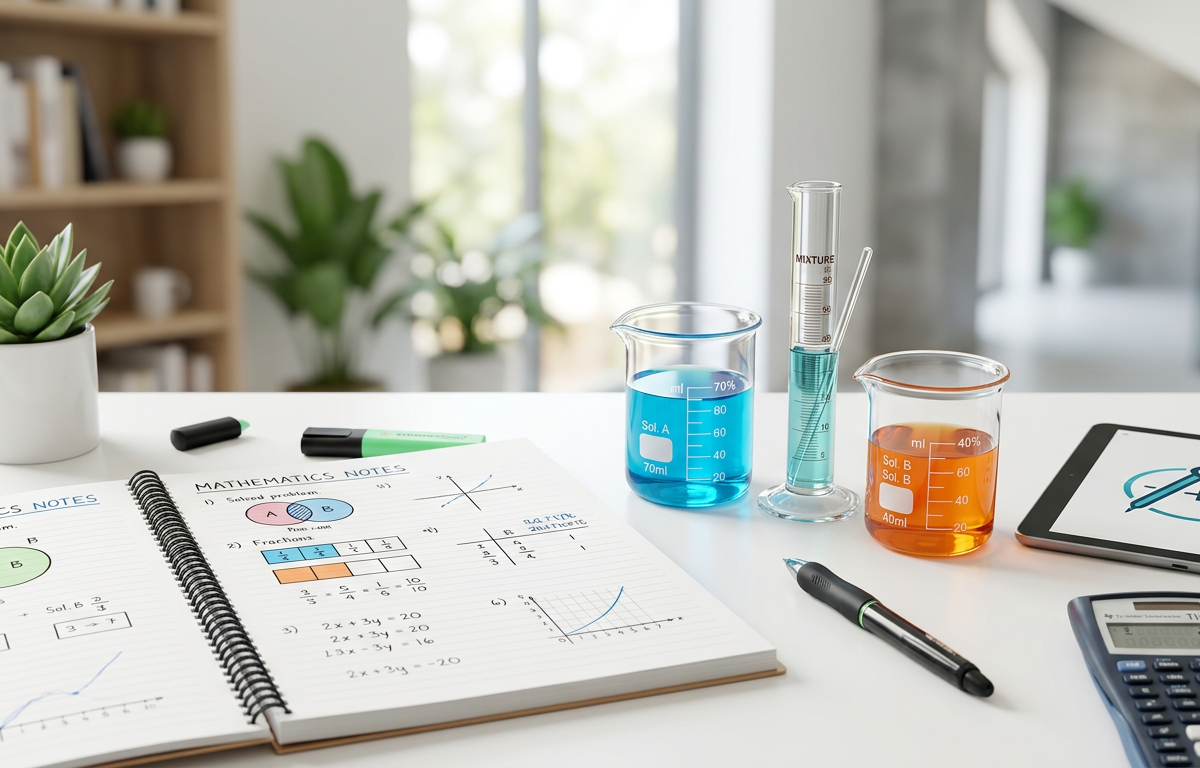
Mastering Easy SAT Mixture Practice Questions is essential for scoring high on the math section of the SAT, as these problems test your ability to combine algebraic reasoning with real-world scenarios. Whether you are dealing with chemical solutions, nut mixes, or ticket sales, the logic remains the same: the sum of the individual parts must equal the total whole.
Concept Explanation
SAT mixture problems are mathematical word problems that require you to find the concentration, quantity, or price of a final blend created by combining two or more distinct substances. These problems are fundamentally based on the principle of conservation: the total amount of a specific ingredient (like salt, sugar, or money) before mixing is exactly equal to the amount of that ingredient in the final mixture.
To solve these efficiently, you should use the general formula:
When two items are mixed, we typically set up a system of equations or a single linear equation. If you have substance and substance forming mixture , the weight/volume relationship is . The relationship for the specific component (like salt or cost) is:
Where represents the concentration or price per unit. Understanding this structure helps you transition easily to more complex topics, such as those found in Medium SAT Math Practice Questions. Success on the SAT often depends on your ability to translate these word problems into manageable algebraic expressions quickly.
Solved Examples
Review these worked examples to understand the step-by-step logic applied to basic mixture problems.
- Example 1: Chemical Concentration
A chemist has 10 liters of a solution that is 20% acid. How many liters of pure water (0% acid) must be added to create a solution that is 10% acid?- Identify the amount of acid in the original solution: .
- Let be the amount of water added. The total volume becomes .
- Since water has 0% acid, the amount of acid remains 2 liters. Set up the equation: .
- Solve for : .
- The chemist must add 10 liters of water.
- Example 2: Price Mixtures
A coffee shop owner wants to mix 5 pounds of coffee beans that cost $12 per pound with some beans that cost $8 per pound to create a blend that costs $10 per pound. How many pounds of the $8 beans are needed?- Let be the weight of the $8 beans. The total weight is .
- Calculate the total cost: .
- Simplify: .
- Rearrange: .
- The owner needs 5 pounds of the $8 beans.
- Example 3: Simple Interest/Investment
An investor puts $2,000 into an account earning 3% interest and $3,000 into an account earning 5% interest. What is the total interest earned after one year?- Calculate interest from the first account: .
- Calculate interest from the second account: .
- Add the two amounts: .
- The total interest earned is $210.
Practice Questions
Test your skills with these Easy SAT Mixture Practice Questions. If you find these straightforward, you might want to challenge yourself with Easy SAT Algebra Practice Questions to round out your skills.
1. A 50-ounce juice box contains 20% real fruit juice. How many ounces of real fruit juice are in the box?
2. A jeweler mixes 4 ounces of an alloy that is 50% gold with 6 ounces of an alloy that is 20% gold. What is the percentage of gold in the final 10-ounce mixture?
3. Tickets for a school play cost $5 for students and $8 for adults. If a group of 10 people buys tickets for a total of $62, how many student tickets were purchased?
4. How many liters of a 40% sugar solution must be added to 2 liters of pure water (0% sugar) to obtain a 10% sugar solution?
5. A trail mix contains 3 pounds of peanuts costing $4 per pound and 2 pounds of raisins costing $6 per pound. What is the cost per pound of the final mixture?
6. A scientist has 30 mL of a 15% saline solution. She adds 10 mL of a 35% saline solution. What is the concentration of the new mixture?
7. A pet store owner mixes 10 pounds of cat food worth $2 per pound with 5 pounds of cat food worth $5 per pound. What is the total value of the mixture?
8. A 12-gallon container is filled with a 25% bleach solution. If 3 gallons of the solution are replaced with 3 gallons of pure bleach (100%), what is the new percentage of bleach in the container?
Answers & Explanations
- Answer: 10 ounces
Multiply the total volume by the percentage: . - Answer: 32%
Gold in first alloy: . Gold in second: . Total gold: . Total weight: 10. Percentage: . - Answer: 6 student tickets
Let be students. Then are adults. Equation: . Simplify: . - Answer: 0.66 liters (or 2/3 liters)
Let be the liters of 40% solution. Equation: . Solve: . - Answer: $4.80
Total cost: . Total weight: . Cost per pound: . - Answer: 20%
Total saline: . Total volume: . Concentration: or 20%. - Answer: $45
Total value = . - Answer: 43.75%
Remaining solution: 9 gallons at 25% = . Added pure bleach: 3 gallons. Total bleach: . Total volume: 12. Percentage: .
1. A mixture of 20 pounds of candy costs $3.00 per pound. If it contains 5 pounds of chocolate worth $5.00 per pound and 15 pounds of gummies, what is the price per pound of the gummies?
Frequently Asked Questions
What is the most common mistake in SAT mixture problems?
The most common mistake is failing to account for the total volume or total weight when setting up the final equation. Students often forget that adding substance B to substance A increases the total amount of the mixture, which is the denominator in concentration calculations.
Do I need to memorize specific formulas for different types of mixtures?
No, you only need to understand the fundamental concept that the sum of the components equals the total. Whether it is interest rates, acid concentrations, or fruit juice, the math follows the same linear structure of .
How do I handle "pure" substances in mixture problems?
Treat pure substances as having a concentration of 100% (or 1.00) and substances like pure water as having a concentration of 0% for the solute. This allows you to use the standard mixture equation without changing your algebraic approach.
Are mixture problems common on the Digital SAT?
Yes, mixture problems frequently appear as word problems in the Heart of Algebra and Problem Solving and Data Analysis sections. They test your ability to create and solve linear equations, which is a core skill for the Easy SAT Math Practice Questions category.
Can I solve mixture problems using a table?
Many students find using a table with columns for "Amount," "Concentration/Price," and "Total Value" very helpful for organizing information. Multiplying the first two columns gives you the third, and you can then sum the rows to create your equation.
For more resources on SAT preparation, you can visit Khan Academy or check out the official College Board SAT site.
Enjoyed this article?
Share it with others who might find it helpful.
Related Articles
Hard SAT Mixture Practice Questions
Hard SAT Mixture Practice Questions
Apr 26, 2026
Medium SAT Mixture Practice Questions
Medium SAT Mixture Practice Questions
Apr 26, 2026
SAT Mixture Practice Questions with Answers
SAT Mixture Practice Questions with Answers
Apr 26, 2026
Solving High-Level SAT Integer Logic and Number Theory Problems
Hard SAT Integers Practice Questions
Apr 27, 2026

Hard SAT Number Properties Practice Questions
Hard SAT Number Properties Practice Questions
Apr 27, 2026

Defeating Extraneous Solutions and Rational Exponents on the SAT
Hard SAT Radicals Practice Questions
Apr 27, 2026

Hard SAT Exponents Practice Questions
Hard SAT Exponents Practice Questions
Apr 27, 2026

Hard SAT Percent Practice Questions
Hard SAT Percent Practice Questions
Apr 27, 2026