Hard SAT Mixture Practice Questions
Hard SAT Mixture Practice Questions
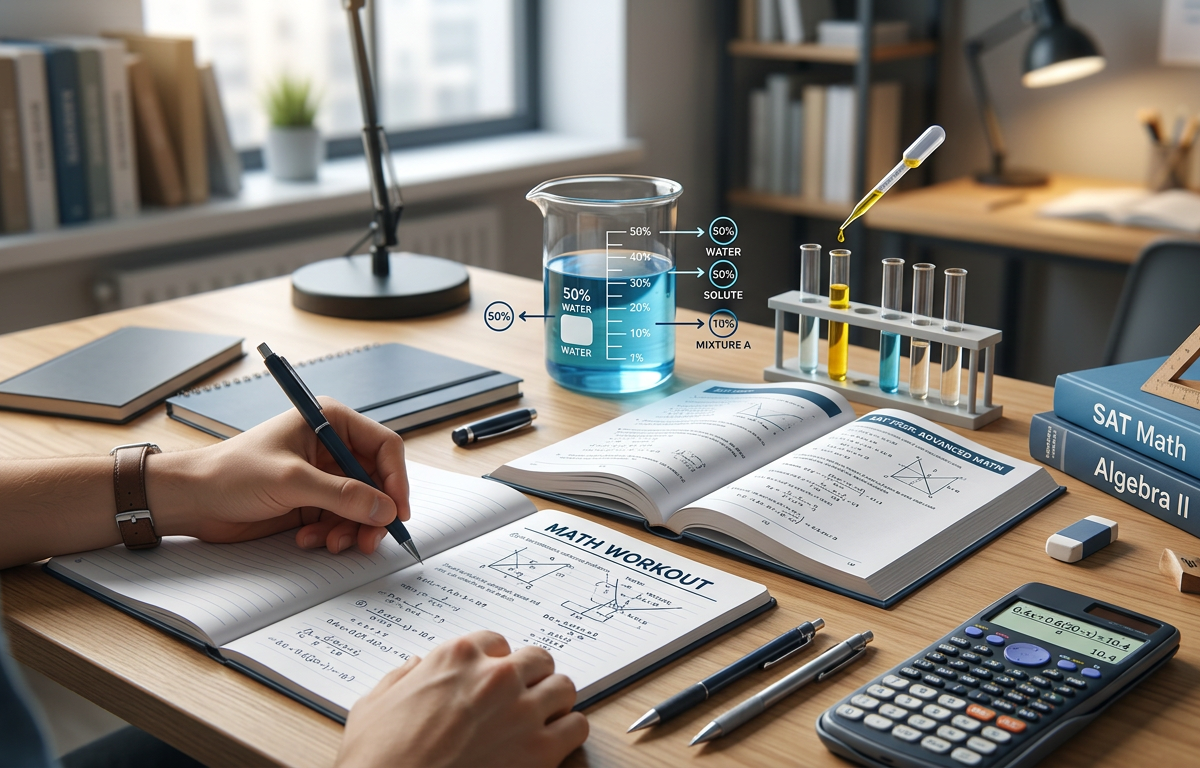
Mastering Hard SAT Mixture Practice Questions requires a combination of algebraic fluency and logical reasoning to solve problems involving the blending of different substances or values. These problems are a staple of the Heart of Algebra and Problem Solving and Data Analysis sections of the SAT, often appearing in the calculator-permitted portion. By understanding the underlying structures of weighted averages and systems of equations, you can approach even the most complex mixture word problems with confidence.
Concept Explanation
SAT mixture problems are mathematical word problems that require you to find the final concentration, volume, or cost of a substance formed by combining two or more individual components with different properties. The fundamental principle governing these problems is the Law of Conservation of Mass: the total amount of a specific ingredient (like salt, acid, or sugar) in the final mixture must equal the sum of that ingredient in the individual parts. To solve these, we typically use the formula or .
When tackling hard SAT math practice questions involving mixtures, you should follow a systematic approach:
- Identify the variables: Define what you are looking for (e.g., = gallons of solution A).
- Set up a table: Organize the data by concentration, quantity, and total amount of the specific substance.
- Create the equation: Use the relationship , where is concentration and is volume.
- Solve for the unknown: Isolate the variable using standard algebraic techniques.
According to Khan Academy's SAT prep resources, many students struggle with these because they forget that the total volume of the final mixture is the sum of the volumes of the parts. For more foundational practice, you might want to review medium SAT algebra practice questions before diving into these advanced scenarios.
Solved Examples
Example 1: A chemist has 60 milliliters of a solution that is 15% acid. How many milliliters of pure acid must be added to create a solution that is 40% acid?
- Identify variables: Let be the milliliters of pure acid added. Pure acid has a concentration of 100% or 1.0.
- Set up the equation: The amount of acid in the original solution is . The amount added is . The final volume is and the final concentration is 0.40.
- Write the equation:
- Solve:
- The chemist must add 25 milliliters of pure acid.
Example 2: A coffee shop owner wants to create a 20-pound blend of coffee that sells for $12.50 per pound. She uses Coffee A, which costs $14.00 per pound, and Coffee B, which costs $9.00 per pound. How many pounds of Coffee A should she use?
- Identify variables: Let be the pounds of Coffee A. Then is the pounds of Coffee B.
- Set up the equation: The total cost of the blend must equal the sum of the costs of the parts.
- Write the equation:
- Solve:
- She should use 14 pounds of Coffee A.
Example 3: Solution X is 20% alcohol by volume, and Solution Y is 50% alcohol by volume. If a mixture of the two solutions contains 12 liters of alcohol and has a total volume of 30 liters, how many liters of Solution X were used?
- Identify variables: Let be the liters of Solution X and be the liters of Solution Y.
- Set up a system:
- Substitute into the second equation:
- Solve:
- 10 liters of Solution X were used.
Practice Questions
1. A jeweler melts 40 grams of an 18-karat gold alloy (75% gold) with 60 grams of a 14-karat gold alloy (58% gold). What is the percentage of gold in the resulting 100-gram mixture?
2. A 5-liter container is filled with a 20% saline solution. How many liters of water (0% saline) must be evaporated to increase the concentration to 25% saline?
3. Brand A fruit punch is 10% real fruit juice, and Brand B is 25% real fruit juice. If a party host mixes 4 gallons of Brand A with some amount of Brand B to get a final mixture that is 15% real fruit juice, how many gallons of Brand B were used?
4. A nut mix sells for $8.00 per pound. It contains cashews ($12.00/lb) and peanuts ($6.00/lb). If a 30-pound batch is made, what is the weight, in pounds, of the peanuts used?
5. A radiator currently holds 4 gallons of a 25% antifreeze solution. How many gallons of a 70% antifreeze solution must be added to bring the total concentration up to 50%?
6. Two types of metal alloys, Alloy P and Alloy Q, are mixed. Alloy P is 30% copper and Alloy Q is 80% copper. If the final 50 kg mixture is 50% copper, how many more kilograms of Alloy P were used than Alloy Q?
7. A lab technician has two stocks of hydrochloric acid: Stock A (10% concentration) and Stock B (pure acid, 100%). If the technician needs to produce 9 liters of a 20% acid solution, how many liters of Stock A should be used?
8. A confectioner mixes 10 kg of candy worth $5.40/kg with 5 kg of candy worth $8.40/kg. What is the price per kilogram of the new candy mixture?
9. A pool is filled with 10,000 gallons of water containing 0.01% chlorine. Due to evaporation and refill, the owner wants to raise the chlorine level to 0.03%. How many gallons of a 5% chlorine solution should be added to the pool? (Assume the volume change is negligible for the final percentage calc or use the exact volume sum for a harder challenge; here, use the exact sum).
10. A 400-gram mixture of spices contains 15% cumin. If 50 grams of pure cumin are added and 50 grams of a non-cumin spice are added, what is the new percentage of cumin in the 500-gram mixture?
Answers & Explanations
1. Answer: 64.8%
Calculate the total gold: . Since the total mass is 100g, the percentage is .
2. Answer: 1 liter
Let be the liters of water evaporated. The amount of salt stays constant: .
.
3. Answer: 2 gallons
Let be the gallons of Brand B. Equation: .
.
4. Answer: 20 pounds
Let be the pounds of peanuts and be the pounds of cashews.
.
5. Answer: 5 gallons
Let be the gallons of 70% solution added.
.
6. Answer: 10 kg
Let be Alloy P and be Alloy Q. .
.
If , then . The difference is .
7. Answer: 8 liters
Let be Stock A. .
.
8. Answer: $6.40
Total cost: .
Total weight: .
Price per kg: .
9. Answer: 40.24 gallons
Let be the gallons of 5% solution.
.
10. Answer: 22%
Original cumin: .
New cumin: .
New total mass: .
Percentage: or 22%.
1. If 2 liters of a 10% sugar solution are mixed with 3 liters of a 20% sugar solution, what is the sugar concentration of the final mixture?
Frequently Asked Questions
What is the general formula for mixture problems?
The general formula is , where represents the concentration or price and represents the volume or quantity of each component and the final mixture. This ensures that the total amount of the specific substance remains consistent throughout the blending process.
How do I handle "pure" substances in mixture equations?
Pure substances should be treated as having a concentration of 100% or a decimal value of 1.0 in your equation. For example, if you are adding pure acid to a solution, its contribution is .
What does it mean to evaporate a solvent in a mixture problem?
Evaporation typically refers to removing the liquid (usually water) while the solute (like salt or acid) remains in the container. In your equation, this is represented by subtracting volume with a 0% concentration of the solute from the original mixture.
Can I use a system of equations for these problems?
Yes, systems of equations are often the most efficient way to solve hard SAT algebra practice questions involving mixtures. You create one equation for the total volume () and a second equation for the total amount of the specific component ().
Why is the final volume usually the sum of the parts?
In standard SAT math problems, volumes are considered additive, meaning the final volume is equal to . While real-world chemistry can sometimes result in volume contraction, the SAT assumes ideal conditions where volumes add up perfectly.
Enjoyed this article?
Share it with others who might find it helpful.
Related Articles
Medium SAT Mixture Practice Questions
Medium SAT Mixture Practice Questions
Apr 26, 2026
Easy SAT Mixture Practice Questions
Easy SAT Mixture Practice Questions
Apr 26, 2026
SAT Mixture Practice Questions with Answers
SAT Mixture Practice Questions with Answers
Apr 26, 2026
Solving High-Level SAT Integer Logic and Number Theory Problems
Hard SAT Integers Practice Questions
Apr 27, 2026

Hard SAT Number Properties Practice Questions
Hard SAT Number Properties Practice Questions
Apr 27, 2026

Defeating Extraneous Solutions and Rational Exponents on the SAT
Hard SAT Radicals Practice Questions
Apr 27, 2026

Hard SAT Exponents Practice Questions
Hard SAT Exponents Practice Questions
Apr 27, 2026

Hard SAT Percent Practice Questions
Hard SAT Percent Practice Questions
Apr 27, 2026