Predicting Reaction Direction: Q vs K Comparison Practice
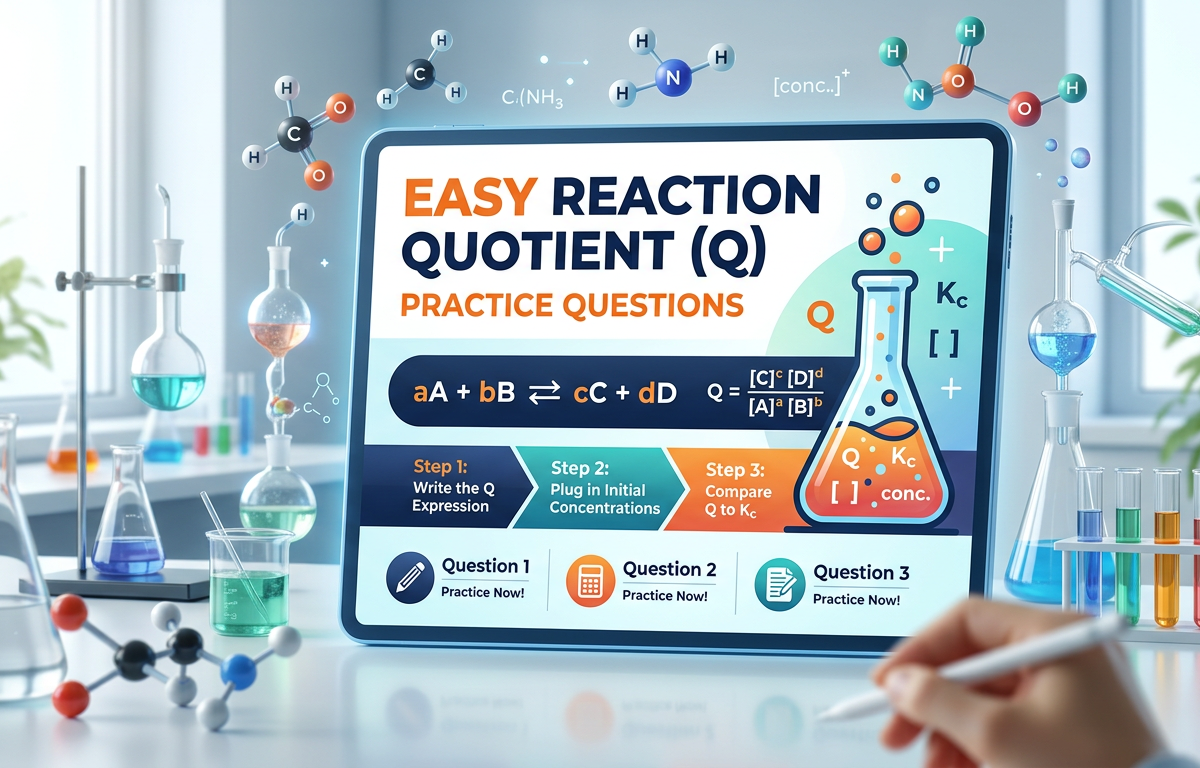
Imagine you have just injected nitrogen and hydrogen into a reactor to produce ammonia, but you aren't sure if the system is actually making product or if it has already stalled. You cannot rely on the equilibrium constant K alone because that only tells you where the reaction wants to end up, not where it is right now. This is where the reaction quotient, Q, acts as a chemical GPS. By plugging your current, real-time concentrations into the equilibrium expression, you get a numerical value that reveals exactly how far you are from the finish line.
A common pitfall occurs when students treat Q as a fixed property of the reaction. Unlike K, which is constant at a specific temperature, Q is a moving target that changes every second the reaction progresses. If you calculate a Q of 15.0 for a system where K is 50.0, the math is telling you the numerator is too small. The system must mathematically increase the concentration of products to reach balance. Mastering this comparison allows you to predict whether a flask will heat up, change color, or remain deceptively still.
Calculating and Interpreting the Quotient
The reaction quotient (Q) is a mathematical expression that describes the relative amounts of products and reactants present in a reaction at any given point in time, not just at equilibrium. By comparing the value of Q to the equilibrium constant (K), chemists can predict the direction in which a chemical reaction will shift to reach a state of balance. The formula for Q is identical in structure to the formula for K (products over reactants raised to their stoichiometric coefficients), but it uses the current concentrations or partial pressures rather than equilibrium values.
Understanding the reaction quotient is essential for mastering chemical kinetics and thermodynamics. According to Wikipedia, the reaction quotient provides a snapshot of the chemical system's progress. Here is how to interpret the relationship between Q and K:
If Q < K: The ratio of products to reactants is lower than at equilibrium. The reaction will proceed in the forward direction (to the right) to form more products.
If Q > K: The ratio of products to reactants is higher than at equilibrium. The reaction will proceed in the reverse direction (to the left) to form more reactants.
If Q = K: The system is at chemical equilibrium, and no net change in concentration will occur.
When calculating Q, remember that pure solids and liquids are excluded from the expression, as their activities are defined as one. This concept is closely related to other thermodynamic calculations, such as those found in easy enthalpy change practice questions, which help describe the energy state of a system.
Solved Examples
Below are worked examples demonstrating how to set up and solve for the reaction quotient in various scenarios.
Calculating Q for a Simple Gaseous Reaction
For the reaction N2(g) + 3H2(g) ⇌ 2NH3(g), the current concentrations are [N2] = 0.10 M, [H2] = 0.30 M, and [NH3] = 0.20 M. Calculate Q.Write the Q expression: Q = [NH3]2 / ([N2][H2]3).
Substitute the values: Q = (0.20)2 / ((0.10)(0.30)3).
Solve: Q = 0.04 / (0.10 × 0.027) = 0.04 / 0.0027 = 14.81.
Predicting Reaction Direction
A reaction has K = 50. If the calculated Q is 120, which way will the reaction shift?Compare Q and K: Q (120) > K (50).
Interpret: Since Q is greater than K, there are too many products.
Conclusion: The reaction will shift to the left (toward reactants).
Excluding Solids from Q
For the reaction CaCO3(s) ⇌ CaO(s) + CO2(g), the partial pressure of CO2 is 0.5 atm. Calculate Qp.Identify the states: CaCO3 and CaO are solids.
Write the Q expression: Qp = PCO2.
Substitute values: Qp = 0.5.
Practice Questions
Test your knowledge with these easy reaction quotient (Q) practice questions. For more foundational chemistry practice, you might also enjoy easy bond energy practice questions.
Write the reaction quotient expression (Qc) for the reaction: 2SO2(g) + O2(g) ⇌ 2SO3(g).
Given the reaction H2(g) + I2(g) ⇌ 2HI(g) with concentrations [H2] = 0.2 M, [I2] = 0.2 M, and [HI] = 0.4 M, calculate Q.
If Kc = 1.5 × 10⁻² and Qc = 1.5 × 10⁻², is the system at equilibrium?
Want unlimited practice questions like these?
Generate AI-powered questions with step-by-step solutions on any topic.
Try Question Generator Free →For the reaction 2NO(g) + Cl2(g) ⇌ 2NOCl(g), the concentrations are all 1.0 M. Calculate Q.
A reaction has K = 0.05. If Q = 0.001, which direction will the reaction shift?
Write the Q expression for AgCl(s) ⇌ Ag+(aq) + Cl-(aq).
For the reaction PCl5(g) ⇌ PCl3(g) + Cl2(g), Kc = 4.0. If [PCl5] = 0.5 M, [PCl3] = 2.0 M, and [Cl2] = 2.0 M, calculate Q and determine the shift.
If a reaction shift to the right is required to reach equilibrium, what is the relationship between Q and K?
Answers & Explanations
Answer: Q = [SO3]2 / ([SO2]2[O2])
Explanation: Q is products raised to their coefficients divided by reactants raised to theirs.Answer: 4
Explanation: Q = [HI]2 / ([H2][I2]) = (0.4)2 / (0.2 × 0.2) = 0.16 / 0.04 = 4.Answer: Yes
Explanation: When Q = K, the system has reached chemical equilibrium.Answer: 1
Explanation: Q = [NOCl]2 / ([NO]2[Cl2]) = (1.0)2 / ((1.0)2 × 1.0) = 1/1 = 1.Answer: Shift Right (Forward)
Explanation: Since Q (0.001) < K (0.05), the system needs to produce more products to reach equilibrium.Answer: Q = [Ag+][Cl-]
Explanation: AgCl is a solid and is excluded from the expression. This is similar to solubility product concepts discussed by LibreTexts Chemistry.Answer: Q = 8.0; Shift Left
Explanation: Q = (2.0 × 2.0) / 0.5 = 8.0. Since 8.0 > 4.0 (Q > K), the reaction shifts left.Answer: Q < K
Explanation: A shift to the right means products must increase, which happens when the current ratio (Q) is less than the equilibrium ratio (K).
1. What does it mean if Q is greater than K?
Frequently Asked Questions
What is the difference between Q and K?
Q represents the ratio of products to reactants at any point in time, whereas K represents that ratio only when the system is at equilibrium. They use the same mathematical formula but different concentration values.
Can Q be a negative number?
No, Q cannot be negative because concentrations and partial pressures are always zero or positive values. A value of zero for Q indicates that no products are currently present.
Why do we ignore solids in the reaction quotient?
The concentration of a pure solid or liquid is constant regardless of how much of it is present. Therefore, their activity is defined as one and they do not affect the ratio in the Q expression.
How does Q relate to Le Chatelier’s Principle?
Q is the mathematical way to apply Le Chatelier’s Principle; by comparing Q to K, we can quantitatively determine which way the system must shift to restore equilibrium. For more on related energy shifts, see easy heat of reaction practice questions.
What does a very small Q value indicate?
A very small Q value indicates that the concentration of reactants is much higher than the concentration of products. This usually means the reaction will shift forward to reach equilibrium.
Want unlimited practice questions like these?
Generate AI-powered questions with step-by-step solutions on any topic.
Try Question Generator Free →
Want unlimited practice questions like these?
Generate AI-powered questions with step-by-step solutions on any topic.
Try Question Generator Free →Enjoyed this article?
Share it with others who might find it helpful.
Related Articles

Calculating High-Stakes Meds: BSA Mosteller Formula Practice
Master hard body surface area-based dosage calculations with our comprehensive guide, solved examples, and practice questions for healthcare students.
May 17, 2026
Predicting Periodic Anomalies: Beyond Basic Trend Rules
Hard Periodic Trends Practice Questions
Apr 4, 2026
Hard Redox Reaction Practice Questions
Master complex chemistry with our Hard Redox Reaction Practice Questions. Learn to balance equations in acidic/basic media and calculate cell potentials.
Apr 4, 2026
Medium Redox Reaction Practice Questions
Master medium-level redox reaction problems with our comprehensive guide featuring solved examples, balancing tips, and practice questions for students.
Apr 4, 2026
Easy Redox Reaction Practice Questions
Master the basics of electron transfer with these easy redox reaction practice questions, featuring step-by-step solutions and clear explanations.
Apr 4, 2026
Redox Reaction Practice Questions with Answers
Master redox reactions with these practice questions and answers. Learn to identify oxidation, reduction, and balancing techniques for your chemistry exams.
Apr 3, 2026

Easy Reaction Order Practice Questions
Master chemical kinetics with these easy reaction order practice questions. Learn to calculate overall reaction orders and understand zero, first, and second-order reactions.
Apr 2, 2026
Medium Reaction Order Practice Questions
Master chemical kinetics with these medium reaction order practice questions, including step-by-step solutions, rate law calculations, and a quick quiz.
Apr 2, 2026