Easy Bond Energy Practice Questions
Concept Explanation
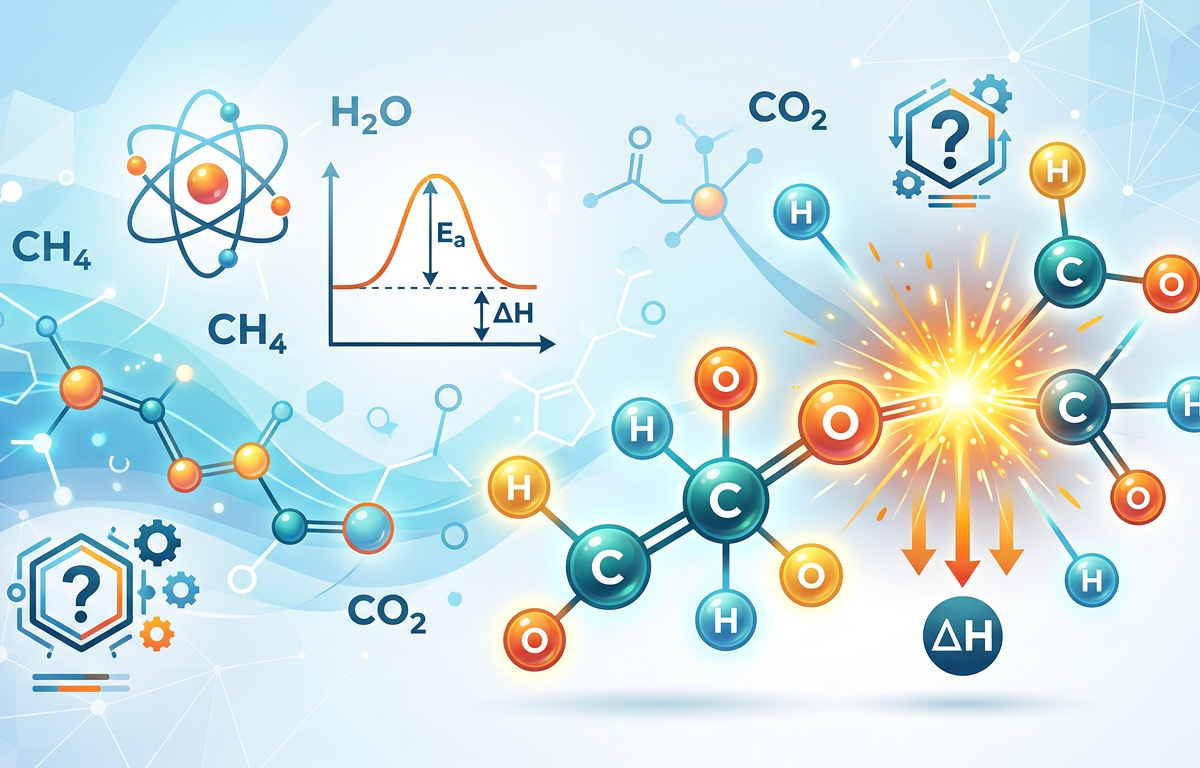
Bond energy is the measure of bond strength in a chemical bond and is defined as the amount of energy required to break one mole of a specific type of bond between two atoms in the gaseous state. It is an essential concept in thermodynamics because it allows us to estimate the enthalpy change of a chemical reaction. During a chemical reaction, energy is absorbed to break bonds in the reactants (an endothermic process) and energy is released when new bonds are formed in the products (an exothermic process). The formula for calculating the overall energy change using bond energies is:
ΔH = Σ (Bond Energies of Broken Bonds) - Σ (Bond Energies of Formed Bonds)
Because breaking bonds always requires energy, bond energy values are typically listed as positive numbers. When we use these values in calculations, we subtract the energy of the bonds formed because that energy is being released into the surroundings. Understanding this balance is critical for mastering heat of reaction practice questions. According to Wikipedia, bond energy is often referred to as bond enthalpy and is usually measured in kilojoules per mole (kJ/mol).
Solved Examples
Review these step-by-step examples to understand how to apply the bond energy formula to simple chemical reactions.
Calculate the enthalpy change for the reaction: H₂ + Cl₂ → 2HCl.
Given bond energies: H-H = 436 kJ/mol, Cl-Cl = 242 kJ/mol, H-Cl = 431 kJ/mol.
Identify bonds broken: 1 mole of H-H and 1 mole of Cl-Cl. Total = 436 + 242 = 678 kJ.
Identify bonds formed: 2 moles of H-Cl. Total = 2 × 431 = 862 kJ.
Calculate ΔH: 678 - 862 = -184 kJ. The reaction is exothermic.
Estimate the energy change for the burning of hydrogen: 2H₂ + O₂ → 2H₂O.
Given bond energies: H-H = 436 kJ/mol, O=O = 498 kJ/mol, O-H = 463 kJ/mol.
Bonds broken: 2(H-H) + 1(O=O) = 2(436) + 498 = 872 + 498 = 1370 kJ.
Bonds formed: 4(O-H) [since each H₂O has two O-H bonds] = 4 × 463 = 1852 kJ.
Calculate ΔH: 1370 - 1852 = -482 kJ.
Calculate the ΔH for the reaction of ethene with hydrogen: C₂H₄ + H₂ → C₂H₆.
Given bond energies: C=C = 614 kJ/mol, C-C = 348 kJ/mol, C-H = 413 kJ/mol, H-H = 436 kJ/mol.
Bonds broken: 1(C=C) + 4(C-H) + 1(H-H) = 614 + 4(413) + 436 = 2702 kJ.
Bonds formed: 1(C-C) + 6(C-H) = 348 + 6(413) = 2826 kJ.
Calculate ΔH: 2702 - 2826 = -124 kJ.
Practice Questions
Test your knowledge with these easy bond energy practice questions. Use the provided bond energy values for your calculations: C-H (413 kJ/mol), C-C (348 kJ/mol), O=O (498 kJ/mol), C=O (799 kJ/mol), O-H (463 kJ/mol), H-H (436 kJ/mol), N≡N (945 kJ/mol), N-H (391 kJ/mol).
Calculate the energy required to break all the bonds in 1 mole of Methane (CH₄).
A reaction has a ΔH of -100 kJ. If 500 kJ of energy was used to break the reactant bonds, how much energy was released during the formation of product bonds?
Calculate the enthalpy change for the synthesis of ammonia: N₂ + 3H₂ → 2NH₃.
Want unlimited practice questions like these?
Generate AI-powered questions with step-by-step solutions on any topic.
Try Question Generator Free →Define whether the breaking of a chemical bond is an endothermic or exothermic process.
Calculate the ΔH for the combustion of methane: CH₄ + 2O₂ → CO₂ + 2H₂O.
Which bond is stronger based on bond energy: C-C (348 kJ/mol) or C=C (614 kJ/mol)?
If a reaction releases more energy during bond formation than it absorbs during bond breaking, is it endothermic or exothermic?
Calculate the energy change for: H₂ + F₂ → 2HF. (H-H: 436, F-F: 158, H-F: 567 kJ/mol).
Explain why bond energy values are averages rather than exact figures for every molecule.
Calculate the total energy released when 2 moles of water (H₂O) are formed from gaseous atoms.
Answers & Explanations
Answer: 1652 kJ. Methane (CH₄) contains 4 C-H bonds. 4 × 413 kJ/mol = 1652 kJ.
Answer: 600 kJ. Using ΔH = Broken - Formed: -100 = 500 - Formed. Formed = 500 + 100 = 600 kJ.
Answer: -93 kJ. Broken: 1(N≡N) + 3(H-H) = 945 + 3(436) = 2253 kJ. Formed: 6(N-H) = 6(391) = 2346 kJ. ΔH = 2253 - 2346 = -93 kJ.
Answer: Endothermic. Breaking bonds always requires an input of energy from the surroundings.
Answer: -808 kJ. Broken: 4(C-H) + 2(O=O) = 4(413) + 2(498) = 1652 + 996 = 2648 kJ. Formed: 2(C=O) + 4(O-H) = 2(799) + 4(463) = 1598 + 1852 = 3450 kJ. ΔH = 2648 - 3450 = -802 kJ (Note: values may vary slightly based on specific data tables used).
Answer: C=C. A higher bond energy (614 kJ/mol) indicates a stronger bond that requires more energy to break.
Answer: Exothermic. When the energy released (products) exceeds the energy absorbed (reactants), the net energy change is negative.
Answer: -540 kJ. Broken: 436 + 158 = 594 kJ. Formed: 2 × 567 = 1134 kJ. ΔH = 594 - 1134 = -540 kJ.
Answer: Environment matters. The energy of a C-H bond can vary slightly depending on the other atoms attached to the carbon; therefore, tables provide the mean bond enthalpy.
Answer: 1852 kJ. Two moles of H₂O contains 4 moles of O-H bonds. 4 × 463 kJ/mol = 1852 kJ.
1. Which of the following describes an exothermic reaction?
Frequently Asked Questions
What is the difference between bond energy and bond dissociation energy?
Bond dissociation energy refers to the energy required to break one specific bond in a specific molecule, while bond energy is an average value for that bond type across many different molecules. For simple diatomic molecules like H₂, the two values are identical.
Why is bond breaking considered endothermic?
Bond breaking is endothermic because atoms are naturally more stable when bonded together; pulling them apart requires an input of work to overcome the electrostatic attraction between the nuclei and the shared electrons. This concept is fundamental to bond energy practice questions.
How does bond length relate to bond energy?
Generally, there is an inverse relationship where shorter bonds are stronger and have higher bond energies. For example, a C≡C triple bond is shorter and much stronger than a C-C single bond.
Can bond energy be used to find the exact ΔH of a reaction?
No, bond energy calculations provide an estimate because they use average values rather than the specific energies for those exact molecules in their specific states. For more precise results, scientists use Hess's Law or standard enthalpies of formation.
What happens to bond energy as bond polarity increases?
Usually, as the difference in electronegativity between two atoms increases, the bond becomes more polar and the bond energy increases due to the added electrostatic attraction. This is why H-F bonds are significantly stronger than H-I bonds.
Is bond energy always positive?
Yes, by convention, bond energy is expressed as a positive value because it represents the energy required to break a bond. When calculating enthalpy, we assign a negative sign to the energy of bonds being formed.
Want unlimited practice questions like these?
Generate AI-powered questions with step-by-step solutions on any topic.
Try Question Generator Free →
Want unlimited practice questions like these?
Generate AI-powered questions with step-by-step solutions on any topic.
Try Question Generator Free →Enjoyed this article?
Share it with others who might find it helpful.
Related Articles
Hard Le Chatelier’s Principle Practice Questions
Master Hard Le Chatelier’s Principle Practice Questions with our comprehensive guide featuring solved examples, practice problems, and detailed explanations.
Mar 30, 2026

Hard Reaction Quotient (Q) Practice Questions
Hard Reaction Quotient (Q) Practice Questions
Mar 30, 2026
Grams to Moles Practice Questions with Answers
Master grams to moles conversions with our comprehensive guide. Includes step-by-step examples, practice questions, and detailed answers for chemistry students.
Mar 26, 2026
Avogadro’s Number Practice Questions with Answers
Master the mole concept with our Avogadro’s Number practice questions. Includes step-by-step solved examples, a quick quiz, and detailed explanations.
Mar 26, 2026

Empirical Formulas: Solving Ratios from Mass and Percent Data
Master empirical formula calculations with 10 practice questions, worked answers, and a free step-by-step calculator for mass, percentage, and combustion problems.
Mar 26, 2026