Easy MCAT Work Energy Power Practice Questions

Easy MCAT Work Energy Power Practice Questions
Mastering the fundamentals of physics is a cornerstone of a successful medical school application, and Easy MCAT Work Energy Power Practice Questions provide the ideal starting point for your review. Understanding how energy is transferred and conserved allows you to solve complex biological problems, from blood flow dynamics to muscle contraction. This guide breaks down the essential formulas and concepts you need to score high on the Chemical and Physical Foundations of Biological Systems section.
Concept Explanation
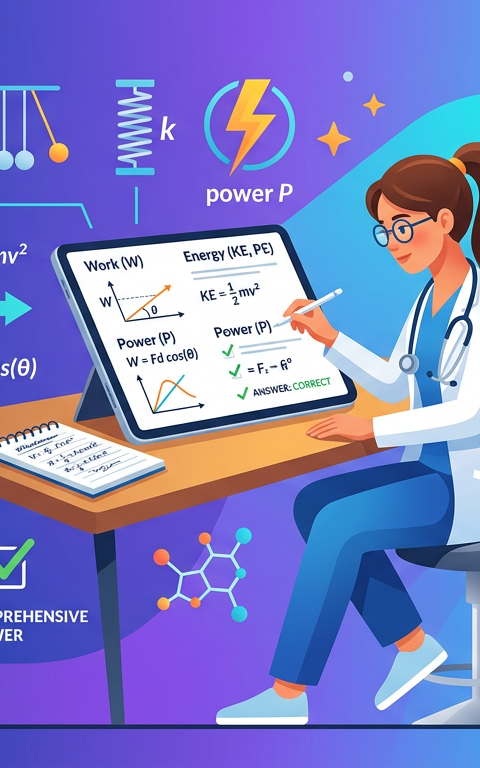
Work, energy, and power are physical quantities that describe the transfer and transformation of energy within a system. In the context of the MCAT, Work () is defined as the process by which energy is transferred from one system to another through the application of a force over a displacement, calculated as . Energy is the capacity to do work and exists in various forms, most notably Kinetic Energy () and Potential Energy (). The Work-Energy Theorem states that the net work done on an object is equal to its change in kinetic energy (). Finally, Power () is the rate at which work is performed or energy is transferred over time, expressed as or . These concepts are governed by the Law of Conservation of Energy, which dictates that in an isolated system, the total mechanical energy remains constant unless non-conservative forces like friction are present.
Solved Examples
- Calculating Work: A researcher pushes a 10 kg equipment crate across a flat laboratory floor with a constant horizontal force of 50 N. If the crate moves 4 meters, how much work was done by the researcher?
- Identify the variables: , , and (since the force is horizontal).
- Use the work formula: .
- Substitute the values: .
- Since , the work is .
- Potential Energy: A 0.5 kg IV bag is hung on a pole 2 meters above the ground. What is the gravitational potential energy of the bag relative to the floor? (Use )
- Identify the variables: , , .
- Use the potential energy formula: .
- Calculate: .
- The result is .
- Power Output: A motorized surgical table lifts a 100 kg patient 0.5 meters vertically in 5 seconds. What is the power output of the motor?
- Calculate the work done against gravity: .
- Use the power formula: .
- Substitute the values: .
- The power output is .
Practice Questions
1. A 2 kg block is slid across a frictionless surface with a force of 10 N over a distance of 5 meters. What is the work done on the block?
2. If an object's velocity doubles, by what factor does its kinetic energy increase?
3. A person performs 600 J of work in 2 minutes. What is their average power output in Watts?
Track your MCAT progress intelligently.
Use Bevinzey’s analytics and AI-powered feedback to identify weaknesses and improve faster.
See My Progress4. An elevator with a mass of 1000 kg moves upward at a constant velocity of 2 m/s. What is the power required to maintain this speed? (Use )
5. A spring with a constant is compressed by 0.1 m. How much elastic potential energy is stored in the spring? (Formula: )
6. A 5 kg object falls from a height of 10 m. Just before hitting the ground, what is its kinetic energy, assuming no air resistance?
7. A force of 20 N is applied at an angle of to the horizontal to pull a cart 10 meters. How much work is done? (Note: )
8. Which of the following is a non-conservative force: Gravity, Electrostatic force, or Friction?
9. A 1 kg ball is thrown straight up with an initial kinetic energy of 50 J. What is the maximum height it reaches?
10. How much work is done by the centripetal force on a satellite orbiting Earth in a perfect circle?
Answers & Explanations
- 50 J: Work is . Here, .
- Factor of 4: Kinetic energy is proportional to the square of velocity (). If velocity doubles (), the energy becomes times larger.
- 5 W: Power is work divided by time in seconds. . .
- 20,000 W: Using , where the force is the weight of the elevator (). .
- 1 J: .
- 500 J: By conservation of energy, the initial potential energy equals the final kinetic energy. .
- 100 J: .
- Friction: Friction is a non-conservative force because the work done depends on the path taken and energy is dissipated as heat. For more on thermodynamics, check our Easy MCAT Kinetics Practice Questions.
- 5 m: At max height, all is converted to . . Solving for gives .
- 0 J: Centripetal force is always perpendicular to the direction of motion (). Since , no work is done. This is similar to the logic used in Easy MCAT Gas Laws Practice Questions regarding pressure-volume work.
1. Which unit is equivalent to a Joule?
Frequently Asked Questions
What is the difference between conservative and non-conservative forces?
Conservative forces, like gravity and electrostatic forces, do not dissipate energy and the work done is independent of the path taken. Non-conservative forces, such as friction and air resistance, dissipate mechanical energy into thermal energy and are path-dependent. Understanding these is as vital as knowing your Easy MCAT Organic Chemistry Practice Questions.
How does the Work-Energy Theorem apply to the MCAT?
The Work-Energy Theorem () is used to relate the total work done by all forces to the change in an object's speed. It is a powerful tool for solving problems where acceleration is not constant or forces are difficult to track individually.
Why is no work done by a force acting at 90 degrees?
Work involves the transfer of energy in the direction of displacement; mathematically, equals zero. If a force is perpendicular to the motion, it changes the direction of the object but does not change its speed or kinetic energy.
What are the standard SI units for power?
The standard SI unit for power is the Watt (W), which is defined as one Joule per second (). In some MCAT passages, you may also see horsepower, but you should always convert to Watts for standard calculations.
Can work be negative?
Yes, work is negative when the force applied is in the opposite direction of the displacement, such as the work done by friction on a sliding block. This indicates that energy is being removed from the system rather than added.
Track your MCAT progress intelligently.
Use Bevinzey’s analytics and AI-powered feedback to identify weaknesses and improve faster.
See My ProgressReviewed by
Michael Danquah, MS, PhD
Dr. Michael Danquah is a professor of pharmaceutical sciences and founder of several educational technology platforms focused on improving student learning and performance.
Enjoyed this article?
Share it with others who might find it helpful.
Related Articles

Hard MCAT Work Energy Power Practice Questions
Hard MCAT Work Energy Power Practice Questions
May 17, 2026

Medium MCAT Work Energy Power Practice Questions
Medium MCAT Work Energy Power Practice Questions
May 17, 2026
MCAT Work Energy Power Practice Questions with Answers
MCAT Work Energy Power Practice Questions with Answers
May 14, 2026

Hard MCAT Philosophy Passage Practice Questions
Master Hard MCAT Philosophy Passage Practice Questions with our comprehensive guide featuring solved examples, practice questions, and expert explanations.
May 17, 2026

Hard MCAT Humanities Passage Practice Questions
Master Hard MCAT Humanities Passage Practice Questions with our comprehensive guide featuring solved examples, practice questions, and expert strategies.
May 17, 2026

Hard MCAT Critical Analysis Practice Questions
Hard MCAT Critical Analysis Practice Questions
May 17, 2026

Hard MCAT Reading Comprehension Practice Questions
Hard MCAT Reading Comprehension Practice Questions
May 17, 2026

Hard MCAT CARS Passage Practice Questions
Master high-difficulty MCAT CARS passages with our expert guide featuring solved examples, practice questions, and detailed logical analysis.
May 17, 2026