Medium MCAT Work Energy Power Practice Questions

Medium MCAT Work Energy Power Practice Questions
Mastering Medium MCAT Work Energy Power Practice Questions is essential for any pre-medical student aiming to excel in the Chemical and Physical Foundations of Biological Systems section. This topic bridges the gap between basic Newtonian mechanics and complex biological systems, such as the metabolic efficiency of muscle contraction or the fluid dynamics of blood flow. By understanding how energy is transferred and transformed, you can solve problems ranging from simple projectile motion to the work required for a heart to pump blood against a pressure gradient.
Concept Explanation
Work, energy, and power are physical quantities that describe how forces interact with objects to cause motion or changes in state. Work () is defined as the process of energy transfer that occurs when a force () is applied over a displacement (), specifically , where is the angle between the force and displacement vectors. Energy represents the capacity to do work and exists in various forms, most notably kinetic energy () and potential energy (). The Work-Energy Theorem states that the net work done on an object equals its change in kinetic energy: . Power () measures the rate at which work is done or energy is transferred, expressed as or for an object moving at a constant velocity. Conservation of mechanical energy () applies when only conservative forces, like gravity or spring forces, are acting on a system. Understanding these relationships is as fundamental to physics as mastering Medium MCAT General Chemistry Practice Questions is to the chemistry section.
Solved Examples
- Example 1: Calculating Work with Angles
A researcher pulls a 10 kg equipment crate across a flat floor by applying a 50 N force at an angle of above the horizontal. If the crate moves 4 meters, how much work is done by the researcher?
- Identify the formula for work: .
- Plug in the known values: , , and .
- Calculate: .
- The researcher does 100 Joules of work on the crate.
- Example 2: The Work-Energy Theorem
A 2 kg block is sliding on a frictionless surface at 4 m/s. A constant force is applied in the direction of motion, increasing its speed to 6 m/s. What is the net work done on the block?
- Recall the Work-Energy Theorem: .
- Calculate initial kinetic energy: .
- Calculate final kinetic energy: .
- Subtract to find work: .
- Example 3: Power and Velocity
An electric motor lifts a 50 kg mass at a constant vertical velocity of 2 m/s. What is the power output of the motor? (Assume )
- Identify the relationship between power, force, and velocity: .
- Determine the force required to lift at constant velocity (equal to weight): .
- Calculate power: (or 1 kW).
Practice Questions
1. A 0.5 kg ball is thrown vertically upward with an initial kinetic energy of 40 J. To what maximum height will the ball rise? (Use )
2. A 1500 kg car accelerates from rest to 20 m/s in 10 seconds. What is the average power delivered by the engine during this interval, ignoring air resistance?
3. A block is pushed 5 meters across a horizontal surface by a 20 N force. If the force of friction is 5 N, what is the net work done on the block?
Track your MCAT progress intelligently.
Use Bevinzey’s analytics and AI-powered feedback to identify weaknesses and improve faster.
See My Progress4. A spring with a force constant is compressed by 0.1 meters. How much elastic potential energy is stored in the spring?
5. An object moves along the x-axis under the influence of a force . How much work is done by this force as the object moves from to ?
6. A 60 kg hiker climbs a mountain path that rises 300 meters vertically. If the hiker completes the climb in 1 hour, what is their average power output in Watts? (Use )
7. A 2 kg box slides down a 5-meter long ramp inclined at . If the ramp is frictionless, what is the speed of the box at the bottom?
8. A non-conservative force does -50 J of work on a 5 kg object. If the object's initial mechanical energy was 200 J, what is its final mechanical energy?
Answers & Explanations
1. Answer: 8 meters. At the maximum height, all initial kinetic energy is converted into gravitational potential energy (). Solving for : , so .
2. Answer: 30,000 W (30 kW). Average power is the change in energy over time. First, find the final kinetic energy: . Then, .
3. Answer: 75 J. Net work is the sum of work done by all forces. . (negative because it opposes motion). .
4. Answer: 1 J. Elastic potential energy is given by . . This concept of energy storage is as precise as identifying functional groups in Medium MCAT Functional Group Practice Questions.
5. Answer: 8 J. For a variable force, work is the integral of force with respect to distance: .
6. Answer: 50 W. Work done is . Time must be in seconds: . Power .
7. Answer: 7.07 m/s (or ). The vertical height of the ramp is . Using conservation of energy: . The mass cancels out: . .
8. Answer: 150 J. The work done by non-conservative forces (like friction) equals the change in total mechanical energy (). So, . This loss of energy is common in biological systems, much like the energy shifts seen in Medium MCAT Kinetics Practice Questions.
1. If the velocity of an object is doubled, by what factor does its kinetic energy increase?
Frequently Asked Questions
What is the difference between conservative and non-conservative forces?
Conservative forces, like gravity, do work that depends only on the initial and final positions, meaning energy is conserved. Non-conservative forces, like friction, depend on the path taken and dissipate mechanical energy as heat or sound.
How does the Work-Energy Theorem apply to the MCAT?
The Work-Energy Theorem is used to relate the net force acting on a particle to its change in speed. It simplifies complex problems where tracking individual forces over time is difficult, focusing instead on initial and final states.
Why is power often measured in Watts?
The Watt is the standard SI unit defined as one Joule per second, representing the rate of energy transfer. In medical contexts, it can describe the metabolic rate or the output of medical devices like ventilators.
Can work be negative?
Yes, work is negative when the force applied is in the opposite direction of the displacement. A classic example is kinetic friction, which always does negative work to slow down a sliding object.
Is mechanical energy always conserved?
Mechanical energy is only conserved in a closed system where only conservative forces are performing work. If friction, air resistance, or internal metabolic processes are involved, total mechanical energy will change.
What is the relationship between work and pressure-volume changes?
In thermodynamics and physiology, work is often calculated as . This is particularly relevant when discussing how the lungs expand or how the heart pumps blood through the circulatory system.
Track your MCAT progress intelligently.
Use Bevinzey’s analytics and AI-powered feedback to identify weaknesses and improve faster.
See My ProgressReviewed by
Michael Danquah, MS, PhD
Dr. Michael Danquah is a professor of pharmaceutical sciences and founder of several educational technology platforms focused on improving student learning and performance.
Enjoyed this article?
Share it with others who might find it helpful.
Related Articles

Hard MCAT Work Energy Power Practice Questions
Hard MCAT Work Energy Power Practice Questions
May 17, 2026

Easy MCAT Work Energy Power Practice Questions
Easy MCAT Work Energy Power Practice Questions
May 17, 2026
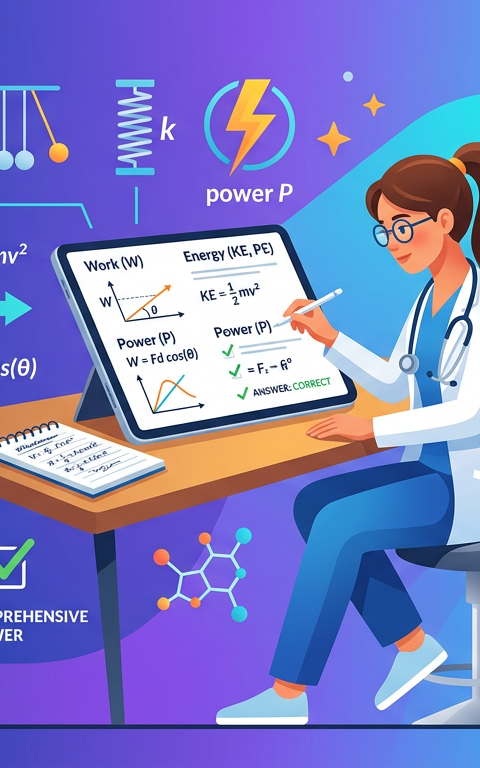
MCAT Work Energy Power Practice Questions with Answers
MCAT Work Energy Power Practice Questions with Answers
May 14, 2026

Hard MCAT Philosophy Passage Practice Questions
Master Hard MCAT Philosophy Passage Practice Questions with our comprehensive guide featuring solved examples, practice questions, and expert explanations.
May 17, 2026

Hard MCAT Humanities Passage Practice Questions
Master Hard MCAT Humanities Passage Practice Questions with our comprehensive guide featuring solved examples, practice questions, and expert strategies.
May 17, 2026

Hard MCAT Critical Analysis Practice Questions
Hard MCAT Critical Analysis Practice Questions
May 17, 2026

Hard MCAT Reading Comprehension Practice Questions
Hard MCAT Reading Comprehension Practice Questions
May 17, 2026

Hard MCAT CARS Passage Practice Questions
Master high-difficulty MCAT CARS passages with our expert guide featuring solved examples, practice questions, and detailed logical analysis.
May 17, 2026