Easy MCAT Kinetics Practice Questions
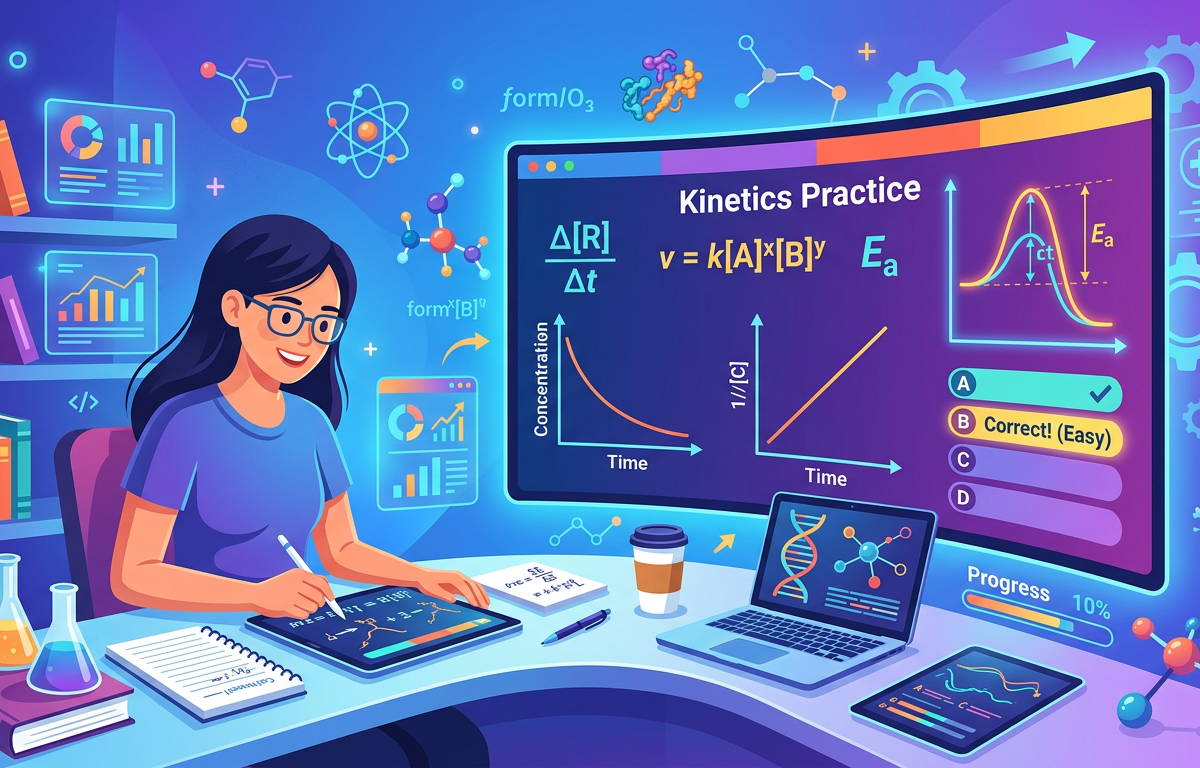
Easy MCAT Kinetics Practice Questions
Mastering chemical kinetics is a fundamental requirement for success on the Chemical and Physical Foundations of Biological Systems section of the MCAT. These Easy MCAT Kinetics Practice Questions focus on the core principles of reaction rates, rate laws, and collision theory. Understanding how molecules interact and the speed at which they transform from reactants to products allows you to predict physiological outcomes and biochemical pathways. By applying retrieval practice techniques to these foundational concepts, you can build the mental stamina required for more complex passage-based analysis later in your prep.
Concept Explanation
Chemical kinetics is the study of reaction rates and the molecular pathways, or mechanisms, by which reactions occur. Unlike thermodynamics, which tells us if a reaction is spontaneous (using ), kinetics tells us how fast that reaction will proceed. The rate of a reaction is defined as the change in concentration of a reactant or product over a period of time, typically expressed in units of or .
Several key factors influence the rate of a chemical reaction:
- Reactant Concentration: Generally, increasing the concentration of reactants increases the frequency of collisions, thereby increasing the reaction rate.
- Temperature: Raising the temperature increases the kinetic energy of molecules, leading to more frequent and more energetic collisions that exceed the activation energy ().
- Catalysts: These substances increase the reaction rate by providing an alternative pathway with a lower activation energy without being consumed in the process.
- Surface Area: For heterogeneous reactions, increasing the surface area of a solid reactant allows more contact with other reactants.
The relationship between concentration and rate is expressed through a Rate Law. For a general reaction , the rate law takes the form:
In this equation, is the rate constant, and the exponents and represent the reaction order with respect to each reactant. It is crucial to remember that these orders must be determined experimentally and are not necessarily equal to the stoichiometric coefficients in the balanced equation. Understanding these basics is a vital part of a medical student's guide to mastering chemistry. For more in-depth scientific resources, you can explore the LibreTexts Chemistry Library or the Khan Academy Kinetics modules.
Solved Examples
Example 1: Determining Reaction Rate
For the reaction , if the concentration of decreases from to in , what is the average rate of disappearance of ?
- Identify the change in concentration: .
- Identify the change in time: .
- Use the formula for rate of disappearance: .
- Calculate: .
Example 2: Calculating Overall Reaction Order
A reaction has the following rate law: . What is the overall order of the reaction?
- Look at the exponent for reactant A, which is 1 (first-order).
- Look at the exponent for reactant B, which is 2 (second-order).
- Add the exponents together: .
- The reaction is third-order overall.
Example 3: Effect of Temperature on Rate Constant
According to the Arrhenius equation, , what happens to the rate constant if the activation energy is decreased by a catalyst?
- Observe the mathematical relationship: is in the negative exponent.
- A smaller makes the term less negative (closer to zero).
- A less negative exponent results in a larger value for .
- Therefore, decreasing increases the rate constant , which speeds up the reaction.
Practice Questions
- A reaction is found to be zero-order with respect to reactant [X]. If the concentration of [X] is doubled, what happens to the rate of the reaction?
- The rate constant for a first-order reaction is . If the initial concentration of the reactant is , what is the initial rate of the reaction?
- Which of the following changes will always increase the rate of a chemical reaction: increasing the volume of the container, decreasing the temperature, or adding a catalyst?
Create your MCAT study system.
Get a personalized MCAT study experience with quizzes, active recall tools, and intelligent study guidance.
Build My Study Plan- In a certain reaction, doubling the concentration of reactant [A] quadruples the rate. What is the order of the reaction with respect to [A]?
- Identify the units of the rate constant for a second-order reaction.
- If a reaction follows the rate law , and the concentration of [A] is tripled while [B] is halved, by what factor does the rate change?
- True or False: The activation energy of the forward reaction is always equal to the activation energy of the reverse reaction.
- According to collision theory, what two conditions must be met for a collision between molecules to result in a reaction?
- In a reaction profile diagram (energy vs. reaction coordinate), what does the peak of the curve represent?
- How does an increase in temperature affect the Maxwell-Boltzmann distribution of molecular energies?
Answers & Explanations
- Answer: The rate remains unchanged.
In a zero-order reaction, the rate is independent of the concentration of the reactant: . Changing the concentration does not affect the speed. - Answer: .
For a first-order reaction, . Substituting the values: . - Answer: Adding a catalyst.
Increasing volume usually decreases concentration (slowing the rate), and decreasing temperature lowers kinetic energy (slowing the rate). A catalyst lowers the activation energy, which always increases the rate. - Answer: Second-order.
If is multiplied by 2 and the rate is multiplied by 4 (), the exponent in the rate law must be 2. - Answer: (or ).
For a second-order reaction, . Solving for gives . - Answer: (or ).
. The rate increases by a factor of 1.5. - Answer: False.
The activation energy for the forward and reverse reactions differ by the enthalpy of the reaction (). They are only equal if . - Answer: Correct orientation and sufficient energy.
Molecules must collide with the correct spatial orientation and possess kinetic energy equal to or greater than the activation energy. - Answer: The Transition State (or Activated Complex).
The peak represents the highest energy point of the reaction pathway, where old bonds are breaking and new ones are forming. - Answer: It shifts the curve to the right and flattens it.
An increase in temperature means a higher average kinetic energy and a larger fraction of molecules having high enough energy to overcome the activation energy barrier.
1. Which factor does NOT change the value of the rate constant (k)?
Frequently Asked Questions
What is the difference between reaction order and molecularity?
Reaction order is an experimentally determined exponent in the rate law, while molecularity refers to the number of molecules colliding in a single elementary step of a mechanism. While they may be the same for elementary steps, they are often different for complex, multi-step reactions.
Can a reaction rate be negative?
No, the rate of a reaction is always expressed as a positive value. While the change in concentration of a reactant is negative (disappearance), we multiply it by negative one to ensure the rate itself is positive.
How does the MCAT test kinetics differently from thermodynamics?
The MCAT tests kinetics regarding the "how fast" (speed, mechanism, catalysts) and thermodynamics regarding the "if and how much" (spontaneity, equilibrium, stability). Using retrieval practice vs practice tests can help you distinguish between these two often-confused topics.
Why does increasing temperature increase the rate constant?
Increasing temperature provides molecules with more kinetic energy, increasing the fraction of collisions that occur with energy exceeding the activation energy. This relationship is mathematically described by the Arrhenius equation.
Does a catalyst affect the equilibrium position?
No, a catalyst does not change the equilibrium constant () or the position of equilibrium. It only allows the system to reach that equilibrium faster by increasing the rates of both the forward and reverse reactions equally.
Create your MCAT study system.
Get a personalized MCAT study experience with quizzes, active recall tools, and intelligent study guidance.
Build My Study PlanReviewed by
Michael Danquah, MS, PhD
Dr. Michael Danquah is a professor of pharmaceutical sciences and founder of several educational technology platforms focused on improving student learning and performance.
Enjoyed this article?
Share it with others who might find it helpful.
Related Articles

Hard MCAT Kinetics Practice Questions
Hard MCAT Kinetics Practice Questions
May 9, 2026
Medium MCAT Kinetics Practice Questions
Medium MCAT Kinetics Practice Questions
May 9, 2026

MCAT Kinetics Practice Questions with Answers
MCAT Kinetics Practice Questions with Answers
May 9, 2026

Hard MCAT Philosophy Passage Practice Questions
Master Hard MCAT Philosophy Passage Practice Questions with our comprehensive guide featuring solved examples, practice questions, and expert explanations.
May 17, 2026

Hard MCAT Humanities Passage Practice Questions
Master Hard MCAT Humanities Passage Practice Questions with our comprehensive guide featuring solved examples, practice questions, and expert strategies.
May 17, 2026

Hard MCAT Critical Analysis Practice Questions
Hard MCAT Critical Analysis Practice Questions
May 17, 2026

Hard MCAT Reading Comprehension Practice Questions
Hard MCAT Reading Comprehension Practice Questions
May 17, 2026

Hard MCAT CARS Passage Practice Questions
Master high-difficulty MCAT CARS passages with our expert guide featuring solved examples, practice questions, and detailed logical analysis.
May 17, 2026