Easy MCAT Immune System Practice Questions
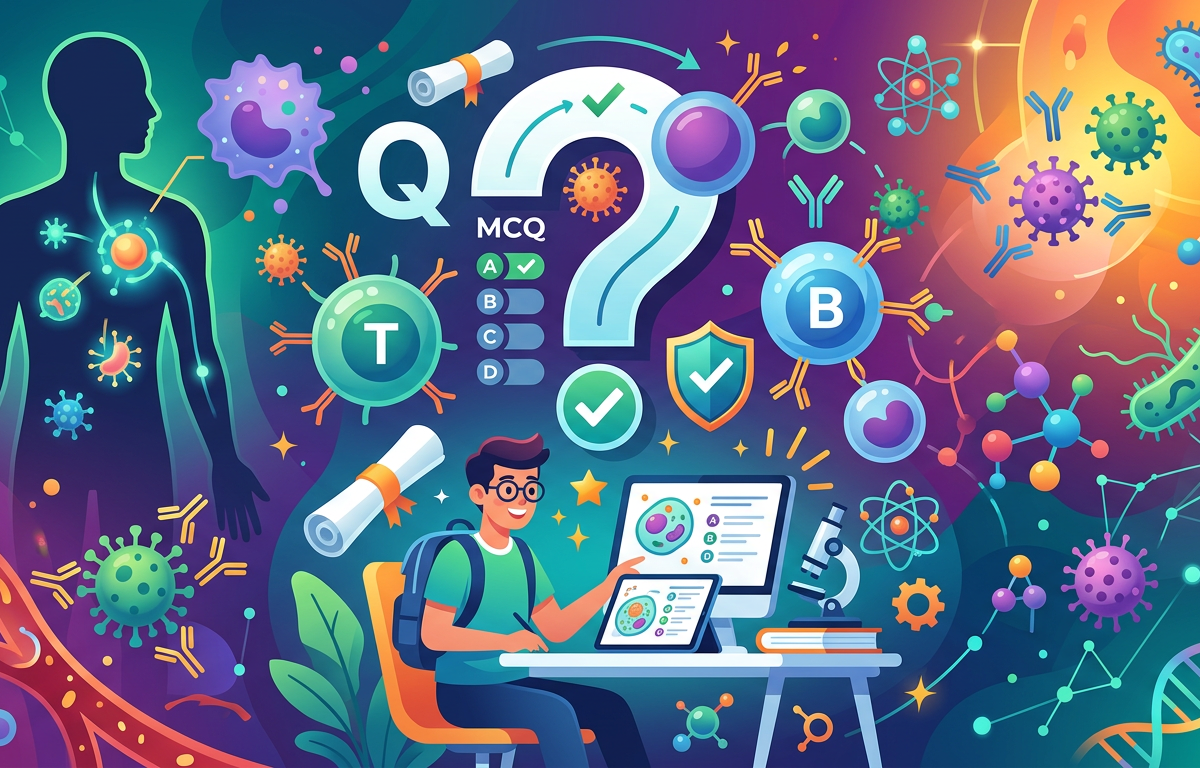
Easy MCAT Immune System Practice Questions
Mastering the fundamentals of the human body is essential for success on the Medical College Admission Test. This guide provides Easy MCAT Immune System Practice Questions designed to solidify your understanding of how the body defends itself against pathogens. Whether you are just beginning your review or looking for a quick refresher, these questions cover the foundational concepts of innate and adaptive immunity, lymphocyte function, and the inflammatory response.
Concept Explanation
The immune system is a complex network of cells, tissues, and organs that work together to protect the body from foreign invaders such as bacteria, viruses, and fungi. It is broadly categorized into two main branches: the innate (non-specific) immune system and the adaptive (specific) immune system. Understanding the distinction between these two is a high-yield topic for MCAT biology practice questions.
The innate immune system provides the first line of defense and responds to threats in a generalized manner. It includes physical barriers like the skin and mucous membranes, as well as cellular components like phagocytes (macrophages and neutrophils) and natural killer (NK) cells. This system is always active or ready to respond immediately, but it does not develop memory of specific pathogens. According to the National Institutes of Health, the innate system is crucial for containing infections during the first few days.
The adaptive immune system is more specialized and takes longer to activate. It involves B-cells and T-cells, which recognize specific antigens. B-cells are responsible for humoral immunity by producing antibodies, while T-cells manage cell-mediated immunity. A hallmark of the adaptive system is its ability to create memory cells, allowing for a faster and stronger response upon subsequent exposure to the same pathogen. This process is fundamental to how vaccines work, a topic frequently explored in medical student study guides.
Key Components of the Immune System
- Leukocytes: White blood cells that serve as the primary effectors of the immune response.
- Lymph Nodes: Small, bean-shaped structures that filter lymph and serve as sites for lymphocyte activation.
- MHC Molecules: Proteins on the cell surface that present antigens to T-cells (MHC I is on all nucleated cells; MHC II is on specialized antigen-presenting cells).
- Cytokines: Signaling molecules that coordinate the immune response and induce inflammation.
Solved Examples
-
Question: Which cell type is primarily responsible for the production of antibodies?
Solution:
- Identify the branch of immunity: Antibody production is part of humoral (adaptive) immunity.
- Recall the lymphocyte types: B-cells and T-cells.
- Differentiate functions: T-cells are involved in cell-mediated responses, while B-cells differentiate into plasma cells to secrete antibodies.
- Answer: B-lymphocytes (Plasma cells).
-
Question: During an inflammatory response, which chemical is released by mast cells to increase capillary permeability?
Solution:
- Identify the cell type: Mast cells are key players in the innate response and allergies.
- Recall the primary signaling molecule: Mast cells release histamine.
- Verify the physiological effect: Histamine causes vasodilation and increases the "leakiness" of blood vessels.
- Answer: Histamine.
-
Question: What is the primary difference between MHC I and MHC II molecules?
Solution:
- Define MHC I: Found on all nucleated cells; presents endogenous antigens to cytotoxic T-cells (CD8+).
- Define MHC II: Found only on antigen-presenting cells (macrophages, B-cells, dendritic cells); presents exogenous antigens to helper T-cells (CD4+).
- Compare: The main difference is the cell distribution and the type of T-cell they interact with.
- Answer: MHC I is on all nucleated cells, while MHC II is only on professional antigen-presenting cells.
Practice Questions
1. Which of the following is considered a primary lymphoid organ?
2. A patient is unable to produce functioning T-cells. Which branch of the immune system is most directly affected?
3. What is the role of the complement system in the innate immune response?
Need more MCAT practice questions?
Generate unlimited MCAT-style questions with instant explanations and adaptive practice powered by Bevinzey AI.
Generate Questions Free4. Which type of leukocyte is typically the first to arrive at the site of an acute bacterial infection?
5. How does the skin contribute to innate immunity?
6. Describe the function of Cytotoxic T-cells (CD8+ cells).
7. Which immunoglobulin (antibody) is the most abundant in the blood and can cross the placenta?
8. What happens during the process of clonal selection in B-cells?
9. A macrophage engulfs a bacterium and presents a piece of it on its surface. Which molecule is used for this presentation?
10. What is the main purpose of memory B-cells?
Answers & Explanations
- Answer: Bone Marrow (or Thymus). Primary lymphoid organs are where lymphocytes are produced and mature. B-cells mature in the bone marrow, and T-cells mature in the thymus. Secondary organs like the spleen and lymph nodes are where they encounter antigens.
- Answer: Adaptive (Cell-Mediated) Immunity. T-cells are the central players in cell-mediated immunity. Without them, the body cannot effectively coordinate the adaptive response or kill virally infected cells directly.
- Answer: Opsonization, inflammation, and pathogen lysis. The complement system consists of proteins in the blood that "complement" the ability of antibodies and phagocytic cells to clear microbes. They can punch holes in bacterial membranes (MAC complex) or "tag" bacteria for phagocytosis (opsonization). More details on protein interactions can be found in MCAT cell biology topics.
- Answer: Neutrophils. Neutrophils are the most abundant white blood cells and are rapid responders to bacterial infections, utilizing phagocytosis to destroy invaders.
- Answer: Physical barrier and chemical defense. The skin provides a physical wall against pathogens. Additionally, it has a low pH (acid mantle) and secretes antimicrobial peptides (defensins) that inhibit microbial growth.
- Answer: To induce apoptosis in infected or abnormal self-cells. CD8+ T-cells recognize antigens presented on MHC I. Once activated, they release perforins and granzymes to kill virally infected cells or cancer cells.
- Answer: IgG. IgG is the primary antibody found in circulation. It provides long-term immunity and is the only class capable of crossing the placenta to provide passive immunity to a fetus.
- Answer: Rapid proliferation of B-cells that recognize a specific antigen. When a B-cell's receptor binds its specific antigen, that specific cell is "selected" to divide and produce a large population of clones (plasma and memory cells) to fight that specific threat.
- Answer: MHC II. Macrophages are professional antigen-presenting cells (APCs). They use MHC II to present exogenous (captured from outside) antigens to helper T-cells.
- Answer: To provide a faster and more robust response upon re-exposure. Memory B-cells persist in the body for years. If the same pathogen enters again, these cells quickly differentiate into plasma cells, producing high levels of antibodies before the person even feels sick.
1. Which of the following is a characteristic of the innate immune system?
Frequently Asked Questions
What is the difference between active and passive immunity?
Active immunity occurs when the body's own immune system produces antibodies in response to an antigen (via infection or vaccination). Passive immunity involves the transfer of ready-made antibodies from one individual to another, such as through breast milk or anti-venom, providing immediate but temporary protection.
How do vaccines work in the context of the immune system?
Vaccines introduce a harmless version of a pathogen or its antigens to the body, triggering a primary immune response. This leads to the production of memory B and T cells that can recognize and neutralize the actual pathogen quickly if encountered in the future.
What are the four signs of inflammation?
The classic signs of inflammation are redness (rubor), heat (calor), swelling (tumor), and pain (dolor). These are caused by increased blood flow and fluid leakage into the affected tissue as the innate immune system responds to injury or infection.
What is the role of the thymus in immunity?
The thymus is a primary lymphoid organ where T-cell progenitors from the bone marrow migrate to mature. During this process, T-cells undergo "education" to ensure they can recognize foreign antigens while ignoring the body's own healthy cells.
What is an autoimmune disease?
An autoimmune disease occurs when the immune system loses the ability to distinguish between "self" and "non-self." As a result, the immune system mistakenly attacks the body's own healthy tissues, as seen in conditions like Type 1 Diabetes or Rheumatoid Arthritis.
Need more MCAT practice questions?
Generate unlimited MCAT-style questions with instant explanations and adaptive practice powered by Bevinzey AI.
Generate Questions FreeReviewed by
Michael Danquah, MS, PhD
Dr. Michael Danquah is a professor of pharmaceutical sciences and founder of several educational technology platforms focused on improving student learning and performance.
Enjoyed this article?
Share it with others who might find it helpful.
Related Articles

Hard MCAT Immune System Practice Questions
Master the complexities of the immune system with these hard MCAT practice questions covering MHC restriction, clonal selection, and the complement system.
May 9, 2026
Hard MCAT Endocrine System Practice Questions
Hard MCAT Endocrine System Practice Questions
May 9, 2026

Hard MCAT Philosophy Passage Practice Questions
Master Hard MCAT Philosophy Passage Practice Questions with our comprehensive guide featuring solved examples, practice questions, and expert explanations.
May 17, 2026

Hard MCAT Humanities Passage Practice Questions
Master Hard MCAT Humanities Passage Practice Questions with our comprehensive guide featuring solved examples, practice questions, and expert strategies.
May 17, 2026

Hard MCAT Critical Analysis Practice Questions
Hard MCAT Critical Analysis Practice Questions
May 17, 2026

Hard MCAT Reading Comprehension Practice Questions
Hard MCAT Reading Comprehension Practice Questions
May 17, 2026

Hard MCAT CARS Passage Practice Questions
Master high-difficulty MCAT CARS passages with our expert guide featuring solved examples, practice questions, and detailed logical analysis.
May 17, 2026

Hard MCAT CARS Practice Questions
Master Hard MCAT CARS Practice Questions with our comprehensive guide featuring solved examples, practice passages, and expert reasoning strategies.
May 17, 2026