Hard MCAT Endocrine System Practice Questions
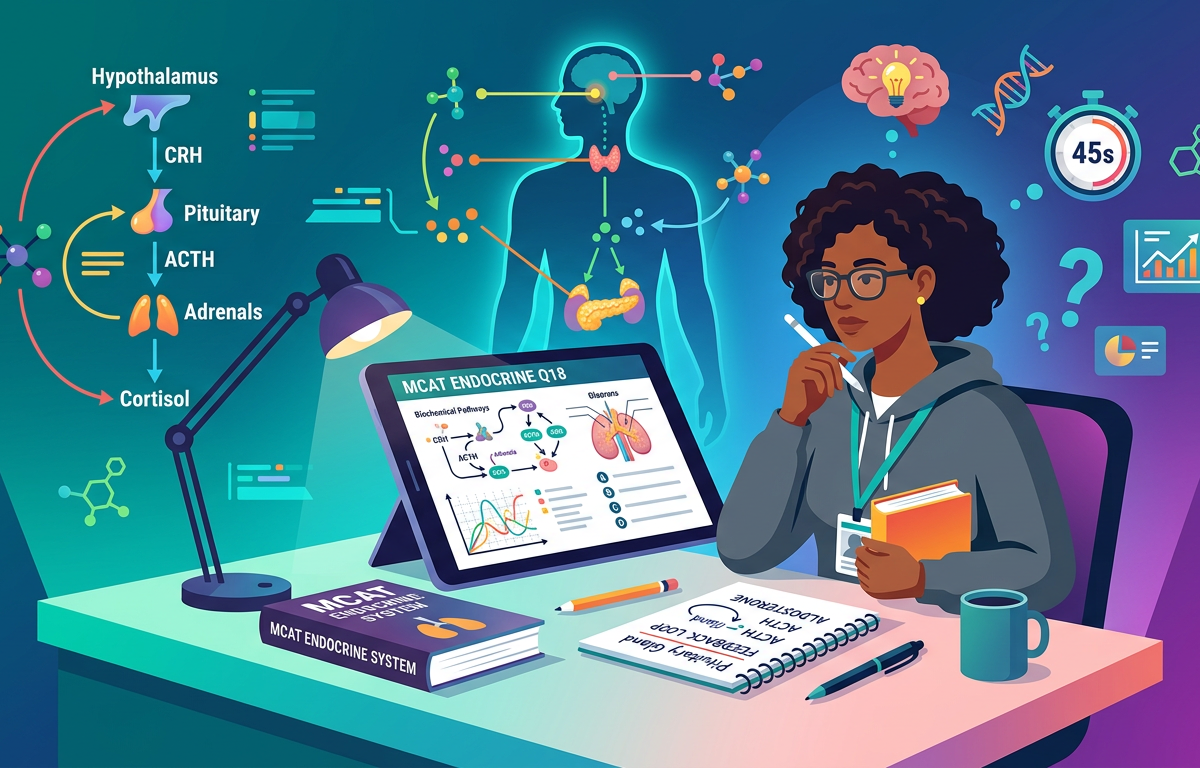
Hard MCAT Endocrine System Practice Questions
The endocrine system is a complex network of glands and organs that use hormones to control and coordinate your body's metabolism, energy level, reproduction, growth and development, and response to injury, stress, and mood. Mastering this topic is essential for success on the biology and biochemistry section of the MCAT, as it requires integrating knowledge of cell signaling, feedback loops, and physiological regulation. This guide provides Hard MCAT Endocrine System Practice Questions designed to challenge your understanding of hormone mechanisms and systemic interactions.
Concept Explanation
The endocrine system consists of ductless glands that secrete chemical messengers called hormones directly into the circulatory system to regulate distant target organs. Unlike the nervous system, which uses electrical impulses for rapid communication, the endocrine system typically exerts slower but longer-lasting effects. Hormones are generally classified into three chemical categories: peptides, steroids, and amino acid derivatives. Cell signaling mechanisms differ significantly between these groups; peptide hormones are polar and bind to extracellular receptors to trigger second messenger cascades (like cAMP or ), while steroid hormones are nonpolar, derived from cholesterol, and cross the plasma membrane to bind intracellular receptors that act as transcription factors.
A central theme in endocrine physiology is the Hypothalamic-Pituitary-Axis (HPA). The hypothalamus acts as the bridge between the nervous and endocrine systems, releasing tropic hormones that stimulate or inhibit the anterior pituitary. For instance, Gonadotropin-releasing hormone (GnRH) stimulates the release of Follicle-stimulating hormone (FSH) and Luteinizing hormone (LH). This hierarchy is governed by negative feedback loops, where the final hormone in the pathway inhibits the release of the initial signaling molecules to maintain homeostasis. Understanding these feedback mechanisms is vital for answering MCAT physiology practice questions accurately.
Solved Examples
- Problem: A patient presents with high serum cortisol levels but low levels of Adrenocorticotropic Hormone (ACTH). Where is the most likely location of a tumor?
Solution:- Identify the pathway: Hypothalamus (CRH) \u2192 Anterior Pituitary (ACTH) \u2192 Adrenal Cortex (Cortisol).
- Analyze the feedback: High cortisol should normally inhibit ACTH production via negative feedback.
- Interpret the data: Since ACTH is low, the pituitary is responding correctly to negative feedback. The excess cortisol must be coming from a source independent of ACTH stimulation.
- Conclusion: The tumor is likely in the adrenal cortex.
- Problem: Compare the mechanism of action of Insulin and Estrogen.
Solution:- Classify the hormones: Insulin is a peptide hormone; Estrogen is a steroid hormone.
- Mechanism of Insulin: Being polar, it binds to a receptor tyrosine kinase on the cell surface, initiating a phosphorylation cascade.
- Mechanism of Estrogen: Being lipophilic, it diffuses through the membrane, binds to an intracellular receptor, and the complex binds to DNA to alter gene expression.
- Key Difference: Insulin acts via second messengers; Estrogen acts via direct transcriptional regulation.
- Problem: If a person suffers from a condition that prevents the conversion of 25-hydroxyvitamin D to 1,25-dihydroxyvitamin D, what would be the effect on Calcium levels?
Solution:- Identify the active form: 1,25-dihydroxyvitamin D (Calcitriol) is the active form required for intestinal calcium absorption.
- Identify the enzyme location: The final activation step occurs in the kidneys, stimulated by Parathyroid Hormone (PTH).
- Predict the outcome: Without active Vitamin D, the body cannot absorb calcium from the gut, leading to hypocalcemia (low blood calcium).
Practice Questions
1. Which of the following hormones is synthesized in the hypothalamus but secreted by the posterior pituitary?
2. A researcher inhibits the activity of Adenylate Cyclase in a cell culture. The signaling of which of the following hormones would be most directly impaired?
3. In a state of prolonged fasting, which hormone profile would most likely be observed in a healthy individual?
Need more MCAT practice questions?
Generate unlimited MCAT-style questions with instant explanations and adaptive practice powered by Bevinzey AI.
Generate Questions Free4. Conn's syndrome involves an overproduction of aldosterone by the adrenal glands. What would be the expected physiological consequence regarding blood pressure and potassium levels?
5. An individual is unable to produce Thyroid Peroxidase, an enzyme involved in the iodination of tyrosine residues. Which hormone's levels will be elevated as a result of negative feedback?
6. How does the action of Parathyroid Hormone (PTH) on the kidneys differ from its action on the bones?
7. Somatostatin is often referred to as an inhibitory hormone. Which two pancreatic hormones does it primarily inhibit?
8. Which of the following best describes the chemical nature and transport of Epinephrine in the blood?
Answers & Explanations
1. Antidiuretic Hormone (ADH) or Oxytocin: The posterior pituitary does not synthesize hormones; it stores and releases hormones produced by the cell bodies of neurons located in the hypothalamus. This is a common point of confusion in MCAT endocrine system study.
2. Glucagon (or ACTH/Epinephrine): Peptide hormones and catecholamines often use the G-protein coupled receptor (GPCR) pathway. Adenylate cyclase converts ATP to cAMP. If this enzyme is inhibited, hormones that rely on cAMP as a second messenger cannot transmit their signal.
3. High Glucagon, High Cortisol, Low Insulin: During fasting, the body must mobilize energy stores. Glucagon promotes glycogenolysis, and cortisol promotes gluconeogenesis. Insulin is low to prevent glucose storage.
4. High Blood Pressure, Low Potassium (Hypokalemia): Aldosterone increases sodium reabsorption in the distal tubule and collecting duct. Water follows sodium, increasing blood volume/pressure. Simultaneously, it promotes the excretion of potassium into the urine.
5. Thyroid-Stimulating Hormone (TSH): Without thyroid peroxidase, and cannot be synthesized. The lack of these hormones removes the negative feedback inhibition on the anterior pituitary, leading to increased TSH secretion.
6. Kidneys: Increase Reabsorption; Bones: Increase Resorption: In the kidneys, PTH increases the reabsorption of calcium and decreases the reabsorption of phosphate. In the bones, PTH stimulates osteoclasts to break down bone matrix (resorption), releasing calcium into the blood. You can learn more about bone tissue in Wikipedia's guide to bone remodeling.
7. Insulin and Glucagon: Somatostatin is produced by delta cells of the pancreas and acts locally (paracrine signaling) to inhibit the secretion of both insulin (beta cells) and glucagon (alpha cells).
8. Amino acid derivative, Water-soluble: Epinephrine is derived from tyrosine. Unlike thyroid hormones (which are also tyrosine-derived but lipid-soluble), catecholamines like epinephrine are polar and circulate freely in the blood plasma.
1. Which of the following is a characteristic of steroid hormones?
Frequently Asked Questions
What is the difference between a tropic hormone and a direct hormone?
Tropic hormones, such as TSH or ACTH, act on other endocrine glands to stimulate the release of further hormones. Direct hormones, such as growth hormone or prolactin, act directly on non-endocrine target tissues to induce a physiological effect.
How do peptide hormones differ from steroid hormones in their transport?
Peptide hormones are water-soluble and travel freely in the blood but cannot cross cell membranes. Steroid hormones are lipid-soluble and require carrier proteins like albumin to travel in the blood, but they easily diffuse through target cell membranes.
What is the role of the hypophyseal portal system?
The hypophyseal portal system is a specialized capillary bed that allows the hypothalamus to secrete releasing and inhibiting hormones directly to the anterior pituitary. This ensures high concentrations of these hormones reach the pituitary without being diluted in the systemic circulation.
Why does the posterior pituitary not produce its own hormones?
The posterior pituitary is an extension of the hypothalamus consisting of axonal projections. It functions as a storage and release site for ADH and oxytocin, which are synthesized in the hypothalamic supraoptic and paraventricular nuclei.
How does the pancreas function as both an exocrine and endocrine gland?
The pancreas performs exocrine functions by secreting digestive enzymes into the duodenum via ducts. Its endocrine function occurs in the Islets of Langerhans, where it secretes hormones like insulin and glucagon directly into the bloodstream.
Need more MCAT practice questions?
Generate unlimited MCAT-style questions with instant explanations and adaptive practice powered by Bevinzey AI.
Generate Questions FreeReviewed by
Michael Danquah, MS, PhD
Dr. Michael Danquah is a professor of pharmaceutical sciences and founder of several educational technology platforms focused on improving student learning and performance.
Enjoyed this article?
Share it with others who might find it helpful.
Related Articles

Hard MCAT Immune System Practice Questions
Master the complexities of the immune system with these hard MCAT practice questions covering MHC restriction, clonal selection, and the complement system.
May 9, 2026

Hard MCAT Philosophy Passage Practice Questions
Master Hard MCAT Philosophy Passage Practice Questions with our comprehensive guide featuring solved examples, practice questions, and expert explanations.
May 17, 2026

Hard MCAT Humanities Passage Practice Questions
Master Hard MCAT Humanities Passage Practice Questions with our comprehensive guide featuring solved examples, practice questions, and expert strategies.
May 17, 2026

Hard MCAT Critical Analysis Practice Questions
Hard MCAT Critical Analysis Practice Questions
May 17, 2026
Hard MCAT Reading Comprehension Practice Questions
Hard MCAT Reading Comprehension Practice Questions
May 17, 2026
Hard MCAT CARS Passage Practice Questions
Master high-difficulty MCAT CARS passages with our expert guide featuring solved examples, practice questions, and detailed logical analysis.
May 17, 2026

Hard MCAT CARS Practice Questions
Master Hard MCAT CARS Practice Questions with our comprehensive guide featuring solved examples, practice passages, and expert reasoning strategies.
May 17, 2026
Hard MCAT Sensation and Perception Practice Questions
Master advanced MCAT Sensation and Perception concepts with hard practice questions, Weber's Law calculations, and detailed explanations of sensory pathways.
May 17, 2026