Easy MCAT Functional Group Practice Questions
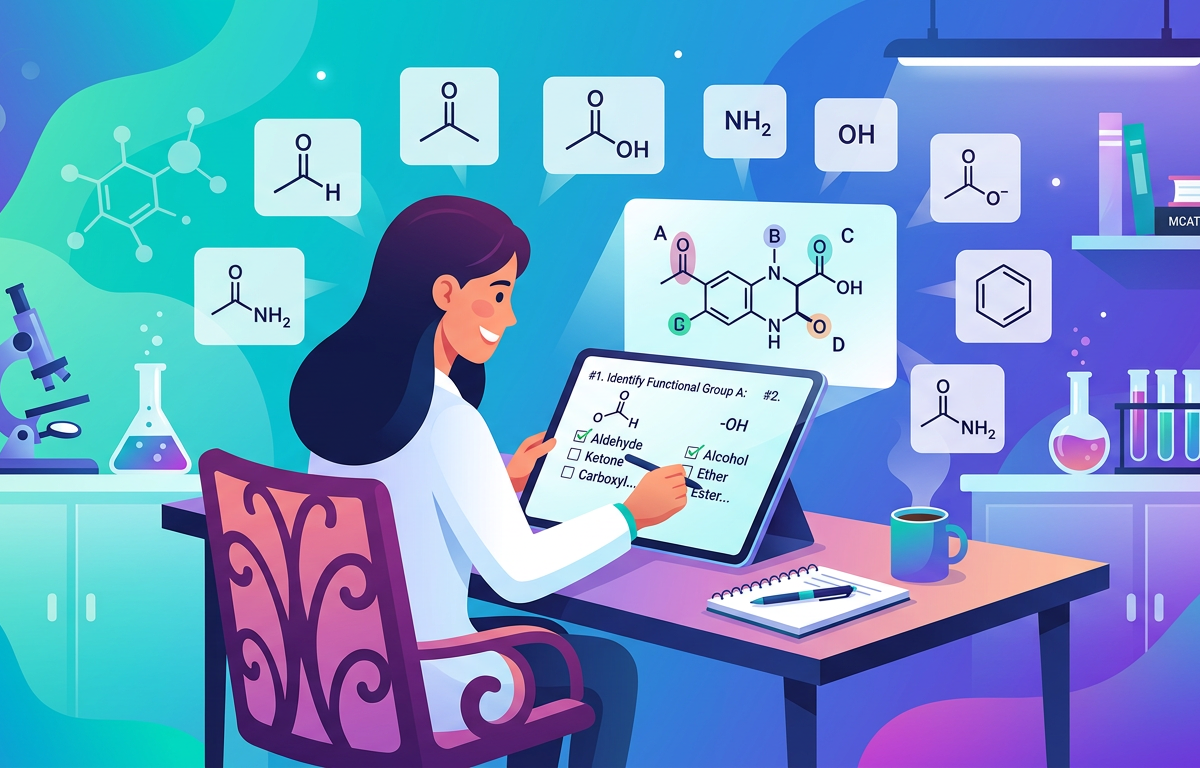
Concept Explanation
An MCAT functional group is a specific arrangement of atoms within a molecule that determines its chemical reactivity and physical properties. These groups are the building blocks of organic chemistry and biochemistry, dictating how a molecule will behave in a physiological environment. Mastering Easy MCAT Functional Group Practice Questions requires recognizing patterns of oxygen, nitrogen, and sulfur atoms bonded to carbon skeletons. For instance, the presence of a hydroxyl group () characterizes alcohols, while a carbonyl group () is the foundational unit for aldehydes, ketones, carboxylic acids, and esters. Understanding these groups is essential for the Chemical and Physical Foundations of Biological Systems section of the exam. To improve your retention of these structures, many students find that using retrieval practice for medical students is a highly effective way to move this information from short-term to long-term memory.
Key Functional Groups to Know
The MCAT frequently tests a specific set of functional groups. Below is a summary table of the most common groups encountered in easy-level practice questions:
| Group Name | Structure | Suffix/Prefix |
|---|---|---|
| Alcohol | -ol | |
| Aldehyde | -al | |
| Ketone | -one | |
| Carboxylic Acid | -oic acid | |
| Amine | -amine |
Solved Examples
- Identify the functional group in .
- Analyze the formula: We see a two-carbon chain (ethyl) attached to an group.
- Recall the definition: A hydroxyl group attached to an alkyl chain is an alcohol.
- Conclusion: The functional group is an alcohol (specifically ethanol).
- What is the difference between an aldehyde and a ketone?
- Both contain a carbonyl group ().
- In an aldehyde, the carbonyl carbon is bonded to at least one hydrogen atom (terminal position).
- In a ketone, the carbonyl carbon is bonded to two other carbon atoms (internal position).
- Conclusion: Aldehydes are , while ketones are .
- Identify the functional group in .
- Break down the structure: We see a carbonyl group () directly bonded to an oxygen which is then bonded to another carbon chain ().
- Recall the definition: An structure is an ester.
- Conclusion: The molecule is an ester (ethyl acetate).
Practice Questions
Test your knowledge with these Easy MCAT Functional Group Practice Questions. Try to identify the groups without looking at your notes first, as this form of retrieval practice is the best way to solidify your memory.
1. Which functional group is characterized by a nitrogen atom bonded to three hydrogen atoms or alkyl groups?
2. Identify the functional group present in the molecule Propanal.
3. What is the molecular geometry of the carbon atom in a carbonyl group?
Study smarter for the MCAT.
Turn practice into performance with AI-powered MCAT tools designed to help students retain more and score higher.
Start Learning Free4. Which functional group contains a sulfur atom and is often found in the amino acid cysteine?
5. Name the functional group represented by the formula .
6. Identify the primary functional group in acetic acid ().
7. What is the difference between an ether and an ester?
8. How many oxygen atoms are present in a carboxylate ion?
9. Identify the functional group in .
10. True or False: An aromatic ring (like benzene) is considered a functional group in MCAT organic chemistry.
Answers & Explanations
- Amine: An amine consists of a nitrogen atom with a lone pair, bonded to either hydrogen atoms or carbon-containing groups.
- Aldehyde: The suffix "-al" indicates an aldehyde. Propanal has a 3-carbon chain with a terminal group.
- Trigonal Planar: The carbonyl carbon is hybridized, resulting in a flat, 120-degree bond angle geometry. This is a common topic in Khan Academy's Organic Chemistry modules.
- Thiol (or Sulfhydryl): The group is known as a thiol. In cysteine, it allows for the formation of disulfide bridges.
- Amide: An amide is a carbonyl group () directly bonded to a nitrogen atom.
- Carboxylic Acid: The group defines organic acids. This is often seen in metabolic pathways like the Krebs cycle.
- Oxygen Bonding: An ether is an oxygen atom single-bonded to two carbon groups (). An ester is a carbonyl group bonded to an group ().
- Two: A carboxylate ion () has two oxygen atoms that share a negative charge through resonance.
- Ketone: This is acetone. The carbonyl group is located on the second carbon, between two methyl groups.
- True: In the context of the MCAT, an aromatic ring or "phenyl" group significantly changes the reactivity of a molecule and is treated as a functional group.
1. Which functional group is most likely to act as a weak acid in physiological pH?
Frequently Asked Questions
What is the most important functional group for the MCAT?
While all are important, the carbonyl group is arguably the most critical because it is the central feature of aldehydes, ketones, carboxylic acids, esters, and amides. Understanding its polarity and electrophilicity is key to predicting many organic reactions.
How can I memorize functional groups quickly?
The most effective method is using retrieval practice with flashcards where you draw the structure based on the name. Consistent active recall is much more effective than passive reading.
What is the difference between an amine and an amide?
An amine is a nitrogen atom bonded to carbons or hydrogens with no adjacent carbonyl group. An amide is a nitrogen atom bonded directly to a carbonyl carbon, which significantly changes its chemical properties and basicity.
Are alkanes and alkenes considered functional groups?
Yes, in organic chemistry, the type of carbon-carbon bond (single, double, or triple) defines the functional group. Alkenes () and alkynes () are more reactive than alkanes due to their pi bonds.
Why does the MCAT test functional groups so heavily?
Functional groups determine how biological molecules like proteins, lipids, and carbohydrates interact. For example, the peptide bond that holds proteins together is actually an amide functional group, a concept frequently discussed in Wikipedia's functional group overview.
Study smarter for the MCAT.
Turn practice into performance with AI-powered MCAT tools designed to help students retain more and score higher.
Start Learning FreeReviewed by
Michael Danquah, MS, PhD
Dr. Michael Danquah is a professor of pharmaceutical sciences and founder of several educational technology platforms focused on improving student learning and performance.
Enjoyed this article?
Share it with others who might find it helpful.
Related Articles

Hard MCAT Functional Group Practice Questions
Hard MCAT Functional Group Practice Questions
May 11, 2026
Medium MCAT Functional Group Practice Questions
Medium MCAT Functional Group Practice Questions
May 11, 2026

MCAT Functional Group Practice Questions with Answers
MCAT Functional Group Practice Questions with Answers
May 10, 2026

Hard MCAT Philosophy Passage Practice Questions
Master Hard MCAT Philosophy Passage Practice Questions with our comprehensive guide featuring solved examples, practice questions, and expert explanations.
May 17, 2026

Hard MCAT Humanities Passage Practice Questions
Master Hard MCAT Humanities Passage Practice Questions with our comprehensive guide featuring solved examples, practice questions, and expert strategies.
May 17, 2026

Hard MCAT Critical Analysis Practice Questions
Hard MCAT Critical Analysis Practice Questions
May 17, 2026

Hard MCAT Reading Comprehension Practice Questions
Hard MCAT Reading Comprehension Practice Questions
May 17, 2026

Hard MCAT CARS Passage Practice Questions
Master high-difficulty MCAT CARS passages with our expert guide featuring solved examples, practice questions, and detailed logical analysis.
May 17, 2026