Easy Lewis Structure Practice Questions
Concept Explanation
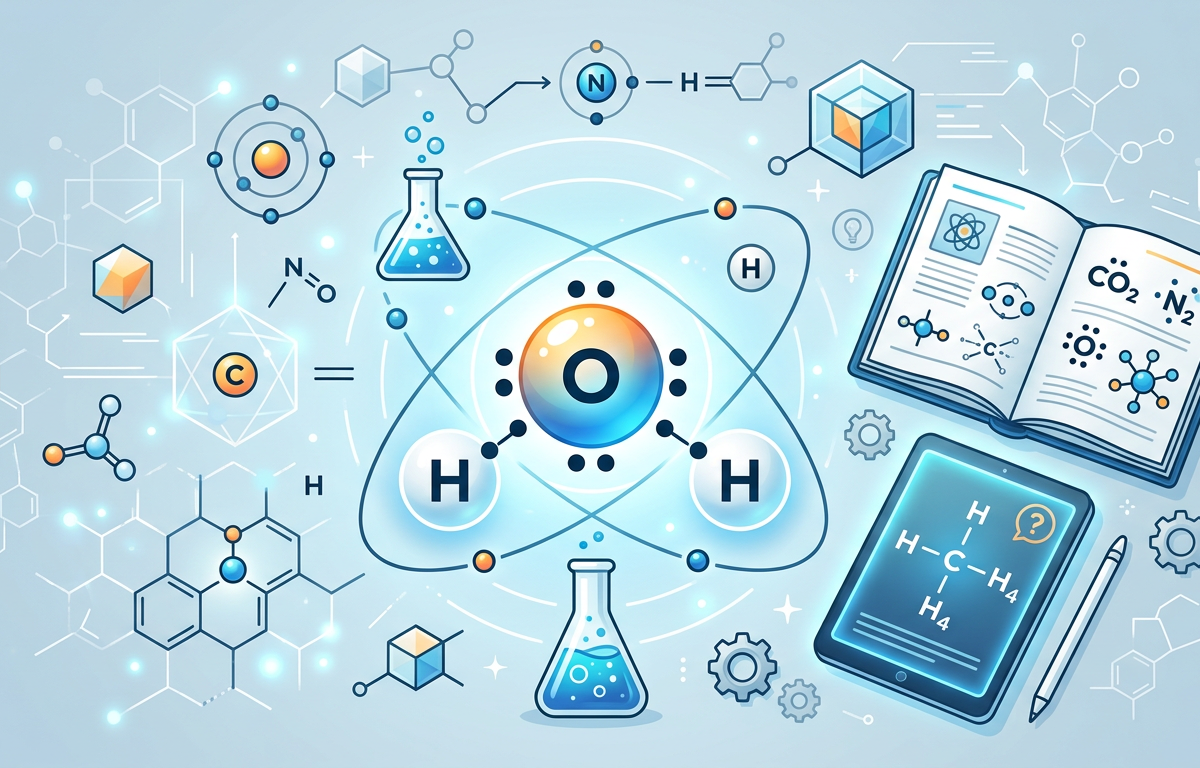
A Lewis structure is a simplified graphic representation of the distribution of valence electrons around atoms in a molecule or polyatomic ion. These diagrams, named after chemist Gilbert N. Lewis, use dots to represent individual electrons and lines to represent chemical bonds. The primary goal of drawing these structures is to satisfy the Octet Rule, which states that atoms are generally most stable when they have eight electrons in their valence shell, similar to the electron configuration of noble gases. Understanding these structures is a fundamental skill in chemistry because they provide insights into molecular geometry, reactivity, and polarity determination.
The Step-by-Step Process
Calculate Total Valence Electrons: Sum the valence electrons for every atom in the molecule. For anions, add an electron for each negative charge; for cations, subtract an electron for each positive charge.
Identify the Central Atom: Usually, the least electronegative element is the central atom (excluding hydrogen, which is always terminal).
Draw Single Bonds: Connect the outer atoms to the central atom using single lines (representing 2 electrons each).
Distribute Remaining Electrons: Fill the octets of the outer atoms first, then place any remaining electrons on the central atom.
Satisfy the Octet Rule: If the central atom does not have an octet, move lone pairs from outer atoms to form double or triple bonds.
While the octet rule is a reliable guide for most "easy" structures involving carbon, nitrogen, oxygen, and halogens, there are exceptions. Hydrogen only needs 2 electrons (a duet), and elements like Boron can often be stable with only 6. Once you master basic structures, you can explore more complex topics like hybridization or VSEPR geometry.
Solved Examples
Review these step-by-step solutions to master the basics of drawing Lewis structures.
Example 1: Water (H₂O)
Total Valence Electrons: Hydrogen has 1 (x2) and Oxygen has 6. Total = 8 electrons.
Central Atom: Oxygen is the central atom because Hydrogen cannot be central.
Bonds: Draw two single bonds (O-H). This uses 4 electrons.
Remaining Electrons: 8 - 4 = 4 electrons. Hydrogen is satisfied with 2 (duet), so place the remaining 4 electrons as two lone pairs on Oxygen.
Final Check: Oxygen has 8 electrons (4 in bonds + 4 in lone pairs). Each H has 2.
Example 2: Methane (CH₄)
Total Valence Electrons: Carbon has 4 and Hydrogen has 1 (x4). Total = 8 electrons.
Central Atom: Carbon is the central atom.
Bonds: Draw four single bonds (C-H). This uses all 8 electrons (4 bonds × 2).
Remaining Electrons: 0 electrons left.
Final Check: Carbon has an octet (4 bonds × 2 = 8). Each Hydrogen has a duet.
Example 3: Carbon Dioxide (CO₂)
Total Valence Electrons: Carbon has 4 and Oxygen has 6 (x2). Total = 16 electrons.
Central Atom: Carbon is less electronegative than Oxygen.
Bonds: Draw single bonds: O-C-O. This uses 4 electrons. Remaining = 12.
Distribute: Place 6 electrons on each Oxygen. Now all 16 are used.
Adjust for Octet: Carbon only has 4 electrons. Move one lone pair from each Oxygen to form double bonds: O=C=O. Now Carbon has 8 electrons and each Oxygen has 8.
Practice Questions
Test your knowledge with these easy Lewis structure practice questions. Grab a periodic table and a piece of paper.
1. Draw the Lewis structure for Ammonia (NH₃). How many lone pairs are on the central Nitrogen atom?
2. Determine the total number of valence electrons and draw the structure for Carbon Tetrachloride (CCl₄).
3. Draw the Lewis structure for Fluorine gas (F₂). Does it contain a single, double, or triple bond?
Want unlimited practice questions like these?
Generate AI-powered questions with step-by-step solutions on any topic.
Try Question Generator Free →4. Draw the Lewis structure for Hydrogen Chloride (HCl). How many lone pairs are on the Chlorine atom?
5. Draw the Lewis structure for Ethane (C₂H₆). Note: Both Carbons act as central atoms bonded to each other.
6. Draw the structure for the Hydroxide ion (OH⁻). Remember to account for the negative charge in your electron count.
7. Draw the Lewis structure for Boron Trifluoride (BF₃). Note: Boron is an exception to the octet rule.
8. Draw the Lewis structure for Phosphorus Trichloride (PCl₃). How many total valence electrons are in the molecule?
9. Draw the structure for Silane (SiH₄). Compare its structure to Methane (CH₄).
10. Draw the Lewis structure for Formaldehyde (CH₂O). Carbon is the central atom.
Answers & Explanations
NH₃: Total valence electrons = 5 (N) + 3 (H) = 8. Nitrogen is the central atom with 3 single bonds to H atoms. This uses 6 electrons. The remaining 2 electrons form one lone pair on the Nitrogen.
CCl₄: Total valence electrons = 4 (C) + 28 (7x4 from Cl) = 32. Carbon is central, bonded to 4 Chlorine atoms via single bonds. Each Chlorine has 3 lone pairs (6 electrons) to complete its octet.
F₂: Total valence electrons = 14 (7x2). The two Fluorine atoms are connected by a single bond. Each Fluorine atom has 3 lone pairs to satisfy the octet rule.
HCl: Total valence electrons = 1 (H) + 7 (Cl) = 8. A single bond connects H and Cl. Chlorine has 3 lone pairs (6 electrons) to reach 8, while Hydrogen is happy with its 2 electrons in the bond.
C₂H₆: Total valence electrons = 8 (C) + 6 (H) = 14. The two Carbons share a single bond. Each Carbon is then bonded to 3 Hydrogens. All 14 electrons are used in bonds, and all octets/duets are satisfied.
OH⁻: Total valence electrons = 6 (O) + 1 (H) + 1 (charge) = 8. A single bond connects O and H. Oxygen has 3 lone pairs. The entire structure is usually placed in brackets with a "-" sign.
BF₃: Total valence electrons = 3 (B) + 21 (7x3 from F) = 24. Boron is central with single bonds to 3 Fluorines. Each Fluorine has 3 lone pairs. Boron is stable with only 6 electrons in this case.
PCl₃: Total valence electrons = 5 (P) + 21 (7x3 from Cl) = 26. Phosphorus is central, bonded to 3 Chlorines. P has one lone pair, and each Cl has three lone pairs.
SiH₄: Total valence electrons = 4 (Si) + 4 (H) = 8. Silicon is central with 4 single bonds to H. It is structurally identical to Methane because Si and C are in the same group on the periodic table.
CH₂O: Total valence electrons = 4 (C) + 2 (H) + 6 (O) = 12. Carbon is central. It forms single bonds with two H atoms and a double bond with Oxygen (C=O) to ensure Carbon gets an octet. Oxygen has 2 lone pairs.
1. How many valence electrons are in the Lewis structure of Nitrogen gas (N₂)?
Frequently Asked Questions
What is the octet rule in Lewis structures?
The octet rule is a chemical rule of thumb that reflects the observation that atoms of main-group elements tend to combine in such a way that each atom has eight electrons in its valence shell. This configuration gives them the same electronic stability as a noble gas.
How do you calculate the total number of valence electrons?
To find the total valence electrons, sum the valence electrons for each individual atom based on its group number on the periodic table. For ions, add one electron for each negative charge or subtract one for each positive charge.
Why can't hydrogen be a central atom?
Hydrogen can only form one bond because it only has one electron and its valence shell (the 1s orbital) can only hold a maximum of two electrons. A central atom must be able to bond to at least two other atoms, which hydrogen cannot do.
What are lone pairs?
Lone pairs are pairs of valence electrons that are not shared with another atom in a chemical bond. They are represented as dots in Lewis structures and play a significant role in determining the shape and polarity of a molecule.
When do you need to use double or triple bonds?
Double or triple bonds are used when the central atom does not have a complete octet after all available valence electrons have been distributed as single bonds and lone pairs. Moving lone pairs from outer atoms into a bonding position provides the necessary electrons for the octet.
Want unlimited practice questions like these?
Generate AI-powered questions with step-by-step solutions on any topic.
Try Question Generator Free →
Want unlimited practice questions like these?
Generate AI-powered questions with step-by-step solutions on any topic.
Try Question Generator Free →Enjoyed this article?
Share it with others who might find it helpful.
Related Articles
Hard Le Chatelier’s Principle Practice Questions
Master Hard Le Chatelier’s Principle Practice Questions with our comprehensive guide featuring solved examples, practice problems, and detailed explanations.
Mar 30, 2026

Hard Reaction Quotient (Q) Practice Questions
Hard Reaction Quotient (Q) Practice Questions
Mar 30, 2026

Grams to Moles Practice Questions with Answers
Master grams to moles conversions with our comprehensive guide. Includes step-by-step examples, practice questions, and detailed answers for chemistry students.
Mar 26, 2026
Avogadro’s Number Practice Questions with Answers
Master the mole concept with our Avogadro’s Number practice questions. Includes step-by-step solved examples, a quick quiz, and detailed explanations.
Mar 26, 2026

Empirical Formulas: Solving Ratios from Mass and Percent Data
Master empirical formula calculations with 10 practice questions, worked answers, and a free step-by-step calculator for mass, percentage, and combustion problems.
Mar 26, 2026