VSEPR Geometry Practice Questions with Answers

Concept Explanation
VSEPR Geometry (Valence Shell Electron Pair Repulsion theory) is a model used in chemistry to predict the three-dimensional shapes of individual molecules based on the idea that electron pairs around a central atom will arrange themselves as far apart as possible to minimize electrostatic repulsion. By identifying the number of bonding pairs and lone pairs of electrons, scientists can determine the precise molecular geometry and electron-group geometry of a substance. This theory is fundamental for understanding how molecules interact, their polarity, and their physical properties, as described in detail by Wikipedia's VSEPR guide.
To determine the shape of a molecule using VSEPR, follow these steps:
Draw the Lewis structure for the molecule or ion.
Count the total number of electron groups around the central atom (a group can be a single bond, double bond, triple bond, or a lone pair).
Identify the Electron-Group Geometry based on the total number of groups (e.g., 2 = linear, 3 = trigonal planar, 4 = tetrahedral, 5 = trigonal bipyramidal, 6 = octahedral).
Determine the Molecular Geometry by looking at the arrangement of only the atoms (ignoring the visual space of lone pairs, though they still exert repulsive force).
Lone pairs occupy more space than bonding pairs, which often results in bond angles being slightly smaller than the ideal angles found in perfectly symmetrical shapes. This concept is critical when solving Ideal Gas Law (PV = nRT) practice questions or studying molecular interactions. For more foundational chemistry concepts, Khan Academy offers excellent visual tutorials on electron repulsion.
Solved Examples
Example 1: Carbon Dioxide (CO₂)
The Lewis structure shows Carbon as the central atom with two double bonds to Oxygen atoms (O=C=O).
There are 2 electron groups around the central carbon (two double bonds).
With 2 electron groups and 0 lone pairs, the electron-group geometry is linear.
The molecular geometry is also linear with a bond angle of 180°.
Example 2: Ammonia (NH₃)
The Lewis structure shows Nitrogen with three single bonds to Hydrogen and one lone pair.
There are 4 electron groups total (3 bonding pairs + 1 lone pair).
The electron-group geometry is tetrahedral.
Because one position is occupied by a lone pair, the molecular geometry is trigonal pyramidal. The bond angle is approximately 107.3°, slightly less than the ideal 109.5°.
Example 3: Sulfur Hexafluoride (SF₆)
Sulfur is the central atom with six single bonds to Fluorine atoms.
There are 6 electron groups around Sulfur.
The electron-group geometry is octahedral.
With 0 lone pairs, the molecular geometry is octahedral with bond angles of 90°.
Practice Questions
1. Determine the molecular geometry and ideal bond angle for Methane (CH₄).
2. Predict the shape and electron-group geometry of the Boron Trifluoride (BF₃) molecule.
3. Carbon Tetrachloride (CCl₄) is a common solvent. What is its molecular geometry and is it polar or non-polar?
Want unlimited practice questions like these?
Generate AI-powered questions with step-by-step solutions on any topic.
Try Question Generator Free →4. Sulfur Dioxide (SO₂) has two resonance structures. Determine its molecular geometry, accounting for its lone pair.
5. Water (H₂O) has two lone pairs on the oxygen atom. Identify its molecular geometry and explain why the bond angle is 104.5°.
6. Phosphorus Pentachloride (PCl₅) expands its octet. What is its molecular geometry and what are the two different bond angles present?
7. Identify the molecular geometry of the Xenon Tetrafluoride (XeF₄) molecule, noting that Xenon has two lone pairs in this structure.
8. Determine the shape of the Nitrite ion (NO₂⁻).
9. The molecule Chlorine Trifluoride (ClF₃) is known for being highly reactive. What is its VSEPR molecular geometry?
10. Compare the bond angles of NH₃ and PH₃. Which has a smaller bond angle and why?
Answers & Explanations
1. Methane (CH₄): Methane has 4 bonding pairs and 0 lone pairs. The electron-group geometry is tetrahedral, and the molecular geometry is tetrahedral. The ideal bond angle is 109.5°.
2. Boron Trifluoride (BF₃): Boron has 3 valence electrons and forms 3 bonds with Fluorine, leaving 0 lone pairs. The geometry is trigonal planar with 120° bond angles.
3. Carbon Tetrachloride (CCl₄): It has 4 bonding pairs and 0 lone pairs, making it tetrahedral. While C-Cl bonds are polar, the symmetrical shape causes the dipoles to cancel out, making the molecule non-polar.
4. Sulfur Dioxide (SO₂): Sulfur has 3 electron groups (2 bonding regions + 1 lone pair). The electron geometry is trigonal planar, but the molecular geometry is bent (or V-shaped). The lone pair pushes the oxygen atoms closer, resulting in an angle of about 119°.
5. Water (H₂O): Oxygen has 4 electron groups (2 bonding pairs + 2 lone pairs). The electron geometry is tetrahedral. The molecular geometry is bent. Lone pair-lone pair repulsion is stronger than bonding pair repulsion, compressing the H-O-H angle to 104.5°.
6. Phosphorus Pentachloride (PCl₅): With 5 bonding pairs and 0 lone pairs, the geometry is trigonal bipyramidal. It features 90° angles between axial and equatorial atoms, and 120° angles between equatorial atoms.
7. Xenon Tetrafluoride (XeF₄): Xenon has 6 electron groups (4 bonds + 2 lone pairs). The electron geometry is octahedral. To minimize repulsion, lone pairs sit opposite each other, resulting in a square planar molecular geometry.
8. Nitrite ion (NO₂⁻): Nitrogen is the central atom with one lone pair and two bonding regions (one single, one double). This results in a bent molecular geometry, similar to SO₂.
9. Chlorine Trifluoride (ClF₃): Chlorine has 5 electron groups (3 bonds + 2 lone pairs). The electron geometry is trigonal bipyramidal. The lone pairs occupy equatorial positions, leading to a T-shaped molecular geometry.
10. NH₃ vs PH₃: Both are trigonal pyramidal. However, PH₃ has a smaller bond angle (~93°) than NH₃ (~107°) because Phosphorus is less electronegative and larger than Nitrogen, meaning the bonding electrons are further from the nucleus and the lone pair exerts more relative pressure.
1. Which molecular geometry is associated with a central atom having 2 bonding pairs and 2 lone pairs?
Frequently Asked Questions
What is the main difference between electron-group geometry and molecular geometry?
Electron-group geometry considers the spatial arrangement of all electron groups (bonds and lone pairs) around the central atom, while molecular geometry describes only the arrangement of the atoms themselves. If no lone pairs are present, both geometries are identical.
How do lone pairs affect bond angles in VSEPR theory?
Lone pairs are more spread out in space because they are attracted to only one nucleus, whereas bonding pairs are held between two nuclei. This increased volume causes lone pairs to exert greater repulsive force, pushing adjacent bonding pairs closer together and reducing the bond angles.
Can a molecule with polar bonds be non-polar overall?
Yes, if a molecule is perfectly symmetrical, the individual bond dipoles will cancel each other out, resulting in a net dipole moment of zero. Common examples include CO₂ (linear) and CCl₄ (tetrahedral), which are non-polar despite having polar bonds.
What is the geometry of a molecule with 4 bonding pairs and 2 lone pairs?
A molecule with 6 total electron groups (4 bonds and 2 lone pairs) has an octahedral electron-group geometry and a square planar molecular geometry. The lone pairs position themselves 180 degrees apart to minimize repulsion.
Why is VSEPR theory important in biological systems?
The three-dimensional shape of molecules determines how they interact with receptors, enzymes, and other cellular components. For instance, the specific "lock and key" fit of a drug molecule into a protein depends entirely on its VSEPR-predicted geometry.
Does VSEPR apply to transition metal complexes?
VSEPR is primarily used for main-group elements; transition metal complexes often require more advanced models like Crystal Field Theory or Ligand Field Theory to account for d-orbital interactions. However, basic VSEPR can still provide a starting point for simple metal structures.
Want unlimited practice questions like these?
Generate AI-powered questions with step-by-step solutions on any topic.
Try Question Generator Free →
Want unlimited practice questions like these?
Generate AI-powered questions with step-by-step solutions on any topic.
Try Question Generator Free →Enjoyed this article?
Share it with others who might find it helpful.
Related Articles
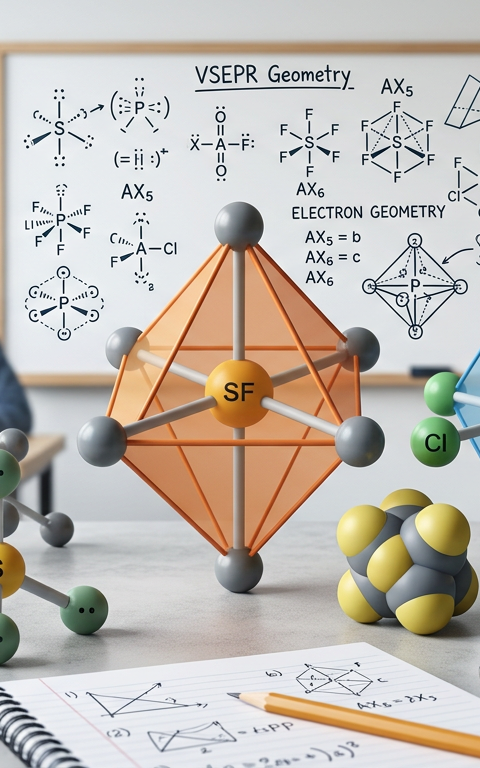
Hard VSEPR Geometry Practice Questions
Master advanced molecular shapes with our Hard VSEPR Geometry Practice Questions. Includes step-by-step solutions for expanded octets and complex ions.
Apr 4, 2026
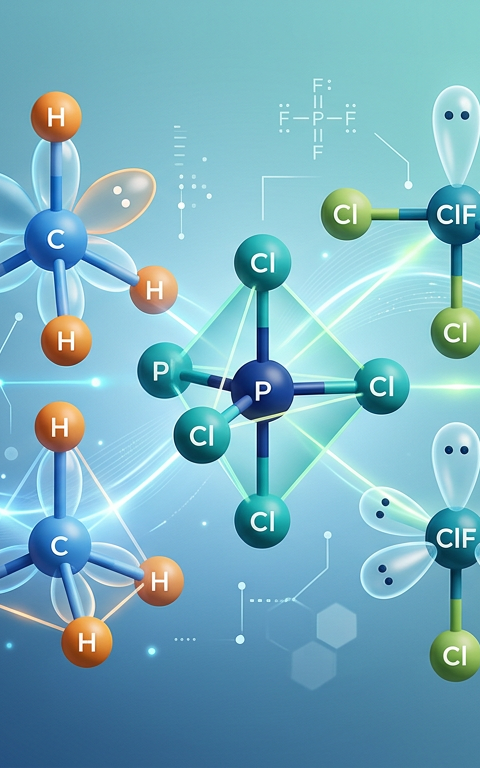
Medium VSEPR Geometry Practice Questions
Master VSEPR geometry with our medium-level practice questions. Learn to predict molecular shapes, bond angles, and electron arrangements with detailed solutions.
Apr 4, 2026

Easy VSEPR Geometry Practice Questions
Master VSEPR theory with our easy practice questions. Learn to predict molecular shapes like linear, tetrahedral, and bent with step-by-step solved examples.
Apr 4, 2026

Decimal Conversion Practice Questions with Answers
Master decimal conversion with our comprehensive guide featuring solved examples, practice questions, and a quick quiz to sharpen your math skills.
Apr 6, 2026

Fraction Practice Questions with Answers
Fraction Practice Questions with Answers
Apr 6, 2026

Solving Time-Shift Algebra: How to Model Age Ratios and Sums
Master age problems with our comprehensive guide featuring solved examples, practice questions, and detailed algebraic explanations for all levels.
Apr 6, 2026

Logarithm Practice Questions with Answers
Master logarithms with our guide featuring core concepts, solved examples, and 10 practice questions with detailed answers to help you ace your math exams.
Apr 6, 2026

Linear Equations Practice Questions with Answers
Master linear equations with our comprehensive guide featuring step-by-step solved examples, practice questions, and detailed explanations for all levels.
Apr 6, 2026