Easy Le Chatelier’s Principle Practice Questions
Concept Explanation
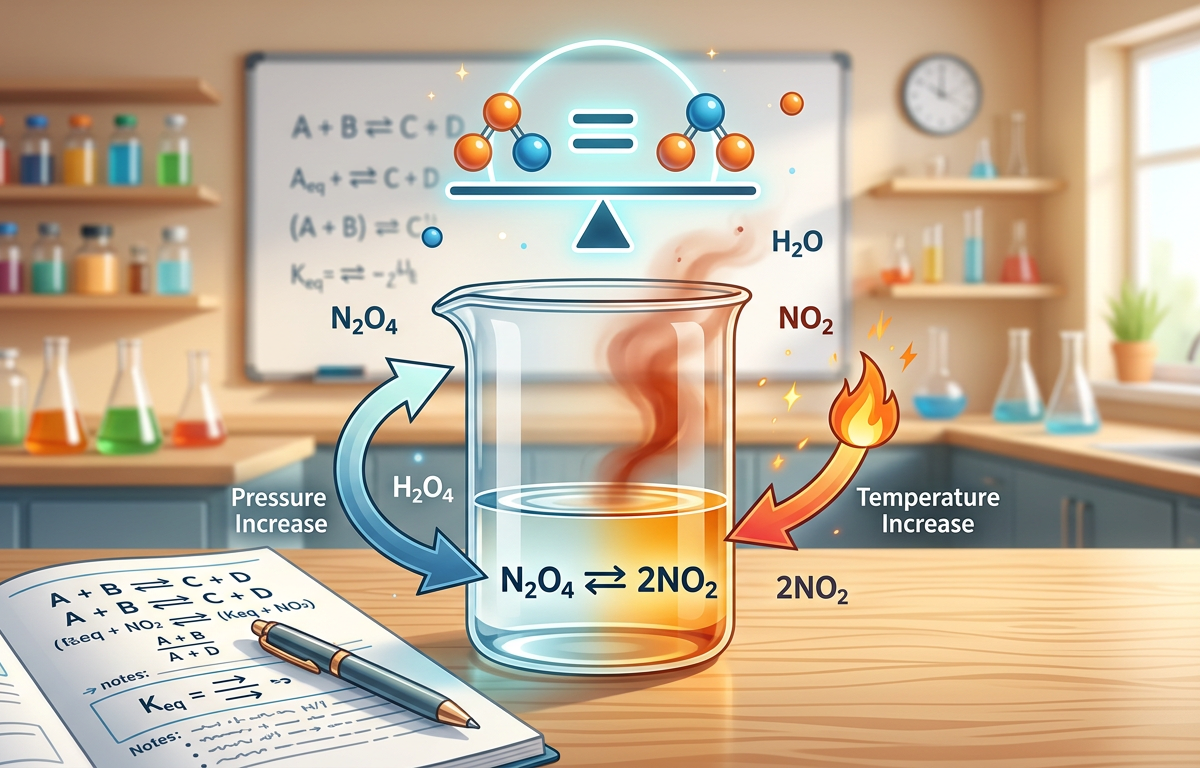
Le Chatelier’s Principle states that if a dynamic equilibrium is disturbed by changing the conditions, the position of equilibrium moves to counteract the change. This fundamental rule in chemistry allows us to predict how a system will react to shifts in concentration, temperature, or pressure. When a system at equilibrium experiences a "stress," it doesn't just sit there; it shifts its chemical composition to reach a new state of balance, effectively minimizing the impact of that stress.
Understanding this concept is essential for mastering chemical kinetics and thermodynamics. For instance, if you increase the concentration of a reactant, the system will shift to the right to produce more products. Conversely, if you remove a product, the system will also shift to the right to replace what was lost. According to the Wikipedia entry on Le Chatelier's Principle, these shifts are predictable and quantifiable using the equilibrium constant ().
There are three primary factors that influence equilibrium:
Concentration: Adding more of a substance causes the system to consume it; removing a substance causes the system to produce more of it.
Pressure/Volume: Increasing pressure (by decreasing volume) shifts the equilibrium toward the side with fewer moles of gas. Decreasing pressure shifts it toward the side with more moles of gas.
Temperature: For an exothermic reaction (where heat is a product), increasing temperature shifts the equilibrium to the left. For an endothermic reaction (where heat is a reactant), increasing temperature shifts it to the right. You can explore how these heat changes relate to Easy Enthalpy Change Practice Questions to deepen your understanding.
Solved Examples
Below are fully worked examples demonstrating how to apply Le Chatelier’s Principle to different chemical systems.
Example 1: Concentration Change
Consider the reaction: . What happens if more is added?
Identify the stress: Concentration of a reactant () is increased.
Determine the system's response: The system aims to decrease the concentration of .
Identify the shift: To consume , the reaction moves forward (to the right).
Conclusion: More will be produced.
Example 2: Pressure Change
Consider the reaction: . What happens if the volume of the container is decreased (increasing pressure)?
Count the gas moles: Reactants = 1 mole; Products = 2 moles ($1 + 1$).
Identify the stress: Increased pressure.
Determine the system's response: The system wants to lower the pressure by having fewer molecules.
Identify the shift: The reaction shifts to the left (toward the side with 1 mole).
Conclusion: The concentration of increases.
Example 3: Temperature Change
Consider the exothermic reaction: . What happens if the temperature is increased?
Identify the type of reaction: Exothermic (heat is on the product side).
Identify the stress: Increased temperature (adding heat).
Determine the system's response: The system wants to remove the extra heat.
Identify the shift: The reaction shifts to the left (the endothermic direction) to consume the heat.
Conclusion: The concentrations of $A$ and $B$ increase.
Practice Questions
Test your knowledge with these easy Le Chatelier’s Principle practice questions. Remember to look at the states of matter and the stoichiometry of the balanced equations.
1. In the reaction , what is the effect of adding more gas?
2. For the reaction $2SO_2(g) + O_2(g) ightleftharpoons 2SO_3(g) + ext{heat}$, in which direction will the equilibrium shift if the temperature is lowered?
3. If the pressure is increased in the system , which way will the equilibrium shift?
Want unlimited practice questions like these?
Generate AI-powered questions with step-by-step solutions on any topic.
Try Question Generator Free →4. In the reaction , what happens to the concentration of if the volume of the reaction vessel is increased?
5. Consider the equilibrium . If $NaCl$ is added (providing more ions), what happens to the amount of solid $AgCl$?
6. For an endothermic reaction, does increasing the temperature increase or decrease the value of the equilibrium constant ($K$)?
7. In the Haber process, , how does removing as it forms affect the yield of ammonia?
8. What effect does adding a catalyst have on the position of equilibrium for any given reaction?
9. In the reaction , how does increasing the pressure affect the equilibrium position?
10. For the reaction , what happens if more solid is added to the system?
Answers & Explanations
1. Shift to the right. Adding a reactant () causes the system to consume it by producing more products ($HI$).
2. Shift to the right. Since the reaction is exothermic, heat is a product. Lowering temperature removes heat, so the system shifts toward the product side to replace it. This is related to the concepts found in Easy Heat of Reaction Practice Questions.
3. Shift to the left. The reactant side has 1 mole of gas (), while the product side has 2 moles of gas ($CO$). Increasing pressure shifts the equilibrium toward the side with fewer gas moles.
4. Concentration of increases. Increasing volume decreases pressure. The system shifts toward the side with more moles of gas (the product side with 2 moles) to increase pressure.
5. Amount of solid $AgCl$ increases. Adding (a product) shifts the equilibrium to the left, favoring the formation of more solid precipitate.
6. Increases. For endothermic reactions, heat is treated as a reactant. Adding heat shifts the equilibrium to the right, increasing the ratio of products to reactants, thus increasing $K$.
7. Increases the yield. By continuously removing the product (), the system constantly shifts to the right to compensate, allowing more reactants to be converted.
8. No effect. A catalyst increases the rate of both the forward and reverse reactions equally. It helps the system reach equilibrium faster but does not change the final position of equilibrium.
9. No effect. Both sides of the equation have 2 moles of gas ($1+1$ on the left, $1+1$ on the right). Pressure changes only affect systems where there is a difference in the number of gas moles.
10. No effect. Adding or removing pure solids or liquids does not change the position of equilibrium, as their "concentration" or activity is constant. Only gases and aqueous solutions affect the equilibrium shift in this manner. You can see similar logic applied in Easy Ka and Kb Calculations Practice Questions when dealing with pure water.
1. Which change will always shift the equilibrium of an exothermic reaction to the left?
Frequently Asked Questions
What is the main purpose of Le Chatelier’s Principle?
The main purpose is to predict how changes in physical or chemical conditions—such as temperature, pressure, or concentration—will affect the position of a chemical equilibrium. It serves as a qualitative tool for chemists to control the yield of reactions in industrial and laboratory settings.
Does a catalyst change the equilibrium constant?
No, a catalyst does not change the equilibrium constant or the position of equilibrium. It only lowers the activation energy for both the forward and reverse reactions, allowing the system to reach the same equilibrium state more quickly than it would otherwise.
Why does pressure only affect equilibrium when gases are involved?
Pressure changes significantly affect the volume and concentration of gases because they are highly compressible, whereas solids and liquids have negligible compressibility. Therefore, a change in pressure only shifts the equilibrium if there is a change in the total number of moles of gas between reactants and products.
How does temperature affect the equilibrium constant K?
Temperature is the only factor that actually changes the value of the equilibrium constant $K$. For endothermic reactions, $K$ increases with temperature, while for exothermic reactions, $K$ decreases as temperature increases, as explained by the LibreTexts Chemistry guide.
What happens if you add an inert gas to an equilibrium system at constant volume?
Adding an inert gas (like Argon) at constant volume increases the total pressure but does not change the partial pressures of the reacting gases. Since the concentrations of the reactants and products remain unchanged, there is no shift in the equilibrium position.
Want unlimited practice questions like these?
Generate AI-powered questions with step-by-step solutions on any topic.
Try Question Generator Free →
Want unlimited practice questions like these?
Generate AI-powered questions with step-by-step solutions on any topic.
Try Question Generator Free →Enjoyed this article?
Share it with others who might find it helpful.
Related Articles
Hard Le Chatelier’s Principle Practice Questions
Master Hard Le Chatelier’s Principle Practice Questions with our comprehensive guide featuring solved examples, practice problems, and detailed explanations.
Mar 30, 2026
Hard Reaction Quotient (Q) Practice Questions
Hard Reaction Quotient (Q) Practice Questions
Mar 30, 2026
Grams to Moles Practice Questions with Answers
Master grams to moles conversions with our comprehensive guide. Includes step-by-step examples, practice questions, and detailed answers for chemistry students.
Mar 26, 2026
Avogadro’s Number Practice Questions with Answers
Master the mole concept with our Avogadro’s Number practice questions. Includes step-by-step solved examples, a quick quiz, and detailed explanations.
Mar 26, 2026
Empirical Formulas: Solving Ratios from Mass and Percent Data
Master empirical formula calculations with 10 practice questions, worked answers, and a free step-by-step calculator for mass, percentage, and combustion problems.
Mar 26, 2026