Solving PV=nRT: Why Units and Constants Trip Up Every Student

A student calculates the pressure of a gas at 25 degrees Celsius and finds a negative value or an impossibly high number. The culprit is almost always the scale. In gas laws, the math only works if you measure from absolute zero. If you plug 25 into the PV = nRT equation instead of 298.15, your entire result will be off by a factor of twelve. This is the first hurdle of the ideal gas law: the formula is simple algebra, but the units are a minefield that requires constant vigilance.
Beyond temperature, the choice of the universal gas constant, R, dictates every other unit in your calculation. If you use 0.0821, you are committed to atmospheres and liters. If you use 8.314, you are working in pascals and cubic meters. Most errors do not come from a lack of algebraic skill, but from mixing these systems. To solve these problems correctly, you must treat the units as part of the numbers, canceling them out until only the variable you need remains. The following practice set focuses on these critical conversions to ensure your setup is bulletproof before you ever touch a calculator.
Aligning Units with the Gas Constant
The Ideal Gas Law is a single equation, PV = nRT, that relates the four variables of a gas: pressure (P), volume (V), amount in moles (n), and absolute temperature (T), using the ideal gas constant (R). This equation combines several individual gas laws, including Boyle’s Law and Charles’s Law, into one comprehensive formula. It describes the behavior of a hypothetical "ideal gas" where particles do not attract each other and occupy no physical space—a model that works remarkably well for real gases at high temperatures and low pressures.
To use the formula correctly, you must ensure your units are consistent with the gas constant (R) you choose. The most common value for R is 0.0821 L·atm/(mol·K). When using this value, your units must be:
- P (Pressure): Atmospheres (atm)
- V (Volume): Liters (L)
- n (Amount): Moles (mol)
- T (Temperature): Kelvin (K)
If your data is in Celsius, always add 273.15 to convert it to Kelvin. If your pressure is in mmHg or kPa, you may need to convert it to atm or use a different R value, such as 8.314 J/(mol·K) for SI units. For more complex scenarios involving mixtures, you might also want to review Dalton’s Law Practice Questions.
Solved Examples
Here are three worked examples to demonstrate how to rearrange and solve the PV = nRT equation for different variables.
- Finding Pressure: A 2.0 mole sample of oxygen gas is confined to a 5.0 L container at a temperature of 300 K. What is the pressure of the gas?
- Identify knowns: n = 2.0 mol, V = 5.0 L, T = 300 K, R = 0.0821 L·atm/(mol·K).
- Rearrange the formula for P: P = nRT / V.
- Substitute the values: P = (2.0 mol × 0.0821 L·atm/mol·K × 300 K) / 5.0 L.
- Calculate: P = 49.26 / 5.0 = 9.85 atm.
- Finding Volume: What volume will 0.50 moles of Nitrogen gas occupy at STP (Standard Temperature and Pressure: 273 K and 1.00 atm)?
- Identify knowns: n = 0.50 mol, P = 1.00 atm, T = 273 K, R = 0.0821 L·atm/(mol·K).
- Rearrange the formula for V: V = nRT / P.
- Substitute the values: V = (0.50 mol × 0.0821 L·atm/mol·K × 273 K) / 1.00 atm.
- Calculate: V = 11.2 L.
- Finding Temperature: If 1.5 moles of a gas exert a pressure of 2.5 atm in a 10.0 L container, what is the temperature in Kelvin?
- Identify knowns: n = 1.5 mol, P = 2.5 atm, V = 10.0 L, R = 0.0821 L·atm/(mol·K).
- Rearrange the formula for T: T = PV / nR.
- Substitute the values: T = (2.5 atm × 10.0 L) / (1.5 mol × 0.0821 L·atm/mol·K).
- Calculate: T = 25 / 0.12315 = 203 K.
Practice Questions
Test your understanding with these Easy Ideal Gas Law (PV = nRT) Practice Questions. Remember to convert all temperatures to Kelvin before calculating.
- A 3.50 L flask contains 0.45 moles of Neon gas at 298 K. What is the pressure inside the flask (in atm)?
- How many moles of gas are contained in a 2.0 L balloon at a pressure of 1.10 atm and a temperature of 25°C?
- Calculate the volume (in Liters) occupied by 2.25 moles of gas at a pressure of 0.85 atm and a temperature of 310 K.
Want unlimited practice questions like these?
Generate AI-powered questions with step-by-step solutions on any topic.
Try Question Generator Free →- Find the temperature (in Kelvin) of 0.10 moles of Helium gas that occupies 2.5 L at 1.5 atm of pressure.
- What is the pressure exerted by 1.2 moles of gas in a 15.0 L container at 400 K?
- If a gas occupies 5.6 L at STP (1.00 atm, 273 K), how many moles of gas are present?
- A sample of 0.75 moles of CO2 is at 350 K and 1.25 atm. What is its volume?
- Determine the pressure of 3.0 moles of gas held in a 12.0 L tank at 20°C.
- A container holds 0.25 moles of gas at 3.0 atm and 300 K. What is the volume of the container?
- What is the temperature of 0.60 moles of gas in a 4.0 L vessel at 2.2 atm?
Answers & Explanations
- 3.14 atm. Using P = nRT/V: P = (0.45 × 0.0821 × 298) / 3.50. This yields 3.14 atm.
- 0.090 mol. First, convert 25°C to 298 K. Using n = PV/RT: n = (1.10 × 2.0) / (0.0821 × 298) = 2.2 / 24.46 = 0.090 mol.
- 67.3 L. Using V = nRT/P: V = (2.25 × 0.0821 × 310) / 0.85 = 57.26 / 0.85 = 67.3 L.
- 456.7 K. Using T = PV/nR: T = (1.5 × 2.5) / (0.10 × 0.0821) = 3.75 / 0.00821 = 456.7 K.
- 2.63 atm. Using P = nRT/V: P = (1.2 × 0.0821 × 400) / 15.0 = 39.408 / 15.0 = 2.63 atm.
- 0.25 mol. Using n = PV/RT: n = (1.00 × 5.6) / (0.0821 × 273) = 5.6 / 22.41 = 0.25 mol. (Note: At STP, 1 mole is 22.4 L).
- 17.2 L. Using V = nRT/P: V = (0.75 × 0.0821 × 350) / 1.25 = 21.55 / 1.25 = 17.2 L.
- 6.01 atm. Convert 20°C to 293 K. Using P = nRT/V: P = (3.0 × 0.0821 × 293) / 12.0 = 72.16 / 12.0 = 6.01 atm.
- 2.05 L. Using V = nRT/P: V = (0.25 × 0.0821 × 300) / 3.0 = 6.157 / 3.0 = 2.05 L.
- 178.6 K. Using T = PV/nR: T = (2.2 × 4.0) / (0.60 × 0.0821) = 8.8 / 0.04926 = 178.6 K.
1. Which temperature scale must always be used in the Ideal Gas Law?
Frequently Asked Questions
What is an ideal gas?
An ideal gas is a theoretical gas composed of randomly moving point particles that do not interact except during elastic collisions. While no gas is perfectly ideal, most real gases behave ideally under conditions of low pressure and high temperature.
How do I convert Celsius to Kelvin?
To convert from Celsius to Kelvin, you simply add 273.15 to the Celsius temperature. For example, room temperature of 25°C is 298.15 K, which is essential for accurate calculations in chemistry.
Can I use milliliters (mL) for volume in the Ideal Gas Law?
You cannot use milliliters directly if your gas constant (R) is in liters. You must convert mL to L by dividing the value by 1,000 to ensure the units cancel out correctly in the equation.
Why does the Ideal Gas Law fail at very high pressures?
At high pressures, the volume of the gas particles themselves becomes significant and intermolecular forces start to attract the particles. These factors are not accounted for in the ideal model but are addressed by the Van der Waals equation.
What happens if I use the wrong R value?
Using the wrong gas constant will lead to an incorrect numerical answer because the units will not cancel. Always check if your pressure is in atm, kPa, or mmHg to select the matching R value from a standard reference table.
How do I study for chemistry exams effectively?
Consistent practice with problems like these is key. You can also explore strategies on how to study for exams in college to improve your retention and problem-solving speed.
Enjoyed this article?
Share it with others who might find it helpful.
Related Articles

Solving High-Stakes IV Titrations and Weight-Based Infusions
Master advanced IV flow rate calculations with these hard practice questions. Covers weight-based dosing, titrations, and dimensional analysis for nurses.
May 17, 2026

Solving Weight-Based Dosing: The 2.2 Conversion and Rounding Logic
Weight-Based Dosage Calculations Practice Questions with Answers
May 17, 2026
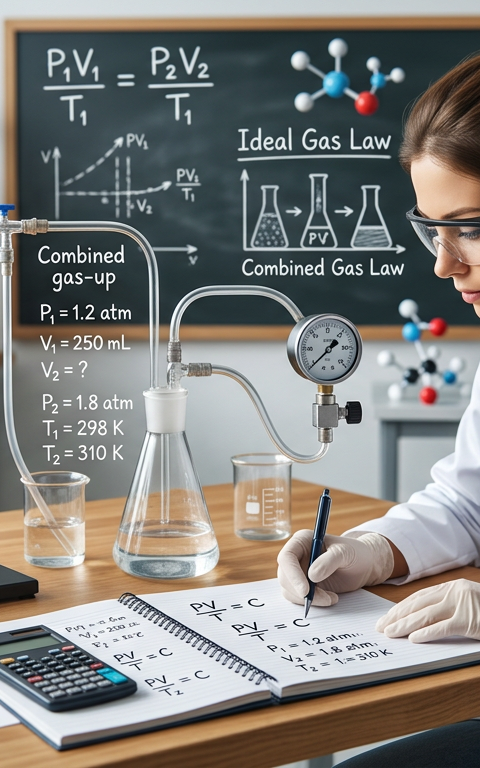
Solving Combined Gas Law Problems: Managing Three Changing Variables
Master the Combined Gas Law with this comprehensive guide featuring clear explanations, step-by-step solved examples, and 10 practice questions with answers.
Apr 2, 2026
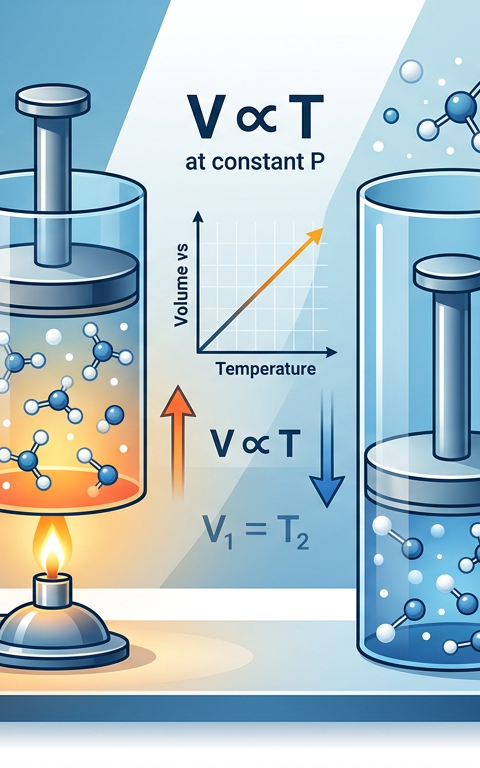
Solving Charles’s Law: Avoiding the Celsius Temperature Trap
Master Charles’s Law with our comprehensive guide featuring solved examples, practice questions, and step-by-step explanations for chemistry students.
Apr 2, 2026
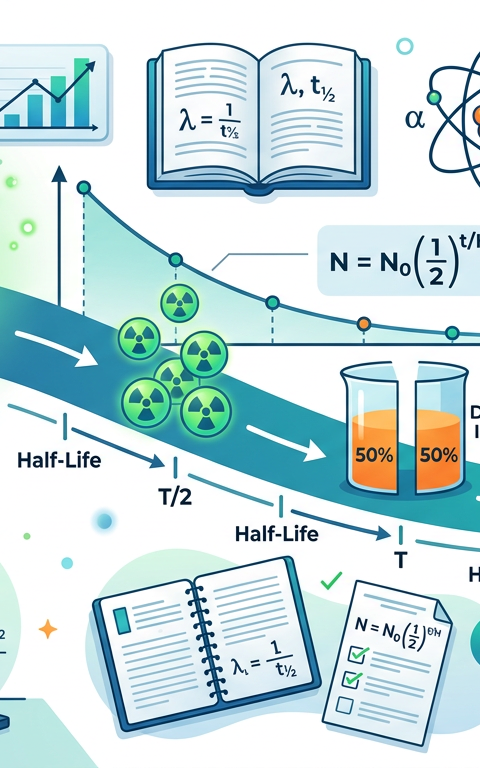
Predicting Radioactive Decay: Solving for Mass and Time Intervals
Master half-life calculations with our comprehensive guide featuring step-by-step solved examples, practice questions, and detailed answers for students.
Apr 2, 2026
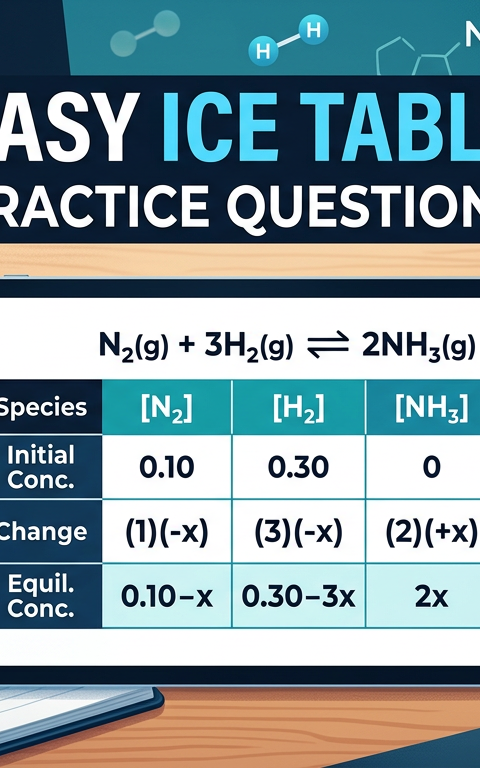
Solving Equilibrium Problems Without Losing Your Stoichiometry
Master chemical equilibrium with these easy ICE table practice questions. Learn to calculate concentrations and K values with step-by-step solved examples.
Mar 30, 2026

Solving Kp with Dalton’s Law and Partial Pressure Gradients
Master Hard Kp Calculations with our comprehensive guide. Includes solved examples, practice questions on partial pressure, and Kp to Kc conversions.
Mar 30, 2026
Calculating Enthalpy Changes: Hess’s Law Puzzle Solving Guide
Master Hess’s Law with our comprehensive guide featuring solved examples, step-by-step practice questions, and detailed answers for chemistry students.
Mar 29, 2026