Easy Combined Gas Law Practice Questions
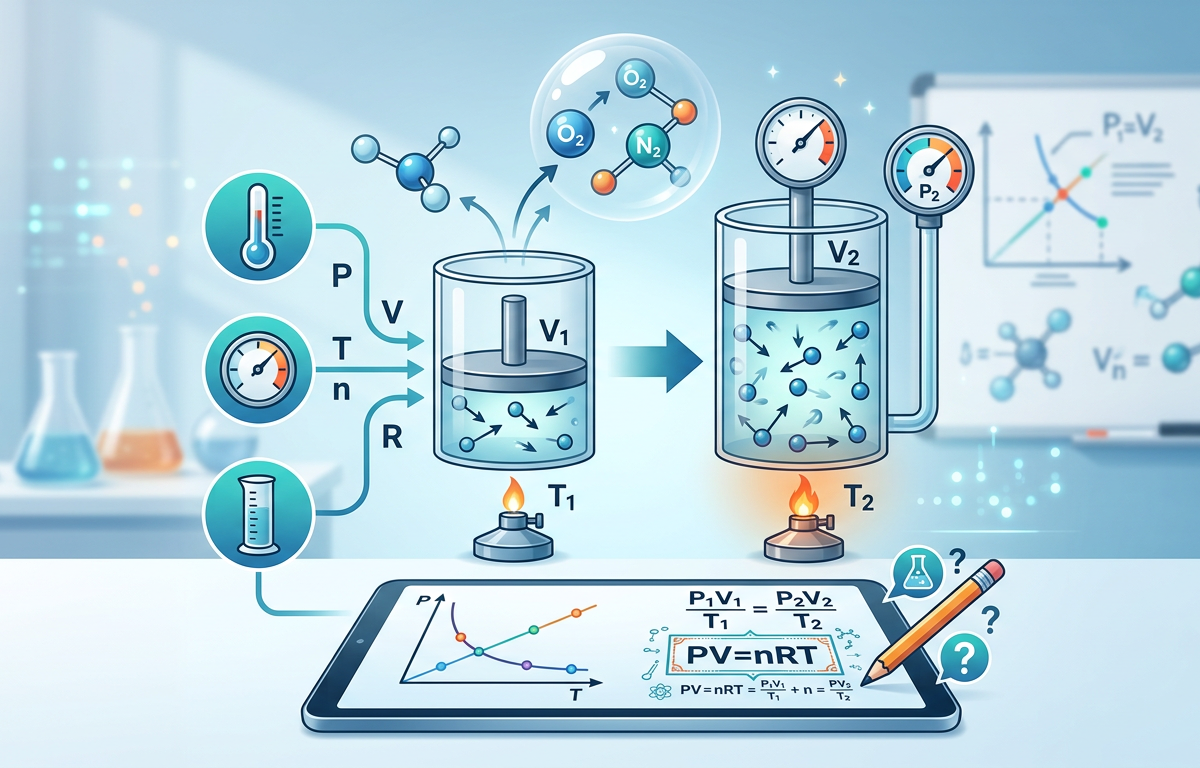
Concept Explanation
The Combined Gas Law is a single mathematical expression that merges Boyle's Law, Charles's Law, and Gay-Lussac's Law into one relationship to describe how the pressure, volume, and temperature of a fixed amount of gas interact. By using this law, you can predict the final state of a gas sample when multiple conditions change simultaneously. According to the Wikipedia page on gas laws, this relationship is essential for understanding atmospheric science and engineering.
The formula for the Combined Gas Law is expressed as:
(P1V1) / T1 = (P2V2) / T2
Where:
P1 and P2: Initial and final pressure (units must be consistent, e.g., atm, kPa, or mmHg).
V1 and V2: Initial and final volume (units must be consistent, e.g., Liters or mL).
T1 and T2: Initial and final temperature (MUST always be in Kelvin).
To convert Celsius to Kelvin, simply add 273.15 to the Celsius temperature. If you are struggling with basic gas relationships, you might want to review Boyle’s Law practice questions or Charles’s Law practice questions to see how individual variables behave when others stay constant.
Solved Examples
Mastering the Combined Gas Law requires a systematic approach to identifying variables and ensuring units match. Here are three fully worked examples to guide you.
Example 1: Finding the Final Volume
A gas sample occupies 2.0 L at 300 K and 1.5 atm. If the pressure increases to 3.0 atm and the temperature rises to 400 K, what is the new volume?
Identify the variables: P1 = 1.5 atm, V1 = 2.0 L, T1 = 300 K, P2 = 3.0 atm, T2 = 400 K. We need to find V2.
Rearrange the formula for V2: V2 = (P1V1T2) / (P2T1).
Substitute the values: V2 = (1.5 atm × 2.0 L × 400 K) / (3.0 atm × 300 K).
Calculate: V2 = 1200 / 900 = 1.33 L.
Example 2: Finding the Final Pressure
A weather balloon contains 50.0 L of helium at 101.3 kPa and 25°C. When it reaches a higher altitude, the volume expands to 150.0 L and the temperature drops to -10°C. What is the new pressure?
Convert temperatures to Kelvin: T1 = 25 + 273 = 298 K; T2 = -10 + 273 = 263 K.
Identify variables: P1 = 101.3 kPa, V1 = 50.0 L, V2 = 150.0 L. We need to find P2.
Rearrange for P2: P2 = (P1V1T2) / (V2T1).
Substitute: P2 = (101.3 × 50.0 × 263) / (150.0 × 298).
Calculate: P2 = 1,332,095 / 44,700 ≈ 29.8 kPa.
Example 3: Finding the Final Temperature
A cylinder holds 5.0 L of oxygen at 2.0 atm and 20°C. If the volume is compressed to 2.5 L and the pressure increases to 6.0 atm, what is the final temperature in Celsius?
Convert T1: 20 + 273 = 293 K.
Rearrange for T2: T2 = (P2V2T1) / (P1V1).
Substitute: T2 = (6.0 atm × 2.5 L × 293 K) / (2.0 atm × 5.0 L).
Calculate: T2 = 4395 / 10 = 439.5 K.
Convert back to Celsius: 439.5 - 273 = 166.5°C.
Practice Questions
Test your knowledge with these easy-to-medium difficulty practice questions. Remember to always convert temperature to Kelvin first!
A gas at 1.0 atm and 300 K occupies 5.0 L. If the volume is reduced to 2.5 L and the temperature increases to 600 K, what is the new pressure?
A balloon has a volume of 2.0 L at 25°C and 760 mmHg. What is its volume at STP (Standard Temperature and Pressure: 273 K and 760 mmHg)?
A sample of nitrogen gas is at 100 kPa and 200 K with a volume of 10 L. If the pressure becomes 200 kPa and the volume becomes 20 L, what is the new temperature?
Start Learning Smarter Today
Join thousands of students using AI-powered study tools to achieve better results.
Get Started FreeA 3.0 L container of gas is at 2.5 atm and 27°C. If the pressure is lowered to 1.0 atm and the temperature is cooled to -73°C, what is the new volume?
A gas occupies 0.5 L at 2.0 atm and 300 K. What will the volume be if the pressure is doubled and the temperature is tripled?
A sample of neon at 0.8 atm and 150 K occupies 4.0 L. If the volume increases to 8.0 L and the pressure remains 0.8 atm, what is the new temperature? (Note: This is a Charles's Law subset).
A gas at 400 K and 2.0 atm occupies 10 L. If the volume stays at 10 L but the pressure drops to 1.0 atm, what is the new temperature?
A container holds 12 L of gas at 3.0 atm and 30°C. If the volume is changed to 6 L and the temperature to 60°C, find the new pressure.
A 500 mL sample of gas at 1.5 atm and 10°C is heated to 100°C and the volume increases to 1000 mL. Calculate the final pressure.
A gas at 273 K and 1.0 atm occupies 22.4 L. If the pressure is increased to 2.0 atm and the volume is decreased to 11.2 L, what is the new temperature?
Answers & Explanations
4.0 atm. Using P2 = (P1V1T2) / (V2T1), we get (1.0 × 5.0 × 600) / (2.5 × 300) = 3000 / 750 = 4.0 atm.
1.83 L. T1 = 298 K, T2 = 273 K. Since pressure is constant (760 mmHg), V2 = (V1T2) / T1 = (2.0 × 273) / 298 = 1.83 L.
800 K. T2 = (P2V2T1) / (P1V1) = (200 × 20 × 200) / (100 × 10) = 800,000 / 1,000 = 800 K.
5.0 L. T1 = 300 K, T2 = 200 K. V2 = (2.5 × 3.0 × 200) / (1.0 × 300) = 1500 / 300 = 5.0 L.
0.75 L. P2 = 4.0 atm, T2 = 900 K. V2 = (2.0 × 0.5 × 900) / (4.0 × 300) = 900 / 1200 = 0.75 L.
300 K. Since pressure is constant, V1/T1 = V2/T2. T2 = (8.0 × 150) / 4.0 = 300 K.
200 K. Since volume is constant, P1/T1 = P2/T2. T2 = (1.0 × 400) / 2.0 = 200 K.
6.59 atm. T1 = 303 K, T2 = 333 K. P2 = (3.0 × 12 × 333) / (6 × 303) = 11988 / 1818 ≈ 6.59 atm.
0.99 atm. T1 = 283 K, T2 = 373 K. P2 = (1.5 × 500 × 373) / (1000 × 283) = 279750 / 283000 ≈ 0.99 atm.
273 K. P2 = (2.0 × 11.2 × 273) / (1.0 × 22.4) = 6115.2 / 22.4 = 273 K. The conditions changed, but the ratio remained the same.
1. Which temperature scale MUST be used when solving Combined Gas Law problems?
Frequently Asked Questions
What is the combined gas law?
The Combined Gas Law is a chemical principle that combines Boyle's, Charles's, and Gay-Lussac's laws into one equation to show the relationship between pressure, volume, and temperature. It allows scientists to calculate changes in one variable when the other two also change.
Can I use Celsius in the combined gas law?
No, you must always convert Celsius to Kelvin by adding 273.15. Using Celsius will lead to incorrect results because the gas laws are based on absolute temperature where zero represents a total lack of kinetic energy.
When should I use the combined gas law instead of the ideal gas law?
Use the Combined Gas Law when you are comparing a single sample of gas under two different sets of conditions (initial and final). Use the Ideal Gas Law (PV = nRT) when you need to find the number of moles or when you only have one set of conditions.
What units should pressure and volume be in?
Pressure and volume can be in any units (like atm, kPa, L, or mL) as long as they are consistent on both sides of the equation. If you use liters for V1, you must use liters for V2.
What happens if one variable remains constant?
If one variable remains constant, it cancels out of the equation. For example, if temperature is constant, the equation simplifies to P1V1 = P2V2, which is Boyle's Law.
Start Learning Smarter Today
Join thousands of students using AI-powered study tools to achieve better results.
Get Started FreeEnjoyed this article?
Share it with others who might find it helpful.
Related Articles
Hard Combined Gas Law Practice Questions
Master complex chemistry problems with our Hard Combined Gas Law Practice Questions. Includes step-by-step solutions, STP conversions, and advanced quiz questions.
Apr 2, 2026

Medium Combined Gas Law Practice Questions
Master the combined gas law with our medium-level practice questions, worked examples, and detailed explanations for chemistry students.
Apr 2, 2026
Solving Combined Gas Law Problems: Managing Three Changing Variables
Master the Combined Gas Law with this comprehensive guide featuring clear explanations, step-by-step solved examples, and 10 practice questions with answers.
Apr 2, 2026

Calculating High-Stakes Meds: BSA Mosteller Formula Practice
Master hard body surface area-based dosage calculations with our comprehensive guide, solved examples, and practice questions for healthcare students.
May 17, 2026

Solving High-Stakes IV Titrations and Weight-Based Infusions
Master advanced IV flow rate calculations with these hard practice questions. Covers weight-based dosing, titrations, and dimensional analysis for nurses.
May 17, 2026

Solving Weight-Based Dosing: The 2.2 Conversion and Rounding Logic
Weight-Based Dosage Calculations Practice Questions with Answers
May 17, 2026

Predicting Periodic Anomalies: Beyond Basic Trend Rules
Hard Periodic Trends Practice Questions
Apr 4, 2026

Hard Electron Configuration Practice Questions
Hard Electron Configuration Practice Questions
Apr 4, 2026