Easy Buffer Solution Practice Questions
Concept Explanation
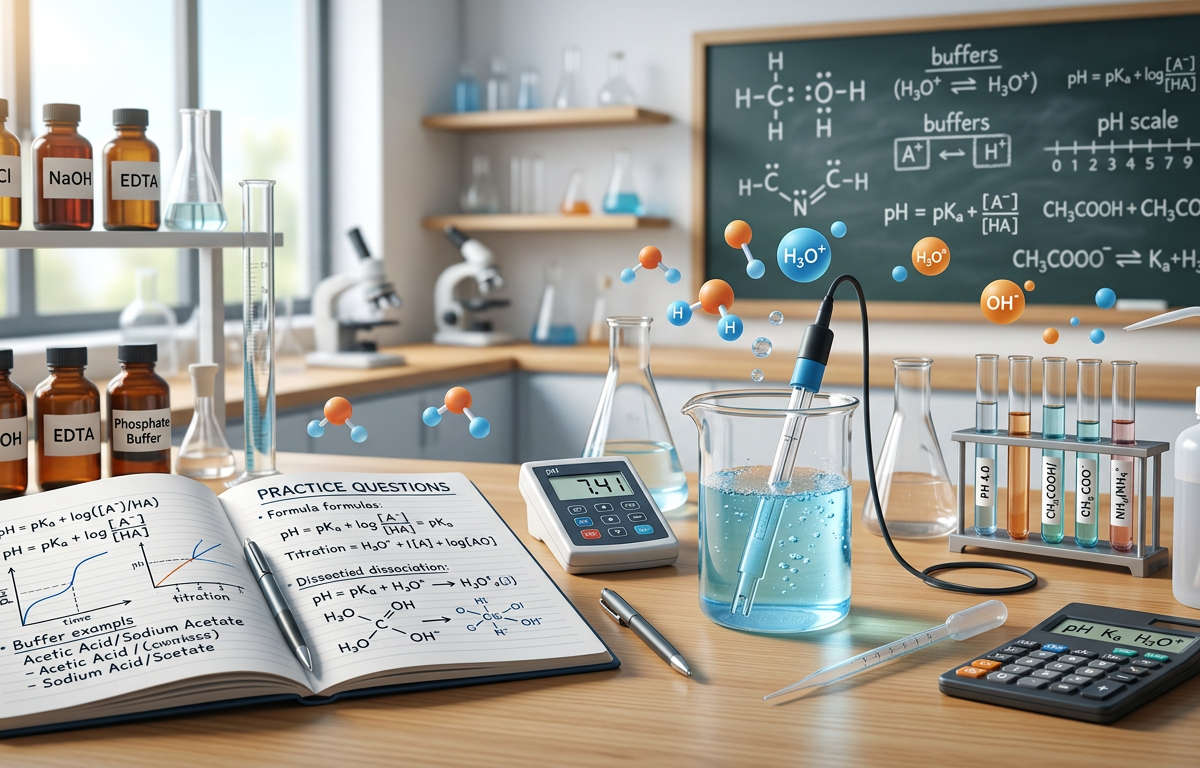
A buffer solution is a chemical system consisting of a weak acid and its conjugate base (or a weak base and its conjugate acid) that resists significant changes in pH when small amounts of acid or base are added. These solutions are vital in biological systems, such as human blood, which maintains a pH near 7.4 through the bicarbonate buffer system. The effectiveness of a buffer depends on the presence of both components to neutralize added hydronium () or hydroxide () ions without a drastic shift in the overall acidity or alkalinity. To understand the underlying math, students often utilize Ka and Kb calculations to determine the strength of the components involved.
The primary tool for calculating the pH of a buffer is the Henderson-Hasselbalch equation, which relates pH to the pKa of the weak acid and the ratio of the concentrations of the conjugate base and acid. For more practice on this specific formula, you can explore Henderson-Hasselbalch equation practice questions. According to Wikipedia, the "buffer capacity" is a quantitative measure of the resistance of a buffer solution to pH change on addition of hydroxide ions.
Solved Examples
Example 1: Identifying a Buffer
Which of the following pairs would form a buffer solution when mixed in equal molar amounts in water: (a) $HCl$ and $NaCl$, or (b) and ?
Solution:Recall that a buffer must consist of a weak acid/base and its salt.
$HCl$ is a strong acid, so it cannot form a buffer.
(acetic acid) is a weak acid and (sodium acetate) provides its conjugate base ().
Therefore, pair (b) forms a buffer.
Example 2: Basic pH Calculation
Calculate the pH of a buffer solution that is 0.20 M in acetic acid () and 0.20 M in sodium acetate (). The of acetic acid is 4.76.
Solution:Use the Henderson-Hasselbalch equation: .
Substitute the values: .
Since , the .
This demonstrates that when concentrations are equal, .
Example 3: Buffer Ratio Change
If a buffer solution has a of 7.0 and the concentration of the conjugate base is 10 times higher than the weak acid, what is the pH?
Solution:Identify the ratio: .
Apply the formula: .
Since , the .
Practice Questions
1. Which of the following combinations will NOT create a buffer solution? (a) and , (b) and , (c) and .
2. A buffer is prepared with 0.50 M formic acid ($HCOOH$) and 0.25 M sodium formate ($HCOONa$). If the is 3.75, calculate the pH.
3. What is the pH of a solution containing 0.15 M and 0.15 M ? The of ammonia is 4.75. (Hint: Find first using ).
Want unlimited practice questions like these?
Generate AI-powered questions with step-by-step solutions on any topic.
Try Question Generator Free →4. Why does adding a small amount of $NaOH$ to an buffer not cause a large increase in pH?
5. Calculate the pH of a buffer where and , given .
6. You need to create a buffer with a pH of 9.25. Which weak acid would be best: Acid A (), Acid B (), or Acid C ()?
7. If the pH of a buffer is 4.0 and the is 4.0, what is the ratio of $[Base]/[Acid]$?
8. Define the term "conjugate base" in the context of an acetic acid buffer.
Answers & Explanations
(c) and . is a strong acid. Buffers require a weak acid and its conjugate salt. Strong acids dissociate completely and do not establish an equilibrium to resist pH changes.
pH = 3.45. Using , we get $3.75 + \log(0.5)$. Since $\log(0.5) \approx -0.30$, the pH is $3.75 - 0.30 = 3.45$.
pH = 9.25. First, find . Since the concentrations of and are equal, the term is zero, and .
Neutralization. The added ions from $NaOH$ react with the weak acid ($HF$) to form water and . This prevents the concentration of free from rising significantly.
pH = 4.0. .
Acid C (). Buffers are most effective when the desired pH is close to the of the acid.
1:1. When , the must be 0, which only happens when the concentrations are equal (ratio of 1).
The Acetate Ion (). It is the species formed when acetic acid loses a proton (). It is capable of reacting with added to reform acetic acid.
1. What is the primary purpose of a buffer solution?
Frequently Asked Questions
What makes a solution a buffer?
A solution is a buffer if it contains both a weak acid and its conjugate base (or a weak base and its conjugate acid) in significant, similar concentrations. This allows the solution to neutralize both added acids and bases through equilibrium shifts.
Can a strong acid and its salt form a buffer?
No, a strong acid and its salt cannot form a buffer because strong acids dissociate completely in water. They lack the equilibrium between the acid and conjugate base required to absorb extra or ions effectively. For more on this, see strong acid vs weak acid practice questions.
What is buffer capacity?
Buffer capacity refers to the amount of acid or base a buffer can neutralize before the pH begins to change significantly. It depends on the absolute concentrations of the buffer components; higher concentrations provide a higher capacity.
How do you choose the right buffer for an experiment?
To choose the right buffer, select a weak acid with a value as close as possible to your desired experimental pH. This ensures the buffer is operating in its most effective range, typically within +/- 1 pH unit of the .
Why is buffering important in biological systems?
Buffering is critical because most biological molecules, like enzymes and proteins, only function within a very narrow pH range. According to the Nature Education series, changes in pH can denature proteins and halt metabolic processes.
Does diluting a buffer change its pH?
In an ideal scenario, diluting a buffer does not change its pH because the ratio of [Base]/[Acid] remains constant. However, extreme dilution can weaken the buffer capacity and eventually lead to pH shifts as the water's own ionization becomes significant.
Want unlimited practice questions like these?
Generate AI-powered questions with step-by-step solutions on any topic.
Try Question Generator Free →Enjoyed this article?
Share it with others who might find it helpful.
Related Articles
Hard Le Chatelier’s Principle Practice Questions
Master Hard Le Chatelier’s Principle Practice Questions with our comprehensive guide featuring solved examples, practice problems, and detailed explanations.
Mar 30, 2026
Hard Reaction Quotient (Q) Practice Questions
Hard Reaction Quotient (Q) Practice Questions
Mar 30, 2026
Grams to Moles Practice Questions with Answers
Master grams to moles conversions with our comprehensive guide. Includes step-by-step examples, practice questions, and detailed answers for chemistry students.
Mar 26, 2026
Avogadro’s Number Practice Questions with Answers
Master the mole concept with our Avogadro’s Number practice questions. Includes step-by-step solved examples, a quick quiz, and detailed explanations.
Mar 26, 2026
Empirical Formulas: Solving Ratios from Mass and Percent Data
Master empirical formula calculations with 10 practice questions, worked answers, and a free step-by-step calculator for mass, percentage, and combustion problems.
Mar 26, 2026