Unforgettable Learning: Why You Forget What You Study & How to Stop It

It’s a frustratingly common experience: you spend hours poring over textbooks, slides, and notes, convinced you’ve grasped the material. Yet, days or even just hours later, a significant portion of that hard-won knowledge has vanished. You find yourself asking, "why do I forget what I study so easily?" This phenomenon, far from a personal failing, is deeply rooted in the intricate science of how our brains process and retain information. Understanding these mechanisms is the first step toward building a more resilient, long-lasting memory for everything you learn.
The Science of Forgetting: More Than Just a Bad Memory
Forgetting isn't just a sign of a "bad memory"; it's an active process, often a necessary one, that helps our brains manage the immense data flow of daily life. Our minds are constantly sifting, prioritizing, and, yes, discarding information. This isn't random; it follows predictable patterns.
Ebbinghaus's Forgetting Curve: The Inevitable Decline
Most of what you study will begin to fade almost immediately if not reinforced. Hermann Ebbinghaus, a pioneering German psychologist, illustrated this with his famous Forgetting Curve.
His experiments in the late 19th century showed that we tend to forget a significant portion of newly learned information within hours or days, with the steepest drop-off occurring very quickly after initial learning.
For instance, he found that over 50% of new information could be forgotten within an hour without review. Imagine spending an hour studying, only to lose half of it by the time you stand up for a break! This curve highlights why simply rereading notes once often proves futile.
Memory Formation: Encoding, Storage, and Retrieval
Memory isn't a single, monolithic entity; it's a dynamic system involving three crucial stages: encoding, storage, and retrieval. Encoding is the initial process of transforming sensory information into a form the brain can store, think of it as saving a file on your computer.
If information isn't properly encoded, often due to lack of attention or shallow processing, it can never be stored effectively. Storage refers to maintaining that encoded information over time. Retrieval is the access and activation of stored memories, much like opening that saved file. Failures can occur at any stage, leading to the frustrating feeling of knowing you "should" know something but being unable to access it.
The Role of Brain Structures: Hippocampus and Prefrontal Cortex
Specific brain regions orchestrate this complex dance of memory. The hippocampus, a seahorse-shaped structure deep within the brain, plays a critical role in forming new explicit (declarative) memories, essentially acting as a temporary holding area before information is sent to other cortical regions for long-term storage.
The prefrontal cortex, the brain's executive control center, manages working memory, the information you're actively thinking about, and helps with memory retrieval and organization. Disruptions or inattention in these areas directly impact your ability to remember what you study.
Common Culprits: Why Your Study Efforts Fade Away
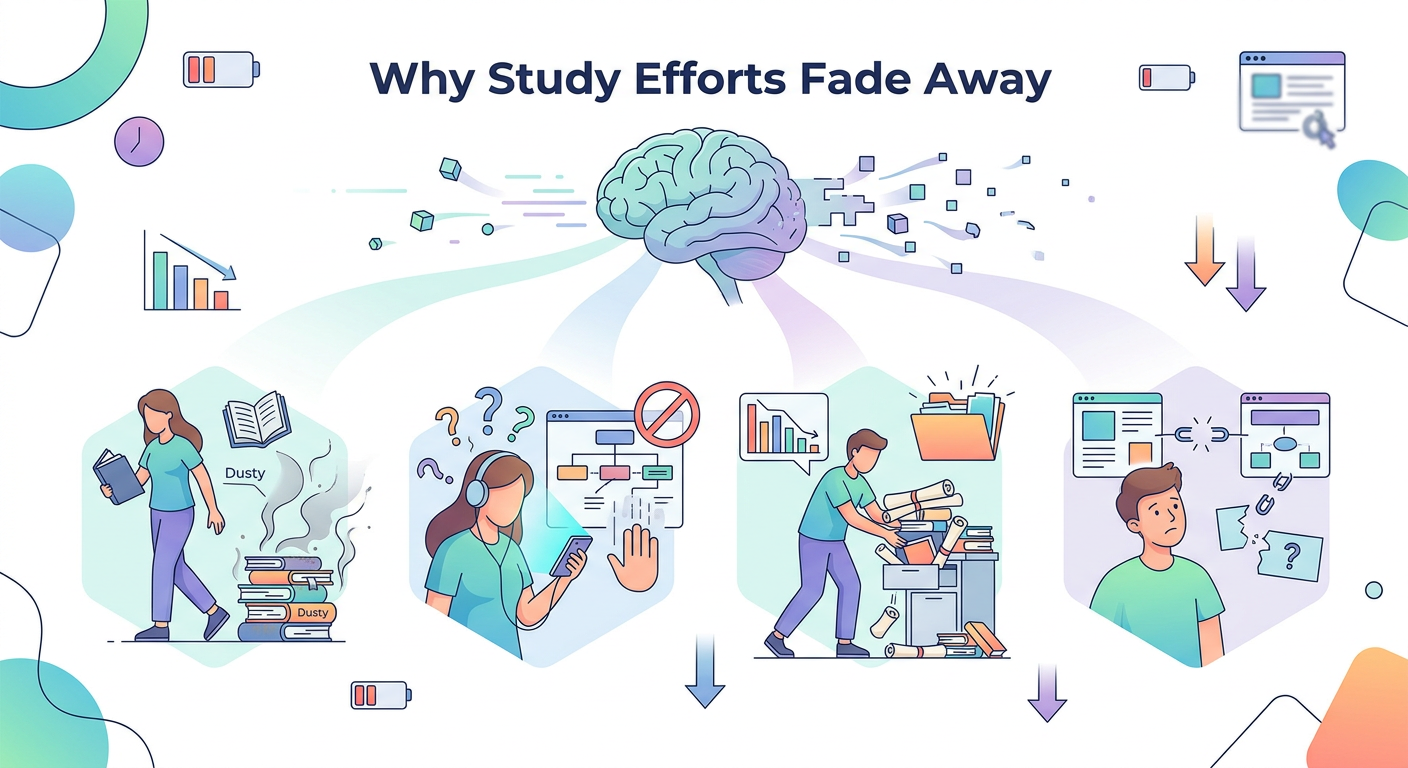
Several common habits and factors sabotage our memory, making our study efforts seem like they're written in sand.
Passive Learning: Reading Without Engaging
Rereading a textbook chapter or highlighting copious amounts of text feels like studying, but it's often a passive activity that yields little long-term retention. When you merely read, your brain isn't actively working to retrieve or process the information in a meaningful way. This type of "recognition memory" is fleeting. For a deeper understanding of why this is ineffective, explore the differences between Passive vs Active Learning. Truly engaging with the material matters.
Lack of Sleep and Its Impact on Consolidation
Sleep isn't just for resting; it's crucial for memory consolidation. During deep sleep stages, your brain actively transfers information from the short-term, temporary storage in the hippocampus to more permanent storage sites in the cortex.
This process solidifies new memories. Skimping on sleep means you're undermining your brain's natural memory-saving protocol, making it much harder to remember what you study. Adults generally need 7-9 hours of quality sleep per night.
Stress, Anxiety, and Cognitive Overload
Chronic stress and acute anxiety flood your system with cortisol, a hormone that can impair hippocampal function, making it difficult to form new memories and retrieve old ones.
Imagine trying to install a new program on a computer that's already running a dozen complex applications and constantly battling malware. Your brain under stress experiences similar overload.
Furthermore, trying to absorb too much information at once, known as cognitive overload, overwhelms working memory, preventing effective encoding in the first place.
Poor Study Habits: Cramming vs. Spaced Repetition
Cramming the night before an exam might help you recall information for an immediate test, but it's a terrible strategy for long-term retention. It overloads working memory and doesn't allow time for consolidation.
This is where the science explicitly tells us why you forget what you study. Instead, spaced repetition, reviewing material at increasing intervals over time, aligns with how our brains naturally store information. The benefits are profound, as detailed in scientific comparisons like Cramming vs Spaced Studying.
Interference: New Information Overwriting Old Memories
Sometimes, forgetting happens because new information interferes with older memories, or vice-versa. Proactive interference occurs when old memories hinder the recall of new ones (e.g., trying to learn a new language word that sounds like an existing word in your native tongue).
Retroactive interference, more common in studying, happens when newly learned information makes it harder to recall previously learned material. This is particularly relevant when subjects have similar concepts or terminology, causing confusion and making you forget what you study from earlier lessons.
To avoid these pitfalls and build more robust study habits, consider exploring why most students study wrong and how to fix it.
Beyond Rote: Strategies to Make Your Learning Stick

To combat the forgetting curve and truly retain what you learn, embrace active, rather than passive, learning strategies.
Active Recall: Testing Yourself for Better Retention
Instead of just rereading your notes, actively retrieve information from memory. Flashcards, self-quizzing, and explaining concepts aloud without looking at your materials are powerful active recall techniques.
This effortful retrieval strengthens the neural pathways associated with that memory, making it easier to access in the future. Studies show that testing yourself is far more effective than just passively reviewing material repeatedly. It's a critical reason why students effectively stop wondering why you forget what you study.
Spaced Repetition: The Power of Timed Review
Reviewing material at optimal, increasing intervals directly counteracts the forgetting curve. Instead of reviewing everything daily, you might review a concept after a day, then three days, then a week, then a month.
This strategy leverages the "testing effect" by prompting recall just as you're about to forget, solidifying the memory each time. Tools like Anki (a flashcard app) use algorithms to automate this process. For deeper insights into this powerful method, check out 10 Study Techniques That Actually Work.
Elaboration and Interleaving: Connecting Concepts
Elaboration involves linking new information to existing knowledge or personal experiences. Ask "why" and "how," create analogies, and think about real-world applications.
The more connections you make, the more retrieval paths you create for that memory. Interleaving, on the other hand, means mixing different subjects or topics during a single study session instead of blocking out time for just one.
For example, instead of studying statistics for three hours straight, you might do 45 minutes of statistics, then 45 minutes of chemistry, then 45 minutes of history. This strengthens your ability to distinguish between concepts and apply the correct strategy at the right time, enhancing overall learning retention tips.
Mnemonic Devices: Creative Memory Aids
Mnemonic devices are memory aids that help you remember complex information by associating it with something easier to recall. Acronyms (e.g., ROY G. BIV for the colors of the rainbow), acrostics (phrases where the first letter of each word stands for something you need to remember), association, and the "memory palace" technique (associating items with locations in a familiar place) are all effective. These techniques provide unique hooks to hang information onto, improving recall, especially for lists or sequential data.
Teaching Others: Solidifying Your Knowledge
The "protégé effect" demonstrates that you learn more effectively when you teach someone else. When preparing to teach, you delve deeper into the material, organize your thoughts, and simplify complex concepts.
The act of explaining forces you to articulate information clearly, identify gaps in your own understanding, and consolidate your knowledge. Try explaining a concept to a classmate, a pet, or even just an imaginary audience. This active engagement makes it far less likely you'll forget what you study.
Tired of Forgetting What You Study?

Transform your study habits with Bevinzey's innovative tools. Our platform helps you implement active recall and spaced repetition effortlessly, ensuring your learning sticks.
Get Started FreeOptimize Your Environment and Lifestyle for Peak Memory
Beyond specific study techniques, your overall well-being and surroundings significantly impact your ability to remember what you study.
The Importance of Quality Sleep
As mentioned, sleep is non-negotiable for memory. To improve your sleep hygiene, establish a consistent sleep schedule (even on weekends), create a dark and cool bedroom environment, avoid screens an hour before bed, and limit caffeine and alcohol in the evenings. Prioritizing 7-9 hours of quality sleep will dramatically improve your brain's capacity for learning and retention. It's truly one of the most effective long-term memory strategies.
Nutrition for Brain Health: Fueling Your Memory
Your brain consumes a significant portion of your body's energy and nutrients. A diet rich in omega-3 fatty acids (found in fish like salmon, walnuts, flaxseed), antioxidants (berries, leafy greens), and whole grains supports cognitive function and memory. Staying hydrated is also crucial, as even mild dehydration can impair concentration and memory. The Harvard Medical School provides excellent guidance on brain-boosting foods.
Mindfulness and Stress Reduction Techniques
Managing stress is vital for clear thinking and robust memory. Incorporate mindfulness practices like meditation, deep breathing exercises, or gentle yoga into your routine. Even short breaks to walk outdoors can reduce cortisol levels and improve focus. These practices enhance your ability to concentrate during study sessions, which directly translates to better encoding and less wondering why you forget what you study.
Minimizing Distractions: Creating a Focused Study Space
A cluttered, noisy, or constantly interrupting environment fragments attention, making effective learning almost impossible. Designate a quiet space solely for studying. Turn off notifications on your phone and computer, or use apps that block distracting websites for set periods. Minimize visual clutter. A focused environment allows your brain to fully engage with the material, maximizing the initial encoding of information. This is a foundational element of effective study habits.
From Student to Lifelong Learner: Embracing Continuous Growth
Learning is a journey, not a destination. Shifting your perspective can profoundly impact how well you retain information.
Cultivating a Growth Mindset
Instead of believing your intelligence is fixed, embrace a growth mindset, the idea that your abilities can be developed through dedication and hard work. When you approach challenges with the belief that you can improve, you're more resilient to setbacks and more open to trying new, more effective study methods. This mindset directly tackles the defeatist attitude that often accompanies the frustration of why you forget what you study.
The Joy of Deep Learning
Beyond memorizing facts, aim for deep understanding. When you grasp the underlying principles and connections between concepts, the information becomes integrated into your broader knowledge network, making it far more memorable and useful.
This isn't just about passing an exam; it's about building a robust internal framework of knowledge. The satisfaction of truly mastering a complex subject is immense.
Applying Knowledge in Real-World Scenarios
Using what you’ve learned in practical situations solidifies memory like few other things. If you're studying a language, practice speaking it. If you're learning coding, build small projects.
Applying knowledge creates new neural pathways and imbues the information with real-world relevance, preventing it from becoming isolated and easily forgotten. This practical application reinforces learning retention tips and makes sense of the material in a tangible way.
Frequently Asked Questions
Why do I forget everything I study right after an exam?
You often forget right after an exam due to "cramming," which prioritizes short-term recall over long-term retention. Your brain discards information not deemed essential for future use once the immediate pressure of the exam is gone.
Is it normal to forget most of what you learn?
Yes, forgetting is a normal part of the memory process. Ebbinghaus's Forgetting Curve demonstrates that we naturally lose a significant portion of new information quickly, especially without reinforcement. The goal isn't to never forget, but to forget less through effective strategies.
Does cramming really not work for long-term memory?
Cramming is highly ineffective for long-term memory. While it might help for immediate recall on a test, it bypasses the necessary consolidation processes that transfer information to permanent storage, leading to rapid forgetting. Spaced repetition works much better.
How can I stop forgetting things I need to remember for my job?
Apply active recall by regularly self-quizzing or explaining concepts to colleagues, use spaced repetition for reviewing critical information, and connect new knowledge to existing tasks or projects. Practical application and teaching others also solidify job-related learning.
What's the single best thing I can do to improve my memory when studying?
The single best thing is to practice active recall. Regularly test yourself on the material without referring to your notes. This effortful retrieval strengthens memory traces more effectively than any other study method.
Can diet actually affect how well I remember things?
Yes, diet significantly impacts memory. A diet rich in omega-3 fatty acids, antioxidants, and whole grains supports brain health and cognitive function. Conversely, poor nutrition can lead to decreased concentration and impaired memory.
Enjoyed this article?
Share it with others who might find it helpful.
Related Articles

How to Solve Molarity Problems: Step-by-Step Mastery
Learn how to solve molarity problems step-by-step with formulas, unit tips, and worked examples so you can calculate concentration with confidence.
Mar 26, 2026

Avoid These 7 Common Molarity Mistakes in Chemistry
Master chemistry calculations! Avoid common molarity mistakes with our expert guide on unit conversions, dilution errors, and proper lab techniques.
Mar 26, 2026

What Is Molarity? The Complete Guide to Molar Concentration
Master molarity with our complete guide. Learn the formula, step-by-step calculations, and the critical differences between molarity and molality.
Mar 26, 2026

Why Molarity Matters: Converting Mass to Moles for Lab Solutions
Master chemistry with our guide to the molarity formula. Learn how to calculate concentration with step-by-step examples, units, and practical lab tips.
Mar 26, 2026

Molarity vs Molality: The Essential Difference Explained
Master the difference between molarity vs molality. Learn the formulas, key differences, and when to use each in this comprehensive chemistry guide.
Mar 26, 2026