Cramming vs Spaced Studying: Which Expert Method Wins?

When looking at Cramming vs Spaced Studying, the scientific consensus is clear: spaced studying allows for superior long-term retention, while cramming only provides a fleeting boost in short-term recall. Most students rely on "massed practice", the technical term for cramming, because it creates a powerful illusion of mastery. However, those who want to actually own their knowledge must transition to "distributed practice," where learning sessions are spread out over time.
The Great Academic Debate: Cramming vs. Spaced Studying
Cramming is the practice of intensive, high-volume study compressed into a single, often grueling session immediately before an assessment. On the flip side, spaced studying involves breaking information into smaller chunks and reviewing them over several days, weeks, or months. While history is full of students who "pulled an all-nighter" and passed, this common study mistake prevents the brain from actually storing information for the long haul.
Why does student intuition fail so consistently? It comes down to the "illusion of competence." When you read the same chapter three times in two hours, the words feel familiar. You confuse this fluency with actual understanding. However, familiarity is not the same as the ability to retrieve information from scratch when the pressure is on.
Educational psychology trends have shifted heavily toward emphasizing distributed practice over massed practice. Research consistently shows that the brain is a biological organ that requires time to synthesize new neural pathways. Expecting to master a semester’s worth of chemistry in ten hours is like trying to grow a tree in a day by giving it a year’s worth of water all at once; it doesn't work, and you usually end up with a mess.
The Science of Memory: How Our Brains Store Information
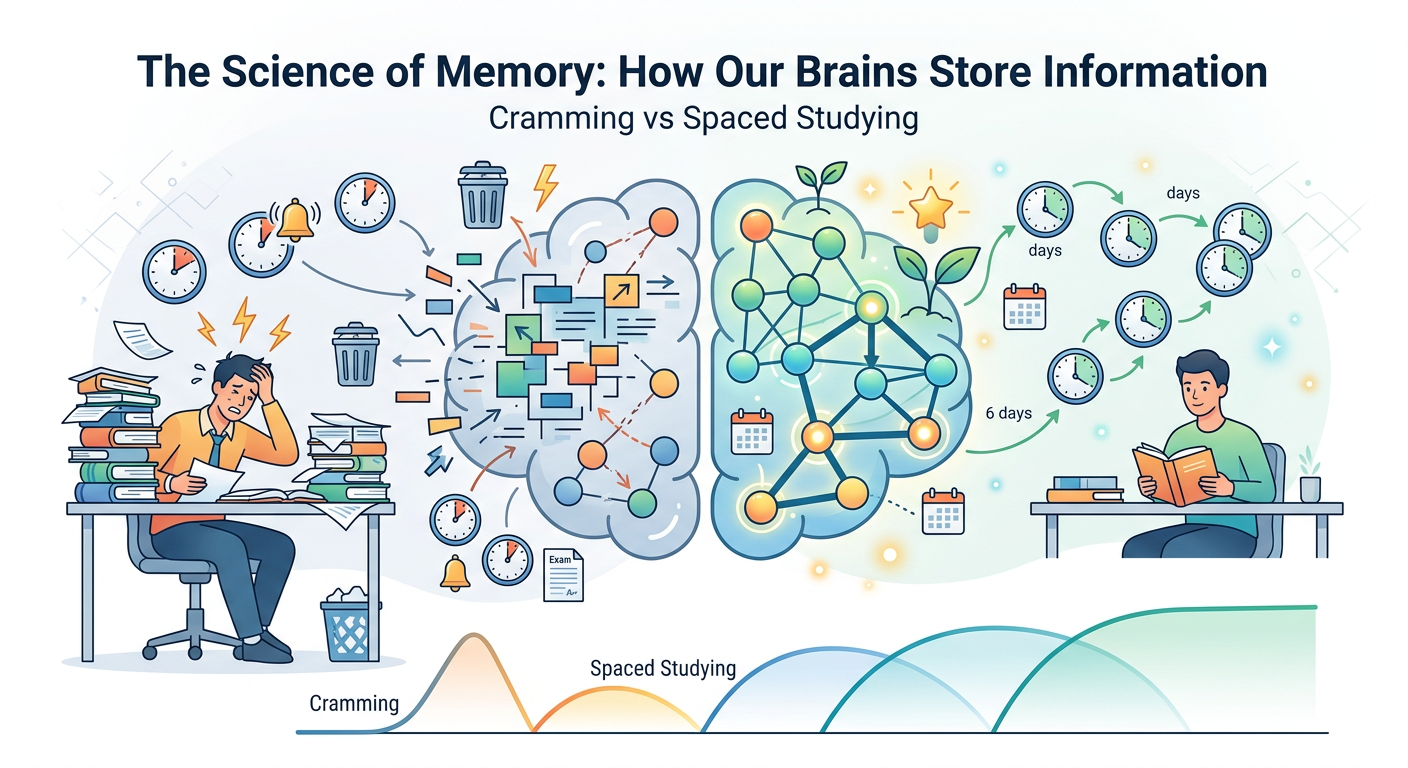
The biological difference between Cramming vs Spaced Studying lies in how the brain encodes and consolidates data. When you first encounter a concept, your hippocampus, the brain's gateway for new memories, holds it temporarily. For that concept to move into the neocortex for long-term storage, it must undergo a process called consolidation. Consolidation is not an immediate event but a biological ritual that requires sleep and repeated activation.
Every time you revisit a piece of information after a break, you trigger Long-Term Potentiation (LTP). This is the process where synapses (the gaps between neurons) strengthen through repeated signals. It is the literal "muscle building" of the mind. Sustainable synaptic growth is physically impossible during a 12-hour cram session. The brain becomes "saturated," and the levels of cortisol (the stress hormone) can actually impair the hippocampus’s ability to form new memories.
If you want to master your memory, you have to work with your biology rather than against it. Sleep is the secret ingredient; it is during the REM and deep sleep stages that the brain replays the day’s learning and "knits" it into the existing neural fabric.
Hermann Ebbinghaus and the Forgetting Curve
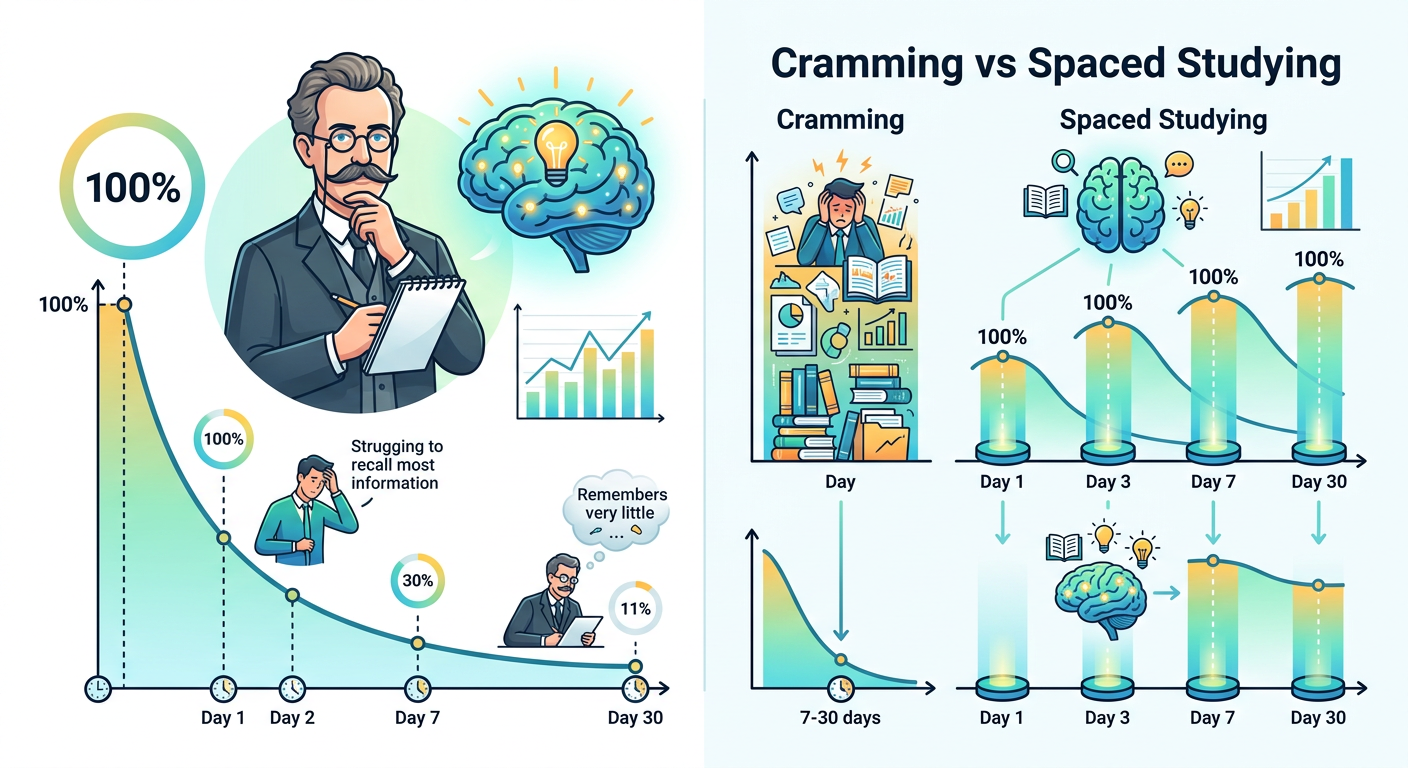
Spaced studying is the only effective antidote to the "Forgetting Curve," a phenomenon discovered by 19th-century psychologist Hermann Ebbinghaus. Through his rigorous self-experimentation, Ebbinghaus found that humans lose roughly 50% of new information within 24 hours if they don't review it. Within a month, about 80% is gone. The discovery of content decay changed everything about how we view Cramming vs Spaced Studying. Ebbinghaus noted that the curve is steepest right after learning.
However, every time you review that information, especially at the "point of forgetting" where your brain has to struggle a bit to remember, the curve flattens. Reviewing at these critical intervals "resets" the forgetting curve. Instead of a sharp drop toward zero, the memory trace becomes more resilient. Think of it like a trail in the woods. Walk it once, and the grass grows back by morning. Walk it once a day for a week, and you have a path that will last for months. You can see this in action by using a structured study plan that forces these periodic reviews.
Why Cramming Feels Effective (But Isn't)
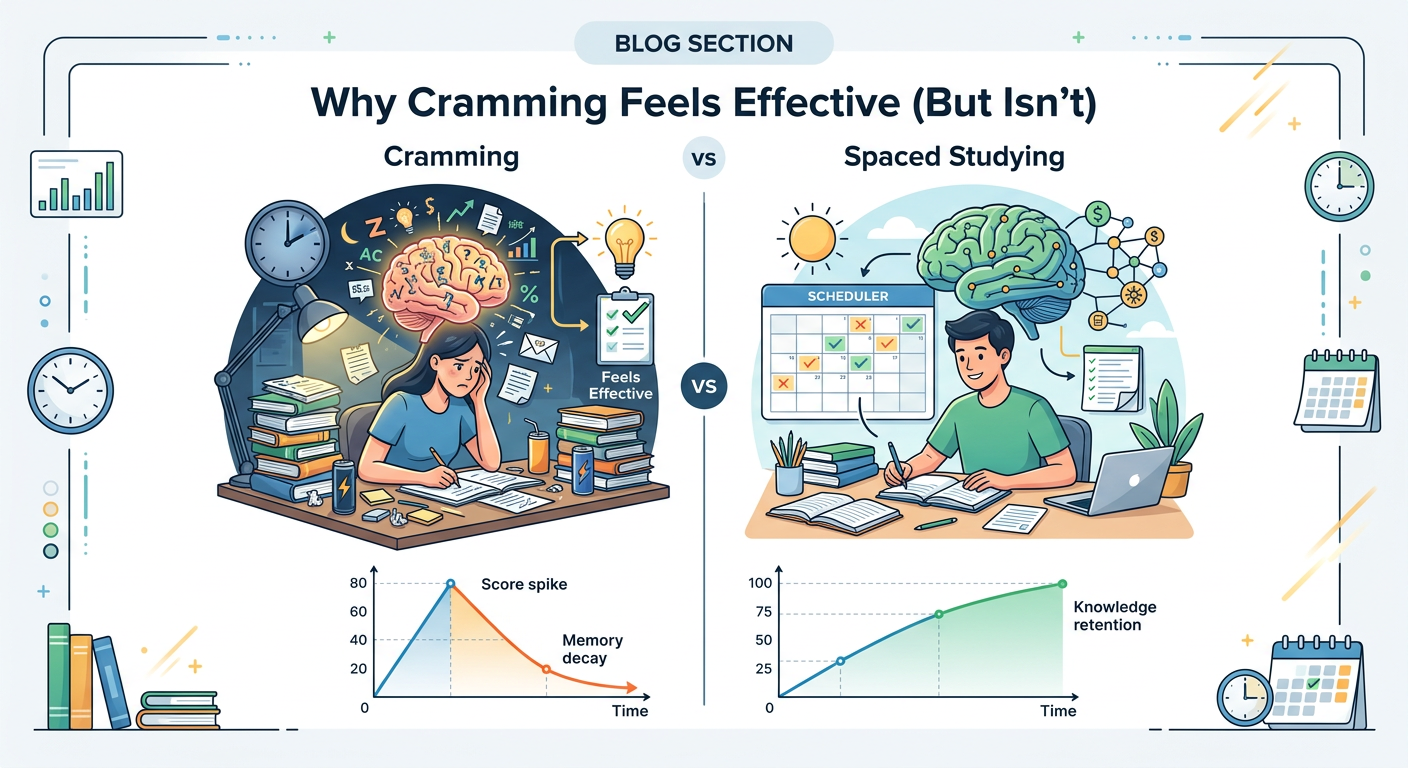
If cramming is so bad, why is it the default for millions of students? Performance and retention are two different metrics. Cramming often works for an exam tomorrow morning, but it fails for the exam in two weeks, or for your future career. Psychologists refer to this as the "bulimic" learning cycle: you "gulp" a massive amount of information and "vomit" it onto the exam paper. Because you successfully pass the test, your brain receives a dopamine hit that reinforces the bad habit. You feel like a genius for beating the system, but 48 hours later, your knowledge of the material has evaporated.
Furthermore, the stress response factor plays a huge role. Cortisol can provide a sharp, narrow focus in the short term, but it prevents the kind of integrative thinking required for complex subjects. If you are learning molarity formulas or complex chemical concentrations, you need deep conceptual understanding, not just the ability to recognize a term on a multiple-choice sheet.
The Benefits of Spaced Studying (Distributed Practice)
The primary benefit of spaced studying is the creation of durable, "sticky" knowledge. By spreading out your sessions, you allow for "chunking", the process of grouping small bits of information into larger, more manageable patterns. This leads to better problem-solving skills because your brain has the "bandwidth" to connect new facts to old ones. Spacing also allows for "interleaving," which is the practice of mixing different topics or types of problems within a single study session.
Research from Harvard Business Review suggests that interleaving forces the brain to constantly restart the retrieval process, making the neural connections even stronger. Additionally, this method drastically reduces test anxiety. When you know you’ve seen the material five times over two weeks, that panicked "blackout" feeling disappears. You are no longer relying on a fragile house of cards built at 3:00 AM; you are relying on a reinforced concrete foundation. To get started, you might want to look into how to study effectively using these science-backed pillars.
Master Spaced Repetition Automatically
Stop guessing when to review. Bevinzey uses advanced algorithms to track your "Forgetting Curve" and tells you exactly when to study for maximum retention.
Get Started FreePractical Strategies to Implement Spaced Repetition
Transitioning away from the **Cramming vs Spaced Studying** battle requires a system. You cannot rely on willpower alone. One of the most famous methods is the Leitner System, which uses physical or digital flashcards organized into "difficulty boxes." 1. Box 1: Every day. 2. Box 2: Every two days. 3. Box 3: Every five days. 4. Box 4: Once a week. If you get a card right, it moves to the next box (less frequent review). If you get it wrong, it goes back to Box 1. This ensures you spend more time on the things you *don't* know and less time on the things you do.
Digital tools like AIflashcard.net, Anki and Quizlet automate this entire process using a Spaced Repetition System (SRS). For those who prefer a calendar-based approach, a 2-4-7 schedule works wonders. Review new material 2 days after first seeing it, then 4 days after that, and finally 7 days after that. This cadence mimics the natural decay of the human memory and reinforces the information just as it begins to slip away. To sharpen your skills, you can try applying this to molarity practice questions to see how long-term retention improves.
Overcoming the Hurdles of Procrastination
The biggest obstacle to spaced studying isn't a lack of intelligence; it's the "Panic Monster." Most students don't start early because the threat of the exam feels too distant. This is why many find themselves choosing between Cramming vs Spaced Studying only when it’s already too late.
To beat this, you must shift from a "performance mindset" (studying for a grade) to a "mastery mindset" (studying to know). Use the Pomodoro Technique, 25 minutes of focus followed by a 5-minute break, to lower the barrier to entry. It is much easier to commit to 25 minutes today than 10 hours next Thursday. Setting micro-goals is also essential.
Instead of "Study Biology," your goal should be "Complete 10 hard molarity practice questions." Achieving these small wins builds momentum and makes the transition to distributed practice feel natural rather than burdensome.
Making the Shift for Lifelong Learning
The evidence in the Cramming vs Spaced Studying debate is overwhelming: spacing wins every time for those who care about actually knowing the material. While cramming might get you through a Friday morning quiz, spaced studying creates the intellectual architecture required for professional success.
Making the shift requires a bit of upfront planning, but the ROI is immense. You will spend fewer total hours studying, experience less stress, and likely see a significant jump in your GPA. Start small by scheduling your first review session for tomorrow’s lecture today. Your future self, the one who remembers the material during the final exam and in your career, will thank you.
Ready to Study Smarter, Not Harder?
Don't let the forgetting curve erase your hard work. Join Bevinzey today and leverage science-backed tools designed to help you master any subject with ease.
Get Started FreeFrequently Asked Questions
Is cramming better than not studying at all?
Yes, in the absolute short term. If the goal is a passing grade on an exam tomorrow, cramming is better than zero preparation. However, expect to forget nearly everything within two days, which makes it a poor strategy for cumulative subjects.
How long should the intervals be in spaced repetition?
Intervals should expand as you become more familiar with the material. A common sequence is 1 day, 3 days, 1 week, 2 weeks, and 1 month. The goal is to review just as the information is beginning to fade from your mind.
Why do students still prefer cramming if it's less effective?
Cramming provides "immediate" results and a sensation of fluency that feels like learning. It also appeals to human nature’s tendency to procrastinate until the "fear" of a deadline provides the necessary motivation to start.
Can you combine cramming and spaced repetition?
You can use a "final review" (which looks like cramming) after a long period of spaced repetition. This acts as a final polish to ensure all concepts are at the forefront of your mind before an exam, but it only works if the foundation was built through spacing.
Does spaced practice work for all subjects?
Absolutely. Whether you are learning a language, practicing dilution practice questions, or memorizing historical dates, the biological principles of memory consolidation remain the same.
How much sleep do you need after a spaced study session?
Research from the Sleep Foundation recommends 7-9 hours. Sleep is when the brain physically encodes the information you studied, so cutting sleep short effectively "deletes" a portion of your study work.
Enjoyed this article?
Share it with others who might find it helpful.
Related Articles

How to Solve Molarity Problems: Step-by-Step Mastery
Learn how to solve molarity problems step-by-step with formulas, unit tips, and worked examples so you can calculate concentration with confidence.
Mar 26, 2026

Avoid These 7 Common Molarity Mistakes in Chemistry
Master chemistry calculations! Avoid common molarity mistakes with our expert guide on unit conversions, dilution errors, and proper lab techniques.
Mar 26, 2026

What Is Molarity? The Complete Guide to Molar Concentration
Master molarity with our complete guide. Learn the formula, step-by-step calculations, and the critical differences between molarity and molality.
Mar 26, 2026
Why Molarity Matters: Converting Mass to Moles for Lab Solutions
Master chemistry with our guide to the molarity formula. Learn how to calculate concentration with step-by-step examples, units, and practical lab tips.
Mar 26, 2026

Molarity vs Molality: The Essential Difference Explained
Master the difference between molarity vs molality. Learn the formulas, key differences, and when to use each in this comprehensive chemistry guide.
Mar 26, 2026