SAT Fractions Practice Questions with Answers

Mastering SAT Fractions is a fundamental requirement for achieving a high score on the math section, as these concepts appear in various forms from basic arithmetic to complex algebraic modeling. Whether you are dealing with simple ratios, complex word problems, or equations involving rational expressions, a solid grasp of how to manipulate numerators and denominators is essential for speed and accuracy.
Concept Explanation
SAT Fractions are numerical representations of a part of a whole, expressed as a numerator divided by a denominator, and they serve as the building blocks for proportions, rates, and algebraic expressions on the exam.
To succeed on the SAT, you must be comfortable with several core operations. First, simplifying fractions involves dividing both the top and bottom by their greatest common factor. When adding or subtracting, you must find a Least Common Denominator (LCD) to ensure the parts being combined are of the same size. Multiplying fractions is more direct—simply multiply the numerators together and the denominators together—while dividing requires you to multiply by the reciprocal (the "flip") of the second fraction.
The SAT often embeds fractions within SAT word problems. You might encounter "fraction of a remainder" problems, where you must calculate a portion of what is left after an initial amount is removed. Additionally, understanding the relationship between fractions, decimals, and percentages is vital. For example, knowing that is or can save valuable seconds. For more advanced applications, you may want to review SAT algebra word practice questions to see how fractions integrate into linear modeling.
Solved Examples
Review these worked examples to understand the step-by-step logic required for common fraction problems on the SAT.
- Example 1: Basic Operations
Simplify the expression: .
- Follow the order of operations (PEMDAS). Perform multiplication first: .
- Simplify the resulting fraction: .
- Find a common denominator for and . The LCD is 30.
- Convert: .
- Example 2: Fraction of a Remainder
A student spends of her savings on a laptop. She then spends of the remaining money on a desk. What fraction of her original savings is left?
- Represent total savings as 1. After the laptop, she has left.
- Calculate the desk cost: .
- Subtract the desk cost from the remainder: .
- Find a common denominator: .
- Simplify: The fraction left is .
- Example 3: Algebraic Fractions
Solve for : .
- Multiply the entire equation by the LCD (15) to clear fractions: .
- Simplify: .
- Distribute: .
- Combine like terms: .
- Solve: , so .
Practice Questions
Test your skills with these SAT fractions practice questions. They range from basic arithmetic to complex multi-step problems.
- If of a number is 24, what is of that number?
- Simplify the expression: .
- A container is full of water. After adding 10 gallons, the container is full. What is the total capacity of the container in gallons?
- In a class of 30 students, are boys. If 3 more girls join the class, what fraction of the class will be girls?
- Solve for : .
- A recipe calls for cups of flour for one batch of cookies. How many cups of flour are needed for batches?
- If and , what is the value of ?
- A piece of wood is 12 feet long. If a carpenter cuts off a piece that is of the total length, and then cuts another piece that is of the remaining length, how many feet of wood are left?
Answers & Explanations
- Answer: 20
Let the number be . We are given . Multiply both sides by to find : . Now, find half of 40: . - Answer: 1
First, solve the numerator: . The expression becomes . Any non-zero number divided by itself is 1. - Answer: 16
Let be the capacity. The equation is . Subtract from both sides: . Convert to common denominator: . Solve for : . - Answer: or
Initial boys: . Initial girls: . After 3 more girls join, total girls = 21 and total students = 33. The fraction is , which simplifies to . - Answer: 4
Combine the fractions on the left: . So, . Since the numerators are equal, the denominators must be equal: , which means . - Answer:
Convert to improper fractions: . Multiply: . Simplify by dividing by 3: or . - Answer:
Numerator: . Denominator: . The expression is . - Answer: 3
First cut: feet. Remaining: feet. Second cut: feet. Remaining: feet.
1. Which of the following is equivalent to \( \frac{3}{x} + \frac{2}{y} \)?
Frequently Asked Questions
How do I convert a mixed number to an improper fraction?
To convert a mixed number, multiply the whole number by the denominator and add the numerator to get the new numerator, then keep the original denominator. For example, becomes , resulting in .
What is the fastest way to compare two fractions on the SAT?
The cross-multiplication method is usually the fastest; multiply the numerator of the first by the denominator of the second and vice versa. The side with the larger product represents the larger fraction, which is often faster than finding a common denominator.
Should I provide my answer as a fraction or a decimal on the SAT grid-in?
The SAT grid-in section accepts both fractions and decimals as long as they fit in the four-column grid and are accurate. However, if a fraction results in a repeating decimal that doesn't fit, it is safer to enter the reduced fraction to avoid rounding errors.
How do I handle "fraction of a remainder" word problems?
Always calculate the remaining amount after each step before applying the next fraction to that new total. Using a variable like to represent the whole or drawing a diagram can help you track the decreasing "whole" through multiple steps.
Can I use a calculator for all fraction problems?
While calculators are allowed on the Math-Calculator section, many fraction problems on the No-Calculator section require manual manipulation. You should be proficient in finding common denominators and simplifying fractions by hand to ensure success on both portions of the test.
Enjoyed this article?
Share it with others who might find it helpful.
Related Articles

Hard SAT Fractions Practice Questions
Hard SAT Fractions Practice Questions
Apr 27, 2026

Medium SAT Fractions Practice Questions
Medium SAT Fractions Practice Questions
Apr 27, 2026
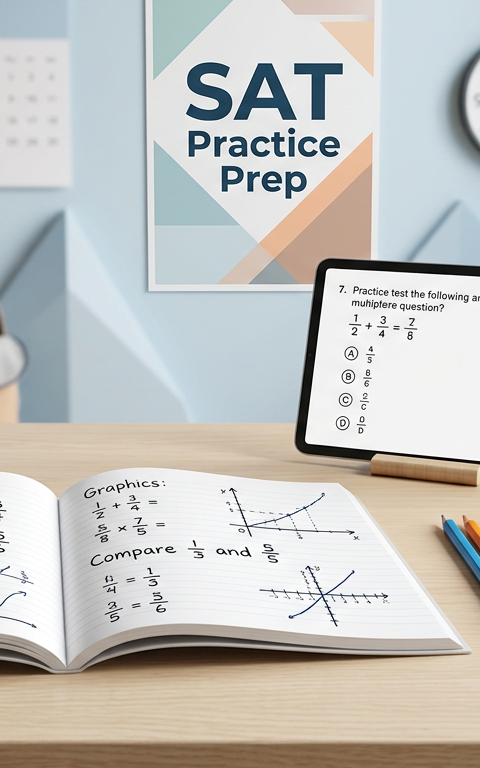
Easy SAT Fractions Practice Questions
Master easy SAT fractions with our guide. Includes step-by-step solved examples, practice questions, and tips to boost your Digital SAT Math score.
Apr 27, 2026
Defeating Extraneous Solutions and Rational Exponents on the SAT
Hard SAT Radicals Practice Questions
Apr 27, 2026

Hard SAT Geometry Word Practice Questions
Hard SAT Geometry Word Practice Questions
Apr 27, 2026
Hard SAT Coordinate Geometry Practice Questions
Hard SAT Coordinate Geometry Practice Questions
Apr 27, 2026
Solving the Hidden Geometry Traps in SAT Triangle Problems
Hard SAT Triangle Practice Questions
Apr 27, 2026
Solving Multistep SAT Geometry: From Circle Equations to Radians
Hard SAT Geometry Practice Questions
Apr 27, 2026