Solving the Hidden Geometry Traps in SAT Triangle Problems
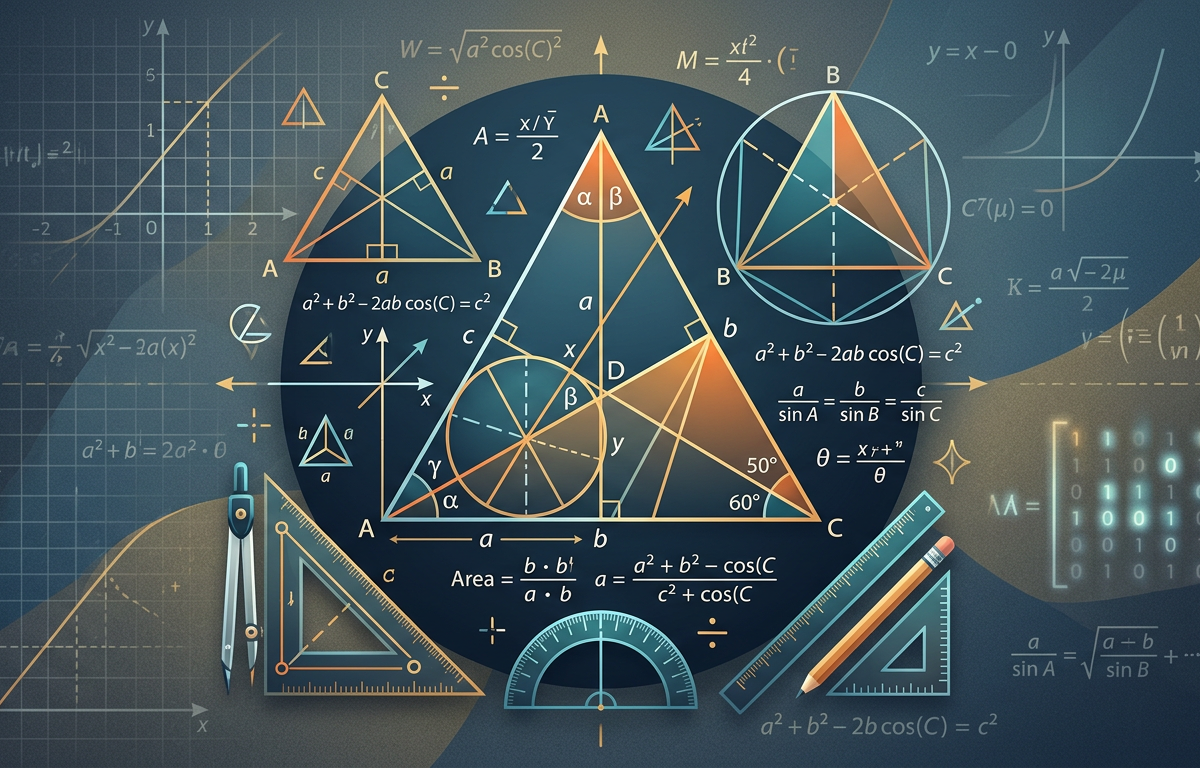
Imagine you are staring at a coordinate plane where a triangle is sliced by a transversal, or worse, a circle with a radius that secretly doubles as a triangle's hypotenuse. The College Board rarely presents a shape in isolation. Instead, they hide the 30-60-90 ratios inside larger polygons or force you to use the Triangle Inequality Theorem to determine if a set of side lengths is even physically possible. The most common error is not the arithmetic, but the failure to recognize that a triangle with angles of 30 and 60 degrees must have sides in the ratio of x, x√3, and 2x.
Advanced SAT geometry demands more than just knowing that angles sum to 180 degrees. You must be able to pivot instantly between trigonometric identities, such as sin(x) = cos(90 - x), and the proportional relationships found in similar triangles. When two triangles share two congruent angles, their areas do not scale linearly; they scale by the square of the side ratio. If you miss this distinction, you will likely choose the trap answer provided in the multiple-choice options. This guide breaks down the specific multi-step reasoning required to dismantle these high-level problems.
Geometric Ratios and Identity Logic
Hard SAT triangle practice questions focus on the convergence of advanced geometric principles, including the Pythagorean theorem, special right triangles, similar triangles, and trigonometric identities. To master these problems, you must understand that the SAT often hides triangles within other shapes or requires multiple steps to find a missing dimension. Key concepts include the Triangle Inequality Theorem, which states that the sum of any two sides of a triangle must be greater than the third side, and the properties of and triangles. Furthermore, similarity is a frequent theme; if two triangles have two congruent angles, their side lengths are proportional. This is often tested alongside SAT linear equations practice questions when solving for variables in geometric contexts.
Advanced problems often require the use of the Law of Sines or Law of Cosines, though most can be solved by dropping an altitude to create right triangles. According to Khan Academy, recognizing these patterns quickly is essential for timing. You should also be comfortable with the relationship between sine and cosine: . This identity is a staple of the "Hard" difficulty tier on the Digital SAT.
Solved Examples
- Example 1: Special Right Triangles
In triangle , angle is a right angle, and angle measures . If the hypotenuse has a length of 12, what is the area of the triangle?- Identify the triangle type: Since the angles are , , and , this is a triangle.
- Apply the side ratios: The sides are , , and .
- Solve for : . The shorter leg (opposite ) is 6, and the longer leg (opposite ) is .
- Calculate area: .
- Example 2: Similar Triangles
In the coordinate plane, a triangle has vertices at , , and . A second triangle is similar to the first and has a perimeter of 72. What is the length of the longest side of the second triangle?- Find the sides of the first triangle: The legs are 8 and 6. Using the Pythagorean theorem: , so the hypotenuse is 10.
- Calculate the first perimeter: .
- Find the scale factor: .
- Apply scale factor to the longest side: .
- Example 3: Trigonometric Identities
If , where , what is the value of ?- Recall the cofunction identity: .
- Substitute the given value: Since , then must also be .
Practice Questions
1. In triangle , the measure of angle is . If , what is the value of ?
2. A triangle has side lengths of 7, 24, and . If is an integer, what is the difference between the maximum and minimum possible values of according to the Triangle Inequality Theorem?
3. Two similar triangles have areas in a ratio of . If the perimeter of the smaller triangle is 20, what is the perimeter of the larger triangle?
4. In an isosceles triangle, the two congruent sides each have a length of 10. If the angle between these sides is , what is the length of the third side?
5. Right triangle and right triangle are similar. The length of hypotenuse is 15, and the length of hypotenuse is 5. If the area of triangle is 6, what is the length of the shortest side of triangle ?
6. In the figure (not shown), triangle is inscribed in a circle with diameter . If and , what is the area of the circle? (Use )
7. A ladder 25 feet long leans against a vertical wall. If the bottom of the ladder is 7 feet from the base of the wall, how high up the wall does the ladder reach? If the ladder slides down so the top is 4 feet lower, how much further does the bottom slide out? This problem is similar to logic found in hard SAT word problems practice questions.
8. In triangle , side and side . If the measure of angle is , what is the value of ?
9. A right triangle has a perimeter of 40 and a hypotenuse of 17. What is the area of the triangle?
10. If the sides of a triangle are in the ratio and the area is 54, what is the length of the longest side?
Answers & Explanations
- Answer: . In a right triangle, . Using the Pythagorean theorem, the hypotenuse is 13. Angle is the other acute angle. . The side opposite to is the side adjacent to , which is 12. Thus, .
- Answer: 12. By the Triangle Inequality Theorem, , so . The minimum integer is 18 and the maximum is 30. .
- Answer: 30. If the ratio of areas is , the ratio of side lengths (and perimeters) is . Here, . Set up a proportion: . Solving for gives 30.
- Answer: . Drop an altitude to split the isosceles triangle into two triangles. The hypotenuse is 10. The side opposite the angle is . Since there are two such segments making up the base, the total length is .
- Answer: 9. The scale factor from to is . If the area of is 6, its legs and satisfy . Since it is a right triangle, . The legs must be 3 and 4. The shortest side of is the shortest side of times the scale factor: .
- Answer: . An angle inscribed in a semicircle is a right angle. Thus, is a right triangle with hypotenuse . . The radius is 6.5. Area = .
- Answer: 8 feet. Initially, the height is . If the top slides down 4 feet, the new height is 20. The new base distance is . The bottom slid from 7 to 15, an increase of 8 feet.
- Answer: . The hypotenuse . . The side adjacent to is . So, .
- Answer: 60. Let sides be and . . Also . Use the identity . . Area = .
- Answer: 15. Let sides be . Area = . . The longest side is . This scaling logic is also found in hard SAT ratio and proportion practice questions.
1. In a right triangle, if \(\sin( heta) = 0.6\), what is \(\cos( heta)\)?
Frequently Asked Questions
What are the most common triangle types on the SAT?
The SAT primarily tests right triangles, specifically the and special triangles, as well as equilateral and isosceles triangles. Understanding these properties allows you to solve for missing sides without complex calculations.
Do I need to memorize the Law of Sines for the SAT?
While the Law of Sines and Law of Cosines are rarely required, they can be helpful for the most difficult questions. Most "hard" problems can be solved by creating right triangles or using the reference formulas provided at the start of the math section.
How does the Triangle Inequality Theorem work?
The Triangle Inequality Theorem states that for any triangle with sides and , the sum of any two sides must be strictly greater than the third side (e.g., ). This is often used to find the possible range for a third side length.
Why is triangle similarity important for the SAT?
Similarity is a core concept because it allows you to set up proportions between corresponding sides of different triangles. If you know two triangles are similar, you can solve for unknown lengths using the ratio of known sides.
What is the relationship between sine and cosine in right triangles?
In any right triangle, the sine of one acute angle is equal to the cosine of the other acute angle. This is expressed by the identity , which is frequently tested in the advanced math modules.
Can I use a calculator for triangle questions?
Yes, the Digital SAT allows the use of a calculator, including the built-in Desmos calculator, for all math questions. This is particularly useful for calculating square roots or trigonometric values in multi-step geometry problems.
Enjoyed this article?
Share it with others who might find it helpful.
Related Articles

Hard SAT Geometry Word Practice Questions
Hard SAT Geometry Word Practice Questions
Apr 27, 2026
Hard SAT Coordinate Geometry Practice Questions
Hard SAT Coordinate Geometry Practice Questions
Apr 27, 2026
Solving Multistep SAT Geometry: From Circle Equations to Radians
Hard SAT Geometry Practice Questions
Apr 27, 2026

Medium SAT Geometry Word Practice Questions
Medium SAT Geometry Word Practice Questions
Apr 27, 2026
Medium SAT Coordinate Geometry Practice Questions
Medium SAT Coordinate Geometry Practice Questions
Apr 27, 2026
Solving Multistep SAT Geometry: Area and Volume Relationships
Master Medium SAT Area and Volume Practice Questions with our comprehensive guide, featuring solved examples, practice problems, and a quick quiz.
Apr 27, 2026
Medium SAT Geometry Practice Questions
Medium SAT Geometry Practice Questions
Apr 27, 2026
Easy SAT Geometry Word Practice Questions
Easy SAT Geometry Word Practice Questions
Apr 27, 2026