Applying USP 795 and 797 Standards to Complex BUD Calculations

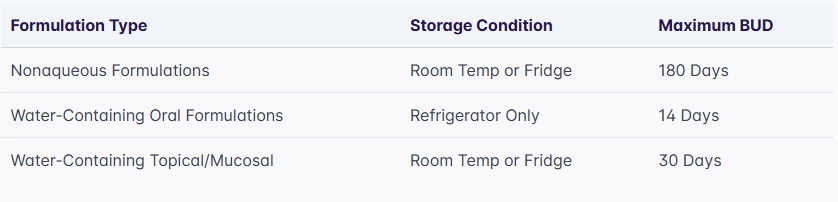
When a pharmacist prepares a 10% hydrocortisone ointment in a pure petrolatum base, the clock starts at 180 days. However, if that same pharmacist adds a single drop of purified water to create a cream, the maximum allowable beyond use date collapses to just 30 days under USP 795 standards. This drastic shift illustrates why simple memorization fails on the NAPLEX. You must identify the water activity of the final preparation before you even glance at the calendar. A common trap involves confusing the 14 day refrigerated limit for aqueous oral liquids with the 30 day limit for aqueous topicals, a mistake that leads to immediate point loss on the exam.
Sterile compounding adds another layer of complexity by shifting the focus from ingredients to the environment. A vancomycin bag mixed in a Segregated Compounding Area is legally expired within 24 hours if refrigerated, regardless of the drug stability. Transitioning your thought process from chemical degradation to microbial risk levels is the only way to navigate Category 1 and Category 2 questions accurately. The following scenarios require you to evaluate the formulation type, the storage temperature, and the ISO classification of the workspace to determine the correct date.
NAPLEX Beyond Use Date Practice Questions with Answers
Mastering the NAPLEX Beyond Use Date standards is essential for ensuring patient safety and passing the pharmacy licensure exam. Beyond-use dates (BUDs) differ from manufacturer expiration dates as they represent the date after which a compounded preparation shall not be used, based on the date it was compounded.
To succeed on the exam, you must be intimately familiar with USP <795> for non-sterile compounding and USP <797> for sterile compounding. This guide provides a deep dive into these standards, offering the practice you need to navigate complex compounding scenarios. For a broader overview of exam topics, visit our NAPLEX Prep hub.
Decoding Water Activity and ISO Risk Levels
A Beyond Use Date (BUD) is the date or time after which a compounded preparation must not be used, administered, or stored, determined by the stability and sterility of the specific formulation. While commercial product expiration dates are determined by the manufacturer after extensive stability testing, BUDs are assigned by the pharmacist based on USP standards.
USP <795> Non-Sterile Compounding BUDs
The revised USP <795> standards categorize non-sterile compounded preparations (CNSPs) based on water activity and the presence of preservatives. If no stability data is available, the following maximum BUDs apply for preparations stored at controlled room temperature or in a refrigerator:
USP <797> Sterile Compounding BUDs
Sterile compounding BUDs are determined by the "Category" of the preparation (Category 1, 2, or 3), which is based on the compounding environment and the probability of microbial growth. Most hospital-based compounding falls under Category 1 or 2. Understanding these limits is as critical as mastering NAPLEX Infectious Disease Practice Questions, as improper BUDs lead to life-threatening infections.
Category 1: Compounded in a Segregated Compounding Area (SCA). BUD is ≤ 12 hours at room temperature or ≤ 24 hours refrigerated.
Category 2: Compounded in a cleanroom suite. BUDs vary from 4 days to 45 days depending on sterilization method and storage.
Solved Examples
Example 1: Non-aqueous Ointment
A pharmacist compounds a 10% hydrocortisone ointment using a petrolatum base (nonaqueous). The compounding date is March 1st. What is the maximum BUD?
Identify the formulation type: Nonaqueous.
Apply USP <795> rule: 180 days.
Calculate the date: 180 days from March 1st is approximately August 28th.
Solution: 180 days.
Example 2: Oral Aqueous Suspension
A pharmacist reconstitutes an amoxicillin oral suspension for a pediatric patient. According to the manufacturer, it is stable for 14 days when refrigerated. If the pharmacist instead compounded an oral liquid from tablets and water, what is the default USP BUD?
Identify formulation type: Water-containing oral formulation.
Apply USP <795> rule: 14 days when refrigerated.
Note: Reconstituted manufactured products follow manufacturer labeling; compounded preparations follow USP.
Solution: 14 days (Refrigerated).
Example 3: Category 1 Sterile Preparation
A nurse prepares a vancomycin IV bag in a Segregated Compounding Area (SCA) for immediate use. If not used immediately, what is the maximum BUD if stored in the refrigerator?
Identify environment: SCA (Category 1).
Apply USP <797> rule for Category 1: 24 hours refrigerated.
Solution: 24 hours.
Practice Questions
1. A pharmacist compounds an oral solution using crushed spironolactone tablets, glycerin, and purified water. The preparation is stored in the refrigerator. What is the maximum BUD?
2. An anhydrous lidocaine gel is prepared using only synthetic powders and a propylene glycol base. If the preparation is stored at room temperature, what is the maximum USP <795> BUD?
3. A Category 2 sterile injectable is prepared using aseptic processing and no sterility testing. It is intended to be stored in a freezer (-25°C to -10°C. What is the maximum BUD?
Train like it\u2019s exam day.
Build confidence with timed NAPLEX practice questions, mock exams, and performance analytics.
Start Timed Practice4. A pharmacist is preparing a topical cream containing progesterone, oil, and water. What is the maximum BUD if stored at room temperature?
5. A multi-dose vial (MDV) of insulin is opened on January 1st. According to general standards, what is the BUD for this vial if stored at room temperature?
6. An emergency room physician performs a "direct-to-patient" sterile compounding of a life-saving medication during a code. According to USP <797>, administration must begin within how many hours?
7. You are compounding a non-sterile preparation using an ingredient that expires in 2 months. The USP <795> default BUD for the formulation is 6 months. Which date should you use?
8. A Category 2 CSP is terminally sterilized by autoclaving and stored at room temperature. What is the maximum BUD?
9. A pharmacist compounds a non-aqueous capsule formulation using lactose as a filler. What is the maximum BUD?
10. If a sterile preparation is compounded using non-sterile starting ingredients and is subsequently filter-sterilized, it is considered Category 2. If stored in the refrigerator without sterility testing, what is the BUD?
Answers & Explanations
1. Answer: 14 Days. This is a water-containing oral formulation. Under USP <795>, these must be refrigerated and have a maximum BUD of 14 days to prevent microbial growth and maintain stability. For more on drug stability in specific conditions, see our NAPLEX Renal Therapeutics Practice Questions.
2. Answer: 180 Days. Because the gel is anhydrous (nonaqueous), USP <795> allows for a BUD of up to 180 days when stored at room temperature or refrigerated.
3. Answer: 45 Days. For Category 2 CSPs prepared via aseptic processing (without sterility testing) and stored in a freezer, the BUD is 45 days. You can use the AI Exam Simulator to practice more of these sterile compounding timeframes.
4. Answer: 30 Days. Water-containing topical or mucosal liquid or semi-solid formulations have a maximum BUD of 30 days under USP <795>.
5. Answer: 28 Days. While some specific insulins vary, the standard BUD for a multi-dose vial after puncture is 28 days, unless otherwise specified by the manufacturer. This is a common safety check in diabetes management.
6. Answer: 4 Hours. For immediate-use sterile preparations, administration must begin within 4 hours of the start of preparation to minimize the risk of contamination in non-controlled environments.
7. Answer: 2 Months. A BUD can never exceed the expiration date of any individual component used in the compound. You must use the shortest date available.
8. Answer: 45 Days. Category 2 CSPs that are terminally sterilized (and have not passed a sterility test) have a BUD of 45 days when stored at room temperature.
9. Answer: 180 Days. Capsules containing only dry powders are considered nonaqueous formulations. The maximum BUD is 180 days.
10. Answer: 9 Days. For Category 2 preparations prepared via aseptic processing (not terminally sterilized) without a sterility test, the refrigerated BUD is 9 days.
1. What is the maximum BUD for a non-sterile, water-containing oral formulation stored in the refrigerator?
Frequently Asked Questions
What is the difference between an expiration date and a BUD?
An expiration date is determined by the manufacturer through rigorous stability testing of a commercial product, whereas a BUD is assigned by a pharmacist for a compounded preparation based on USP guidelines. BUDs are generally much shorter than expiration dates because compounded products lack the same long-term stability data.
Can I extend a BUD if I have peer-reviewed stability data?
Yes, pharmacists may extend a BUD beyond the USP <795> or <797> defaults if there is valid, stability-indicating analytical method data for that specific formulation and container. This data must be documented and applicable to the exact conditions used in the pharmacy.
How do I determine the BUD for a multi-dose vial?
According to CDC and USP guidelines, a multi-dose vial usually has a BUD of 28 days once punctured, unless the manufacturer specifies otherwise. Always check the package insert for product-specific variations.
What happens if a component expires before the USP BUD?
The BUD assigned to a compounded preparation must never exceed the earliest expiration date of any of its ingredients. If a powder used in a compound expires in 10 days, the BUD for the entire preparation must be 10 days or less.
What is the BUD for immediate-use sterile preparations?
Immediate-use sterile preparations, which are compounded in emergency situations or for single patients outside of a cleanroom, must have administration begun within 4 hours of the start of preparation. Any remaining portion must be discarded after the 4-hour window.
Train like it\u2019s exam day.
Build confidence with timed NAPLEX practice questions, mock exams, and performance analytics.
Start Timed Practice
Train like it\u2019s exam day.
Build confidence with timed NAPLEX practice questions, mock exams, and performance analytics.
Start Timed PracticeTags
Enjoyed this article?
Share it with others who might find it helpful.
Related Articles

Hard NAPLEX Compounding Calculations Practice Questions
Hard NAPLEX Compounding Calculations Practice Questions
May 31, 2026
Medium NAPLEX Compounding Calculations Practice Questions
Master medium-level NAPLEX compounding calculations with this guide featuring alligation, mEq formulas, isotonicity problems, and 10 detailed practice questions.
May 31, 2026

Easy NAPLEX Compounding Calculations Practice Questions
Easy NAPLEX Compounding Calculations Practice Questions
May 31, 2026

Applying USP 797 Standards: Solving Sterile Compounding Scenarios
Easy NAPLEX Sterile Compounding Practice Questions
May 31, 2026

NAPLEX Compounding Calculations Practice Questions with Answers
NAPLEX Compounding Calculations Practice Questions with Answers
May 31, 2026

CrCl Calculations: Navigating Obese and Underweight Dosing Traps
Master complex renal dosing with these hard NAPLEX creatinine clearance practice questions, featuring obese, elderly, and underweight patient cases.
Jun 1, 2026

Hard NAPLEX Absolute Risk Reduction Practice Questions
Master Absolute Risk Reduction (ARR) for the NAPLEX with our hard practice questions, step-by-step solutions, and clear concept explanations.
Jun 1, 2026

NAPLEX Absolute Risk Reduction Practice Questions with Answers
Master Absolute Risk Reduction (ARR) for the NAPLEX with our comprehensive guide featuring solved examples, practice questions, and detailed explanations.
Jun 1, 2026