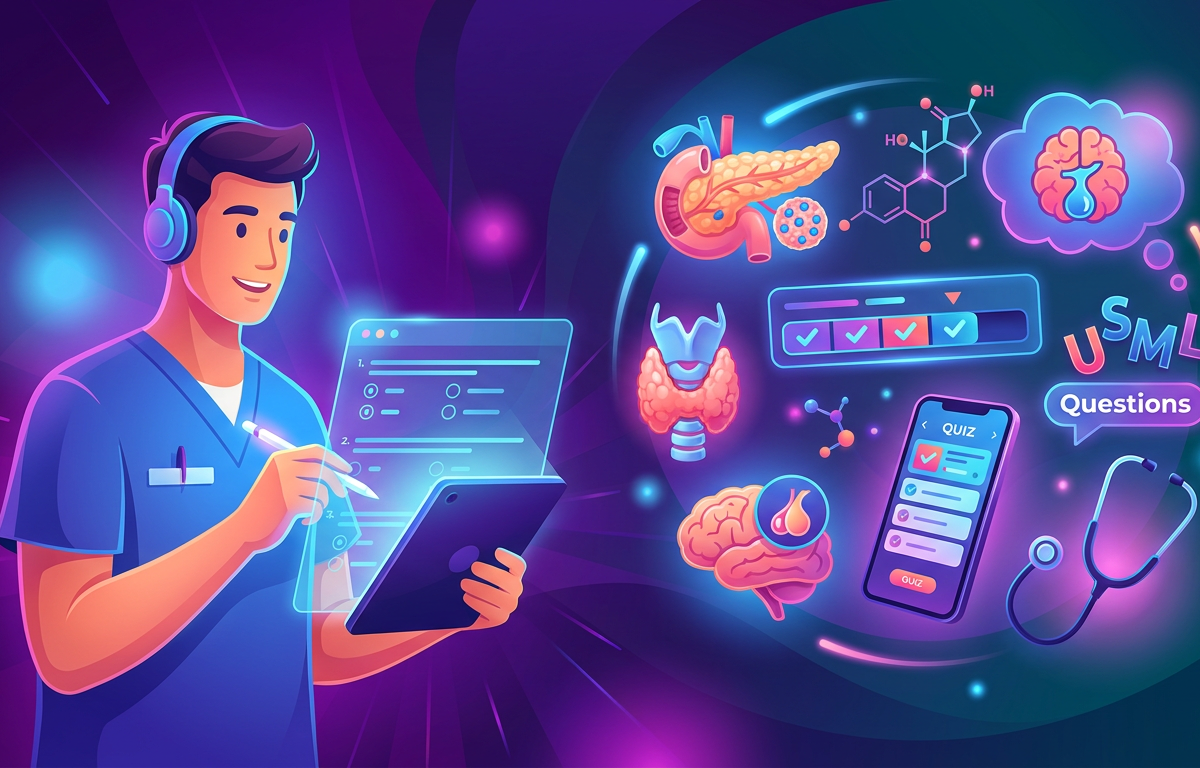
Medium USMLE Endocrine Physiology Practice Questions
1. **Concept Explanation**
Endocrine physiology is the study of hormone production, signaling pathways, and the feedback loops that regulate systemic homeostasis through the bloodstream. These biological processes are essential for maintaining stable internal environments, such as blood glucose levels, calcium concentrations, and metabolic rates. Understanding the mechanism of action for different hormone classes—such as steroid hormones that act via intracellular receptors and peptide hormones that utilize second messengers like cAMP—is vital for success in USMLE Prep. Hormones generally operate through negative feedback loops, where the result of a process inhibits its own further production, though positive feedback loops occur in specific instances like the LH surge during ovulation.
Key concepts often tested in Medium USMLE Endocrine Physiology Practice Questions include the hypothalamic-pituitary-adrenal (HPA) axis, the regulation of insulin and glucagon, and the complexities of thyroid hormone metabolism. For instance, the conversion of to the more active by 5'-deiodinase in peripheral tissues is a common high-yield point. Students should also be familiar with the various signaling cascades, such as the G-protein coupled receptor (GPCR) pathways involving , , and . For additional practice on related systems, you may find USMLE Reproductive Physiology Practice Questions with Answers helpful in integrating these endocrine concepts.
2. **Solved Examples**
- Example 1: The Adrenal Response to Stress
A 45-year-old male is subjected to a prolonged period of fasting and physical stress. Which of the following best describes the hormonal changes in the adrenal cortex?- The hypothalamus releases Corticotropin-Releasing Hormone (CRH).
- CRH stimulates the anterior pituitary to secrete Adrenocorticotropic Hormone (ACTH).
- ACTH acts on the zona fasciculata of the adrenal cortex.
- Cortisol is synthesized from cholesterol and released into the blood to increase gluconeogenesis.
- Example 2: Insulin Signaling Pathway
A researcher is studying the effects of insulin on skeletal muscle cells. What is the sequence of events upon insulin binding?- Insulin binds to the extracellular \u03b1-subunits of the insulin receptor.
- The \u03b2-subunits undergo autophosphorylation via intrinsic tyrosine kinase activity.
- Insulin Receptor Substrates (IRS) are phosphorylated, activating the PI3K pathway.
- GLUT4 transporters are translocated to the plasma membrane to facilitate glucose uptake.
- Example 3: Calcium Homeostasis
When serum ionized calcium levels drop, how does the body compensate?- The parathyroid glands sense low calcium via calcium-sensing receptors (CaSR).
- Parathyroid Hormone (PTH) is released into the circulation.
- PTH stimulates 1\u03b1-hydroxylase in the kidney to produce active Vitamin D ().
- PTH and Vitamin D work together to increase bone resorption and intestinal calcium absorption.
3. **Practice Questions**
1. A 32-year-old woman presents with cold intolerance and weight gain. Laboratory studies show elevated TSH and low free . Which of the following is the most likely physiological cause of her elevated TSH?
2. A patient with a history of small cell lung cancer develops hyponatremia and high urine osmolarity. If this is due to Syndrome of Inappropriate Antidiuretic Hormone (SIADH), which part of the nephron is primarily affected by the excess hormone?
3. During a glucose tolerance test, an individual's blood glucose rises, triggering insulin release. Which ion channel closure in the pancreatic beta cell is directly responsible for the depolarization that leads to insulin secretion?
Ready to elevate your USMLE preparation?
Practice with AI-powered USMLE questions, personalized quizzes, adaptive learning, and detailed explanations.
Start USMLE Prep Free4. A 28-year-old man is diagnosed with a prolactinoma. Which hypothalamic hormone normally provides the primary inhibitory tone on prolactin secretion?
5. A patient is found to have a mutation that renders the protein alpha subunit constitutively active in the thyroid gland. What would be the expected level of intracellular cAMP in these thyroid cells?
6. An experimental drug blocks the action of 11\u03b2-hydroxysteroid dehydrogenase type 2 in the kidney. Which hormone will now be able to activate mineralocorticoid receptors with high affinity?
7. Following a thyroidectomy, a patient develops muscle spasms and a positive Chvostek sign. Which electrolyte abnormality is responsible for these symptoms?
8. In the context of the Renin-Angiotensin-Aldosterone System (RAAS), which enzyme is responsible for converting Angiotensin I to Angiotensin II?
9. A woman in labor experiences uterine contractions. Which posterior pituitary hormone is responsible for these contractions and operates via a positive feedback mechanism?
10. Which hormone, produced by the atria in response to stretch, acts to decrease blood pressure by promoting natriuresis and inhibiting renin release?
4. **Answers & Explanations**
1. Loss of negative feedback: In primary hypothyroidism, low levels of and fail to inhibit the anterior pituitary, leading to increased TSH production via the loss of negative feedback. For more on this, check out USMLE Endocrine Pathology Practice Questions with Answers.
2. Collecting duct: ADH (Vasopressin) acts on the V2 receptors in the principal cells of the late distal tubule and collecting duct, increasing water reabsorption via aquaporin-2 channels. This is a core concept in USMLE Renal Physiology Practice Questions with Answers.
3. ATP-sensitive channels: Increased ATP from glucose metabolism closes these channels, causing depolarization, opening of voltage-gated channels, and subsequent insulin exocytosis.
4. Dopamine: Unlike most anterior pituitary hormones which are primarily stimulated by the hypothalamus, prolactin is under tonic inhibition by dopamine.
5. Increased cAMP: The protein activates adenylyl cyclase, which converts ATP to cAMP. Constitutive activity leads to chronically high cAMP levels.
6. Cortisol: This enzyme normally converts cortisol to inactive cortisone in the kidney to prevent it from binding to mineralocorticoid receptors; without it, cortisol acts like aldosterone.
7. Hypocalcemia: Accidental removal of parathyroid glands during thyroidectomy leads to low PTH and low serum calcium, increasing neuromuscular excitability.
8. Angiotensin-Converting Enzyme (ACE): ACE is primarily found in the pulmonary capillaries and converts Angiotensin I to the potent vasoconstrictor Angiotensin II.
9. Oxytocin: Oxytocin stimulates uterine contractions, which in turn stimulates more oxytocin release, creating a positive feedback loop until delivery. You can use the Retrieval Challenge tool to test your memory on these feedback loops.
10. Atrial Natriuretic Peptide (ANP): ANP is released by atrial myocytes in response to high blood pressure/stretch to promote sodium and water excretion.
1. Which signaling molecule is the primary second messenger for the action of Glucagon in the liver?
6. **Frequently Asked Questions**
What is the difference between a steroid and a peptide hormone?
Steroid hormones are lipophilic molecules derived from cholesterol that typically bind to intracellular receptors to alter gene transcription. Peptide hormones are water-soluble chains of amino acids that bind to cell surface receptors and trigger rapid intracellular signaling via second messengers.
How does the body regulate blood glucose during exercise?
During exercise, the body increases the secretion of catecholamines and glucagon while inhibiting insulin release to mobilize glucose from glycogen stores. Additionally, muscle contraction stimulates the translocation of GLUT4 transporters to the cell membrane independent of insulin action.
What is the role of Somatostatin in the endocrine system?
Somatostatin acts as a universal inhibitory hormone produced in the hypothalamus, pancreas, and GI tract. It inhibits the release of growth hormone, TSH, insulin, glucagon, and various gastrointestinal hormones to modulate metabolic activity.
Why is the hypothalamus called the master regulator?
The hypothalamus integrates signals from the central nervous system to control the anterior pituitary via releasing hormones. It also produces ADH and oxytocin, which are stored and released by the posterior pituitary, effectively linking the nervous and endocrine systems.
How does negative feedback maintain hormone levels?
Negative feedback occurs when the final product of a hormonal pathway, such as cortisol or thyroid hormone, travels back to the hypothalamus or pituitary to inhibit further secretion. This keeps hormone concentrations within a narrow physiological range to prevent over-activity or deficiency.
Ready to elevate your USMLE preparation?
Practice with AI-powered USMLE questions, personalized quizzes, adaptive learning, and detailed explanations.
Start USMLE Prep FreeTags
Enjoyed this article?
Share it with others who might find it helpful.
Related Articles
Hard USMLE Endocrine Physiology Practice Questions
Hard USMLE Endocrine Physiology Practice Questions
Jun 9, 2026
Easy USMLE Endocrine Physiology Practice Questions
Easy USMLE Endocrine Physiology Practice Questions
Jun 8, 2026
USMLE Endocrine Physiology Practice Questions with Answers
USMLE Endocrine Physiology Practice Questions with Answers
Jun 8, 2026
Hard USMLE Reproductive Physiology Practice Questions
Hard USMLE Reproductive Physiology Practice Questions
Jun 9, 2026
Hard USMLE GI Physiology Practice Questions
Hard USMLE GI Physiology Practice Questions
Jun 9, 2026

Hard USMLE Renal Physiology Practice Questions
Hard USMLE Renal Physiology Practice Questions
Jun 9, 2026
Hard USMLE Respiratory Physiology Practice Questions
Hard USMLE Respiratory Physiology Practice Questions
Jun 9, 2026
Hard USMLE Cardiovascular Physiology Practice Questions
Hard USMLE Cardiovascular Physiology Practice Questions
Jun 9, 2026