Medium Redox Reaction Practice Questions
Concept Explanation
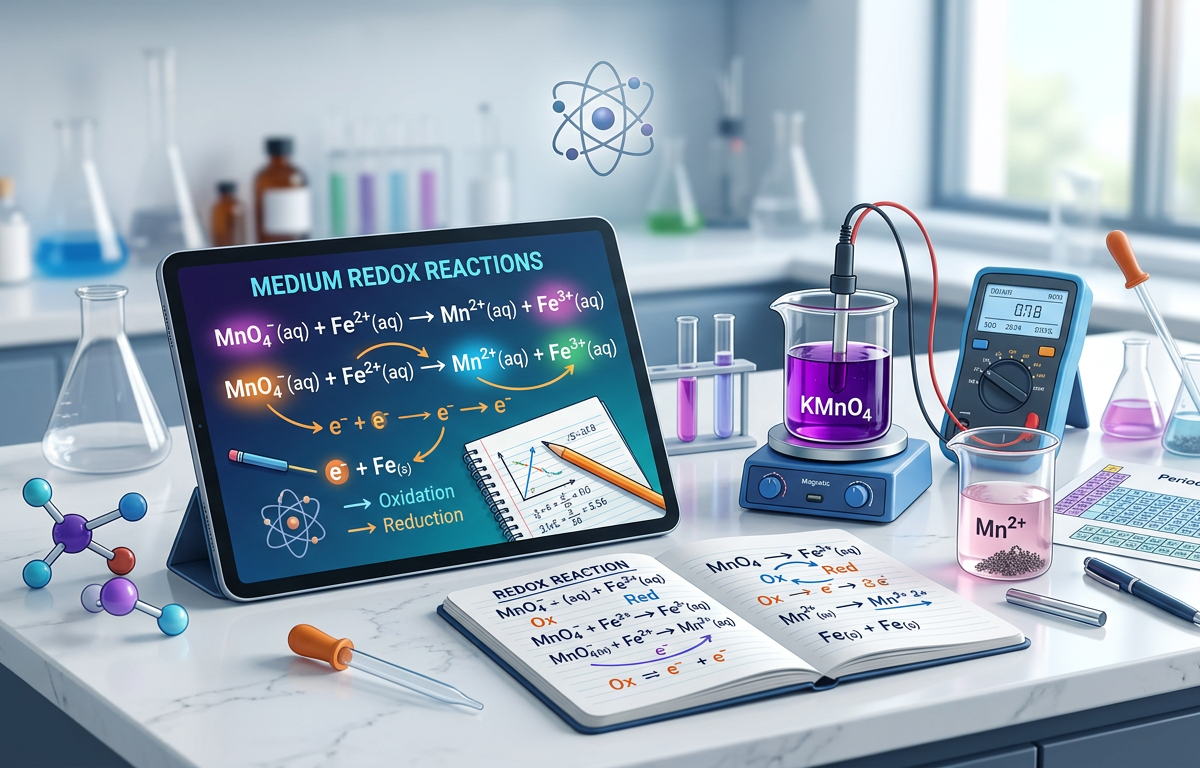
A redox reaction, or reduction-oxidation reaction, is a chemical process involving the transfer of electrons between two species, resulting in changes to their oxidation states. In every redox reaction, one substance undergoes oxidation (loses electrons) while another undergoes reduction (gains electrons). You can remember this using the mnemonic OIL RIG: Oxidation Is Loss, Reduction Is Gain. These reactions are fundamental to both biological systems, such as cellular respiration, and industrial applications like battery technology and electroplating. To master Medium Redox Reaction Practice Questions, you must be proficient in assigning oxidation numbers, identifying oxidizing and reducing agents, and balancing complex equations using the half-reaction method in both acidic and basic solutions. According to Wikipedia, the term "redox" comes from the words reduction and oxidation. Understanding these concepts is a prerequisite for more advanced topics like Nernst Equation Practice Questions with Answers.
Key Rules for Oxidation Numbers
The oxidation number of a free element (e.g., Na, H2, S8) is always 0.
The oxidation number of a monatomic ion equals its charge (e.g., Cl- is -1, Mg2+ is +2).
Oxygen is usually -2, except in peroxides (where it is -1) or with fluorine.
Hydrogen is +1 when bonded to nonmetals and -1 when bonded to metals (hydrides).
The sum of oxidation numbers in a neutral compound is 0; in a polyatomic ion, it equals the ion's charge.
Solved Examples
Reviewing these worked examples will help you prepare for the Balancing Redox Practice Questions with Answers found in more advanced modules.
Example 1: Identifying Agents
Identify the oxidizing agent and the reducing agent in the following reaction: Zn(s) + Cu2+(aq) → Zn2+(aq) + Cu(s).
Assign oxidation numbers: Zn changes from 0 to +2. Cu changes from +2 to 0.
Determine oxidation: Zn loses 2 electrons, so it is oxidized.
Determine reduction: Cu2+ gains 2 electrons, so it is reduced.
Identify agents: Since Zn is oxidized, it is the reducing agent. Since Cu2+ is reduced, it is the oxidizing agent.
Example 2: Balancing in Acidic Solution
Balance the following half-reaction in acidic solution: MnO4- → Mn2+.
Balance elements other than H and O: Mn is already balanced.
Balance O by adding H2O: MnO4- → Mn2+ + 4H2O.
Balance H by adding H+: MnO4- + 8H+ → Mn2+ + 4H2O.
Balance charge by adding electrons: The left side has a +7 charge, and the right has +2. Add 5e- to the left: MnO4- + 8H+ + 5e- → Mn2+ + 4H2O.
Example 3: Disproportionation Reaction
In the reaction Cl2 + 2OH- → Cl- + ClO- + H2O, identify which species is oxidized and which is reduced.
Assign oxidation numbers for Chlorine: Cl2 is 0. In Cl-, it is -1. In ClO-, it is +1.
Analyze the change: Some Cl atoms go from 0 to -1 (reduction). Other Cl atoms go from 0 to +1 (oxidation).
Conclusion: Cl2 acts as both the oxidizing and reducing agent. This is a disproportionation reaction.
Practice Questions
Test your knowledge with these Medium Redox Reaction Practice Questions. If you find these challenging, you may want to review Redox Reaction Practice Questions with Answers for foundational help.
Assign the oxidation number of Sulfur in the following species: H2SO4, S2O32-, and H2S.
Identify the substance oxidized, the substance reduced, the oxidizing agent, and the reducing agent in: 3MnO2 + 4Al → 3Mn + 2Al2O3.
Balance the following skeleton equation in acidic solution: Cr2O72- + Fe2+ → Cr3+ + Fe3+.
Want unlimited practice questions like these?
Generate AI-powered questions with step-by-step solutions on any topic.
Try Question Generator Free →Balance the following reaction occurring in basic solution: MnO4- + I- → MnO2 + I2.
Determine the oxidation state of Nitrogen in the following compounds: NH3, N2H4, and NO3-.
In the reaction 2PbS + 3O2 → 2PbO + 2SO2, which element is the reducing agent?
Balance the redox reaction: Cu + HNO3 → Cu2+ + NO (in acidic solution).
Calculate the total number of electrons transferred in the balanced equation: 2Al + 3Cu2+ → 2Al3+ + 3Cu.
Identify the oxidation state of Phosphorus in P4, PCl5, and PO43-.
Balance the following in basic solution: ClO- + Cr(OH)3 → Cl- + CrO42-.
Answers & Explanations
Answers: H2SO4 (+6), S2O32- (+2), H2S (-2).
Explanation: In H2SO4, 2(+1) + S + 4(-2) = 0 → S = +6. In S2O32-, 2S + 3(-2) = -2 → 2S = +4 → S = +2. In H2S, 2(+1) + S = 0 → S = -2.Answers: Oxidized: Al; Reduced: Mn; Oxidizing Agent: MnO2; Reducing Agent: Al.
Explanation: Mn goes from +4 to 0 (reduction). Al goes from 0 to +3 (oxidation).Answer: Cr2O72- + 14H+ + 6Fe2+ → 2Cr3+ + 6Fe3+ + 7H2O.
Explanation: The Cr half-reaction involves 6 electrons. The Fe half-reaction involves 1 electron. Multiply the Fe reaction by 6 to equalize electrons.Answer: 2MnO4- + 4H2O + 6I- → 2MnO2 + 8OH- + 3I2.
Explanation: Balance in acid first, then neutralize H+ with OH- on both sides to convert to basic conditions.Answers: NH3 (-3), N2H4 (-2), NO3- (+5).
Explanation: H is +1. In NH3: N + 3(1) = 0. In N2H4: 2N + 4(1) = 0. In NO3-: N + 3(-2) = -1.Answer: Sulfur (S).
Explanation: S in PbS is -2 and becomes +4 in SO2. Since S increases in oxidation state, it is oxidized and is the reducing agent.Answer: 3Cu + 8H+ + 2NO3- → 3Cu2+ + 2NO + 4H2O.
Explanation: Cu → Cu2+ + 2e- and NO3- + 4H+ + 3e- → NO + 2H2O. Multiply by 3 and 2 respectively to balance electrons.Answer: 6 electrons.
Explanation: Each Al loses 3 electrons (total 6), and each Cu2+ gains 2 electrons (total 6).Answers: P4 (0), PCl5 (+5), PO43- (+5).
Explanation: Elemental P is 0. Cl is -1, so P + 5(-1) = 0. O is -2, so P + 4(-2) = -3.Answer: 3ClO- + 2Cr(OH)3 + 4OH- → 3Cl- + 2CrO42- + 5H2O.
Explanation: Cr goes from +3 to +6 (3e- loss). Cl goes from +1 to -1 (2e- gain). Cross-multiply and balance O and H using basic rules.
1. What is the oxidation state of Manganese in KMnO4?
Frequently Asked Questions
What is the difference between an oxidizing agent and a reducing agent?
An oxidizing agent facilitates oxidation by accepting electrons and being reduced itself. Conversely, a reducing agent facilitates reduction by donating electrons and being oxidized in the process.
How do you balance oxygen atoms in a redox half-reaction?
In aqueous solutions, oxygen atoms are balanced by adding water (H2O) molecules to the side of the equation that is deficient in oxygen. This is a standard step in the half-reaction method.
Can an element have a fractional oxidation number?
Yes, fractional oxidation numbers can occur when they represent an average of different atoms of the same element in a complex structure, such as in the thiosulfate ion (S2O32-). However, individual atoms always exchange whole electrons.
Why is it necessary to balance charge in redox reactions?
Charge must be balanced to satisfy the Law of Conservation of Charge, ensuring that the number of electrons lost in the oxidation half-reaction exactly equals the number of electrons gained in the reduction half-reaction.
What is a disproportionation reaction?
A disproportionation reaction is a specific type of redox reaction where a single substance is simultaneously oxidized and reduced to form two different products with different oxidation states. Common examples include the decomposition of hydrogen peroxide.
Want unlimited practice questions like these?
Generate AI-powered questions with step-by-step solutions on any topic.
Try Question Generator Free →
Want unlimited practice questions like these?
Generate AI-powered questions with step-by-step solutions on any topic.
Try Question Generator Free →Enjoyed this article?
Share it with others who might find it helpful.
Related Articles
Hard Redox Reaction Practice Questions
Master complex chemistry with our Hard Redox Reaction Practice Questions. Learn to balance equations in acidic/basic media and calculate cell potentials.
Apr 4, 2026
Easy Redox Reaction Practice Questions
Master the basics of electron transfer with these easy redox reaction practice questions, featuring step-by-step solutions and clear explanations.
Apr 4, 2026
Redox Reaction Practice Questions with Answers
Master redox reactions with these practice questions and answers. Learn to identify oxidation, reduction, and balancing techniques for your chemistry exams.
Apr 3, 2026
Hard Balancing Redox Practice Questions
Master complex chemical equations with our hard balancing redox practice questions. Includes step-by-step solutions for acidic and basic media.
Apr 4, 2026
Medium Balancing Redox Practice Questions
Master medium-level redox balancing with our comprehensive guide featuring solved examples, step-by-step methods for acidic/basic solutions, and practice questions.
Apr 4, 2026
Stop Guessing: How to Balance Redox Charges Without Losing Electrons
Master the basics of oxidation-reduction with these easy balancing redox practice questions and step-by-step solutions for students.
Apr 4, 2026
Balancing Redox Practice Questions with Answers
Master balancing redox reactions with our comprehensive guide featuring step-by-step solved examples, practice questions in acidic and basic solutions, and a quick quiz.
Apr 3, 2026

Easy Reaction Order Practice Questions
Master chemical kinetics with these easy reaction order practice questions. Learn to calculate overall reaction orders and understand zero, first, and second-order reactions.
Apr 2, 2026