Medium Reaction Order Practice Questions
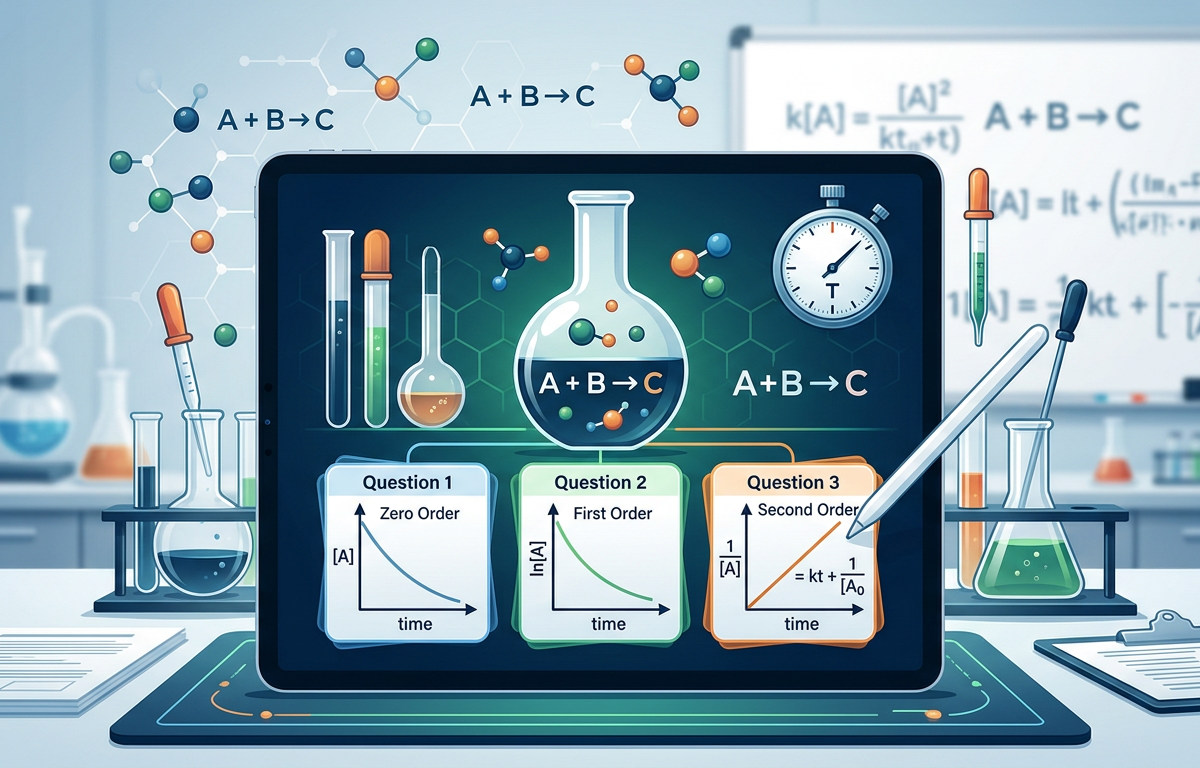
Concept Explanation
Reaction order is the power to which the concentration of a reactant is raised in a rate law, indicating how the rate of a chemical reaction changes in response to changes in that reactant's concentration. While the stoichiometry of a balanced equation tells us the ratio of reactants consumed, the reaction order must be determined experimentally. Total reaction order is the sum of the individual orders for each reactant in the rate law expression. For instance, if a reaction is first-order with respect to reactant A and second-order with respect to reactant B, the overall order is three. Understanding these relationships is critical for predicting how long a chemical process will take or how to optimize industrial yields. Many chemical kinetics studies use the Method of Initial Rates or integrated rate laws to verify these orders, as explained in resources like LibreTexts Chemistry or Khan Academy.
Solved Examples
Review these worked examples to understand how to manipulate experimental data to find the reaction order.
- Example 1: Determining Order from Initial Rates
For the reaction A + B → C, doubling [A] while keeping [B] constant quadruples the rate. When [B] is doubled while [A] is constant, the rate doubles. What is the rate law?- Compare the change in [A]: 2x = 4, so x = 2 (Second order in A).
- Compare the change in [B]: 2y = 2, so y = 1 (First order in B).
- Combine into the rate law: Rate = k[A]2[B]1.
- Example 2: Calculating the Rate Constant (k)
Using the rate law from Example 1, if the rate is 0.040 M/s when [A] = 0.20 M and [B] = 0.10 M, find k.- Plug values into the equation: 0.040 = k(0.20)2(0.10).
- Simplify: 0.040 = k(0.04)(0.10) → 0.040 = k(0.004).
- Solve for k: k = 0.040 / 0.004 = 10 M-2s-1.
- Example 3: Half-Life and First Order
A first-order reaction has a rate constant of 0.0231 min-1. Calculate its half-life.- Recall the formula for first-order half-life: t1/2 = 0.693 / k.
- Substitute k: t1/2 = 0.693 / 0.0231.
- Calculate: t1/2 = 30 minutes. You can practice more of these in our half-life calculations guide.
Practice Questions
Test your knowledge with these medium-difficulty reaction order practice questions. Ensure you have a calculator and periodic table handy.
1. In a reaction 2X + Y → Z, the rate triples when the concentration of Y is tripled. When the concentration of X is doubled, the rate increases by a factor of 8. What is the overall reaction order?
2. The rate constant for a second-order reaction is 0.54 M-1s-1. If the initial concentration of the reactant is 0.25 M, how long will it take for the concentration to drop to 0.10 M?
3. Consider the reaction A + B → Products. If the rate law is Rate = k[A][B]2, by what factor does the rate change if the volume of the reaction vessel is halved (thereby doubling all concentrations)?
Want unlimited practice questions like these?
Generate AI-powered questions with step-by-step solutions on any topic.
Try Question Generator Free →4. A reaction is found to be zero-order with respect to reactant A. If the initial concentration is 1.0 M and the rate constant is 0.050 M/s, what is the concentration of A after 10 seconds?
5. The decomposition of N2O5 follows first-order kinetics. If the rate constant is 4.8 x 10⁻⁴ s-1 at a specific temperature, what percentage of the sample remains after 20 minutes?
6. For the reaction 3A → B, a plot of 1/[A] versus time yields a straight line with a positive slope. What is the reaction order with respect to A?
7. If a reaction's rate triples when the concentration of a reactant is increased nine-fold, what is the order of the reaction with respect to that reactant?
8. A reaction has the rate law Rate = k[A]0.5[B]. If [A] is quadrupled and [B] is halved, what happens to the overall rate?
Answers & Explanations
- Answer: 4.
Explanation: For Y, 3y = 3, so y = 1 (first order). For X, 2x = 8, so x = 3 (third order). Overall order = 1 + 3 = 4. - Answer: 11.1 seconds.
Explanation: Use the second-order integrated rate law: 1/[A]t - 1/[A]0 = kt. Plugging in: 1/0.10 - 1/0.25 = 0.54t → 10 - 4 = 0.54t → 6 = 0.54t → t = 11.11 s. - Answer: Increases by a factor of 8.
Explanation: If volume is halved, concentration doubles. Rate' = k(2[A])(2[B])2 = k(2[A])(4[B]2) = 8(k[A][B]2). - Answer: 0.5 M.
Explanation: Zero-order rate law: [A]t = -kt + [A]0. [A]t = -(0.050)(10) + 1.0 = -0.5 + 1.0 = 0.5 M. - Answer: 56.2%.
Explanation: First-order: ln([A]t/[A]0) = -kt. t = 20 min = 1200 s. ln(ratio) = -(4.8 x 10⁻⁴)(1200) = -0.576. Ratio = e-0.576 = 0.562 or 56.2%. - Answer: Second-order.
Explanation: Integrated rate laws dictate that a linear plot of 1/[Conc] vs time is characteristic of second-order kinetics. - Answer: 0.5 (or Half-order).
Explanation: 9x = 3. Since 3 is the square root of 9, x must be 0.5. - Answer: The rate remains unchanged.
Explanation: (4)0.5 × (0.5) = 2 × 0.5 = 1. The rate is multiplied by 1, meaning it stays the same.
1. Which of the following units represents the rate constant for a first-order reaction?
Frequently Asked Questions
What is the difference between molecularity and reaction order?
Molecularity refers to the number of molecules reacting in an elementary step and is always a whole number, while reaction order is an experimentally determined value that can be zero or fractional. You can learn more about elementary steps in reaction order practice questions.
Can a reaction order be negative?
Yes, a negative reaction order occurs when increasing the concentration of a substance actually decreases the rate of the reaction, often seen in complex mechanisms where a product inhibits the forward process. This usually indicates a multi-step mechanism where one species competes for an active site.
How do you determine the units of the rate constant (k)?
The units of k are calculated using the formula M^(1-n) · t^-1, where n is the overall reaction order and t is time. For example, a third-order reaction would have units of M^-2s^-1.
Why is the reaction order not always equal to the stoichiometric coefficients?
Reaction order depends on the slowest step (rate-determining step) of the mechanism, not the overall balanced equation. For more on temperature effects on these rates, see the Arrhenius equation practice questions.
What does a zero-order reaction imply about the catalyst?
A zero-order reaction often implies that the reaction rate is limited by the available surface area of a catalyst or enzyme, meaning the system is saturated. Once all active sites are occupied, adding more reactant does not speed up the process.
Enjoyed this article?
Share it with others who might find it helpful.
Related Articles

Easy Reaction Order Practice Questions
Master chemical kinetics with these easy reaction order practice questions. Learn to calculate overall reaction orders and understand zero, first, and second-order reactions.
Apr 2, 2026
Hard Redox Reaction Practice Questions
Master complex chemistry with our Hard Redox Reaction Practice Questions. Learn to balance equations in acidic/basic media and calculate cell potentials.
Apr 4, 2026
Medium Redox Reaction Practice Questions
Master medium-level redox reaction problems with our comprehensive guide featuring solved examples, balancing tips, and practice questions for students.
Apr 4, 2026
Easy Redox Reaction Practice Questions
Master the basics of electron transfer with these easy redox reaction practice questions, featuring step-by-step solutions and clear explanations.
Apr 4, 2026
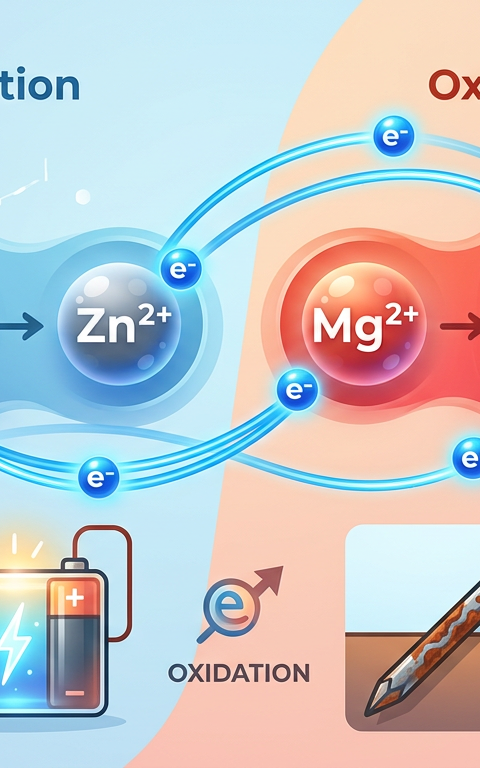
Redox Reaction Practice Questions with Answers
Master redox reactions with these practice questions and answers. Learn to identify oxidation, reduction, and balancing techniques for your chemistry exams.
Apr 3, 2026
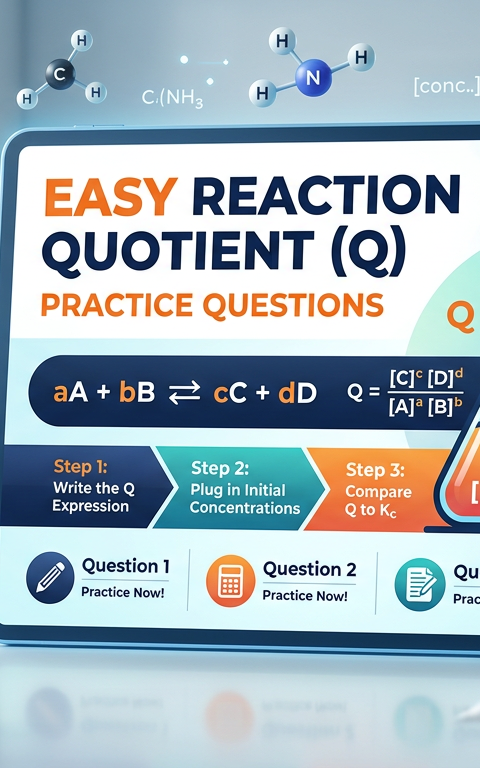
Predicting Reaction Direction: Q vs K Comparison Practice
Master the reaction quotient (Q) with these easy practice questions. Learn how to calculate Q and predict the direction of chemical shifts.
Mar 30, 2026
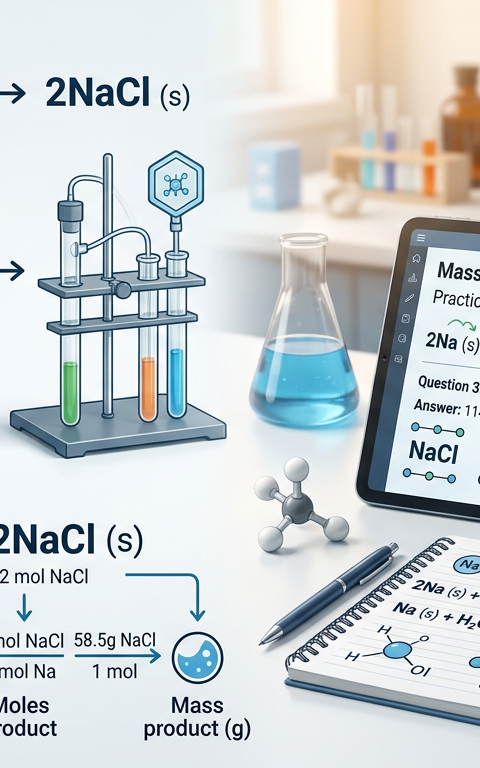
Predicting Reaction Yields: Grams-to-Grams Stoichiometry Guide
Master mass-to-mass stoichiometry with our comprehensive guide. Includes step-by-step solved examples, practice questions, and a quick quiz to test your knowledge.
Mar 21, 2026

Calculating High-Stakes Meds: BSA Mosteller Formula Practice
Master hard body surface area-based dosage calculations with our comprehensive guide, solved examples, and practice questions for healthcare students.
May 17, 2026