Arrhenius Equation Practice Questions with Answers
1. Concept Explanation
The Arrhenius equation is a mathematical expression that describes the relationship between the rate constant of a chemical reaction, the absolute temperature, and the activation energy. This fundamental principle of chemical kinetics explains how chemical reactions speed up as temperature increases by quantifying the fraction of molecules that possess enough kinetic energy to overcome the energy barrier. Developed by Svante Arrhenius in 1889, the equation is typically written in its exponential form: k = Ae^(-Ea/RT).
To understand the Arrhenius equation, one must identify its individual components:
- k: The rate constant, which depends on the temperature.
- A: The pre-exponential factor (or frequency factor), representing the frequency of collisions with the correct orientation.
- Ea: The activation energy, the minimum energy required for a reaction to occur (usually in Joules per mole, J/mol).
- R: The universal gas constant (8.314 J/mol·K).
- T: The absolute temperature (measured in Kelvin).
In many practical scenarios, scientists use the logarithmic form of the equation to create linear plots. By taking the natural log of both sides, we get: ln(k) = -Ea/R(1/T) + ln(A). This follows the linear format y = mx + c, where a plot of ln(k) versus 1/T yields a straight line with a slope of -Ea/R. If you are preparing for high-stakes tests, learning to manipulate these variables is as essential as knowing how to study for exams for the MCAT or other professional certifications.
2. Solved Examples
Reviewing these worked examples will help you master the algebraic manipulations required for chemistry kinetics problems.
Example 1: Calculating the Rate Constant
A reaction has an activation energy of 52.0 kJ/mol and a frequency factor of 2.5 x 10^11 s^-1. Calculate the rate constant at 300 K.
- Convert Ea to J/mol: 52.0 kJ/mol × 1000 = 52,000 J/mol.
- Identify constants: R = 8.314 J/mol·K, T = 300 K, A = 2.5 × 10^11.
- Plug into the equation: k = (2.5 × 10^11) * e^(-52000 / (8.314 * 300)).
- Calculate the exponent: -52000 / 2494.2 = -20.848.
- Solve for k: k = (2.5 × 10^11) * (8.82 × 10^-10) = 220.5 s^-1.
Example 2: Finding Activation Energy from Two Temperatures
The rate constant for a reaction is 0.010 s^-1 at 298 K and 0.050 s^-1 at 318 K. Calculate the activation energy (Ea).
- Use the two-point form: ln(k2/k1) = (Ea/R) * (1/T1 - 1/T2).
- Plug in values: ln(0.050 / 0.010) = (Ea / 8.314) * (1/298 - 1/318).
- Simplify: ln(5) = (Ea / 8.314) * (0.003356 - 0.003145).
- 1.609 = (Ea / 8.314) * (0.000211).
- Ea = (1.609 * 8.314) / 0.000211 = 63,400 J/mol or 63.4 kJ/mol.
Example 3: Determining Temperature
If a reaction has an Ea of 80 kJ/mol and k = 1.2 x 10^-3 s^-1 at 350 K, at what temperature will k be 4.8 x 10^-3 s^-1?
- Identify variables: k1=1.2e-3, k2=4.8e-3, T1=350, Ea=80,000.
- Set up the ratio: ln(4.8e-3 / 1.2e-3) = (80000 / 8.314) * (1/350 - 1/T2).
- ln(4) = 9622.3 * (0.002857 - 1/T2).
- 1.386 / 9622.3 = 0.002857 - 1/T2.
- 0.000144 = 0.002857 - 1/T2 → 1/T2 = 0.002713.
- T2 = 1 / 0.002713 = 368.6 K.
3. Practice Questions
Test your knowledge with these Arrhenius equation practice questions. Ensure you have a calculator and a periodic table handy if needed.
- A first-order reaction has a rate constant of 4.5 x 10^-4 s^-1 at 20°C. If the activation energy is 100 kJ/mol, what is the rate constant at 50°C?
- Calculate the activation energy (in kJ/mol) for a reaction whose rate constant doubles when the temperature is increased from 300 K to 310 K.
- The decomposition of nitrosyl chloride has an activation energy of 100 kJ/mol. At 350 K, the rate constant is 8.0 x 10^-6 L/mol·s. Find the frequency factor (A).
Want unlimited practice questions like these?
Generate AI-powered questions with step-by-step solutions on any topic.
Try Question Generator Free →- A specific biochemical reaction is found to have an activation energy of 45 kJ/mol. By what factor does the rate increase if the temperature is raised from 25°C to 37°C (body temperature)?
- A chemist plots ln(k) vs 1/T for a reaction and finds the slope of the line to be -1.2 x 10^4 K. What is the activation energy of the reaction?
- At 400 K, a reaction has a rate constant of 2.0 x 10^-2. If the pre-exponential factor is 1.5 x 10^10, calculate the activation energy.
- Reaction A has Ea = 50 kJ/mol. Reaction B has Ea = 100 kJ/mol. If both have the same frequency factor, which reaction is faster at 300 K, and by how many times?
- A reaction rate triples when the temperature is raised from 25°C to 45°C. Calculate the activation energy.
- Find the temperature at which the rate constant of a reaction will be 10 times its value at 298 K, given Ea = 75 kJ/mol.
- If the activation energy of a reaction is 0 J/mol, how does the rate constant change with temperature?
4. Answers & Explanations
Compare your results with the detailed solutions below. If you find these difficult, you might want to learn how to study for exams when overwhelmed to manage your study load effectively.
- Answer: 0.021 s^-1. Convert temperatures to Kelvin (293 K and 323 K). Use ln(k2/k1) = (100,000/8.314) * (1/293 - 1/323). ln(k2/4.5e-4) = 12027.9 * 0.000316 = 3.80. k2/4.5e-4 = e^3.80 = 44.7. k2 = 0.0201 s^-1.
- Answer: 53.6 kJ/mol. ln(2) = (Ea/8.314) * (1/300 - 1/310). 0.693 = (Ea/8.314) * 0.0001075. Ea = (0.693 * 8.314) / 0.0001075 = 53,598 J/mol.
- Answer: 7.08 x 10^8 L/mol·s. Use k = Ae^(-Ea/RT). 8.0e-6 = A * e^(-100000 / (8.314 * 350)). 8.0e-6 = A * e^-34.37. 8.0e-6 = A * 1.13e-15. A = 7.08e9. (Note: calculations may vary slightly with rounding).
- Answer: 2.05 times. ln(k2/k1) = (45,000/8.314) * (1/298 - 1/310). ln(ratio) = 5412.5 * 0.00013 = 0.703. Ratio = e^0.703 = 2.02.
- Answer: 99.8 kJ/mol. Slope = -Ea/R. -12,000 = -Ea / 8.314. Ea = 12,000 * 8.314 = 99,768 J/mol.
- Answer: 93.1 kJ/mol. ln(k/A) = -Ea/RT. ln(2.0e-2 / 1.5e10) = -Ea / (8.314 * 400). -27.99 = -Ea / 3325.6. Ea = 93,083 J/mol.
- Answer: Reaction A; 5.1 x 10^8 times. The ratio of rates kA/kB = e^((EaB - EaA)/RT). kA/kB = e^(50000 / (8.314 * 300)) = e^20.04 = 5.1e8.
- Answer: 43.1 kJ/mol. ln(3) = (Ea/8.314) * (1/298 - 1/318). 1.0986 = (Ea/8.314) * 0.000211. Ea = 43,280 J/mol.
- Answer: 324.7 K. ln(10) = (75,000/8.314) * (1/298 - 1/T2). 2.303 / 9020.9 = 0.003356 - 1/T2. 0.000255 = 0.003356 - 1/T2. 1/T2 = 0.003101. T2 = 322.5 K.
- Answer: It remains constant. If Ea = 0, the term e^(-Ea/RT) becomes e^0, which is 1. Thus, k = A, and temperature has no effect on the rate.
1. What happens to the rate constant (k) as the activation energy (Ea) of a reaction increases?
6. Frequently Asked Questions
What is the physical meaning of the pre-exponential factor A?
The pre-exponential factor, or frequency factor, represents the total number of collisions between reactant molecules per second that occur with the correct geometric orientation to result in a reaction. It accounts for the probability that a collision will be effective regardless of the energy involved.
Does activation energy change with temperature?
In the standard Arrhenius model, activation energy is assumed to be independent of temperature over a narrow range of temperatures. While slight variations can occur in complex systems, for most chemistry problems, Ea is treated as a constant characteristic of the specific reaction.
Why is the Arrhenius equation important in the food industry?
Food scientists use the Arrhenius equation to predict the shelf life of products and the rate of spoilage or nutrient degradation at different storage temperatures. This allows for the calculation of "Q10" values, which describe how much the rate of a reaction increases with a 10-degree Celsius rise in temperature.
Can the Arrhenius equation be used for all chemical reactions?
The Arrhenius equation is highly accurate for simple gas-phase and solution-phase reactions, but it may fail for complex enzyme-catalyzed reactions or reactions with multiple steps where the rate-limiting step changes. In such cases, more advanced models like Transition State Theory are used.
How do catalysts affect the Arrhenius equation?
A catalyst works by providing an alternative reaction pathway with a lower activation energy (Ea). In the context of the Arrhenius equation, lowering Ea results in a larger value for the exponential term, which significantly increases the rate constant (k) even if the temperature remains constant.
What is the difference between the linear and exponential forms?
The exponential form (k = Ae^-Ea/RT) is the base mathematical description of the relationship, while the linear form (ln k vs 1/T) is a rearranged version used for graphical analysis. The linear form allows researchers to easily calculate Ea from the slope and A from the intercept of experimental data. If you are struggling with these mathematical transformations, check out our guide on why studying for exams feels hard to improve your quantitative skills.
Enjoyed this article?
Share it with others who might find it helpful.
Related Articles
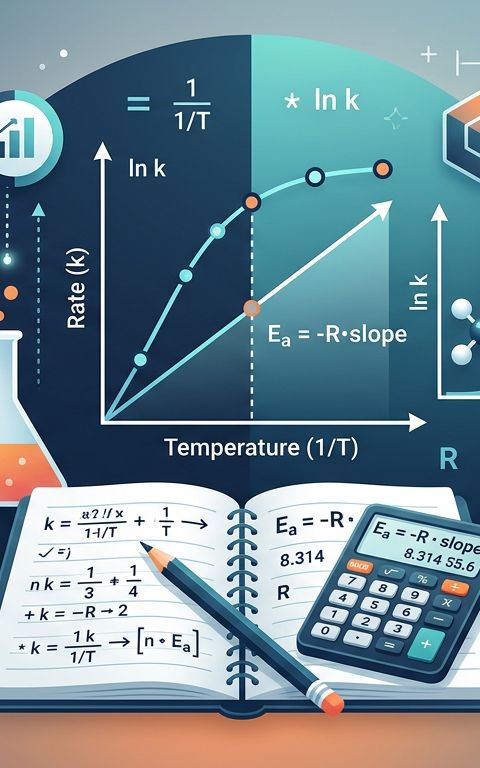
Medium Arrhenius Equation Practice Questions
Master the Arrhenius equation with our medium-level practice questions, including step-by-step solutions for activation energy and rate constant calculations.
Apr 2, 2026

Easy Arrhenius Equation Practice Questions
Master the Arrhenius Equation with these easy practice questions. Learn to calculate rate constants, activation energy, and temperature effects on reactions.
Apr 2, 2026

Absolute Value Equation Practice Questions with Answers
Master the absolute value equation with our comprehensive guide. Includes step-by-step solved examples, practice questions, and detailed explanations.
Apr 6, 2026
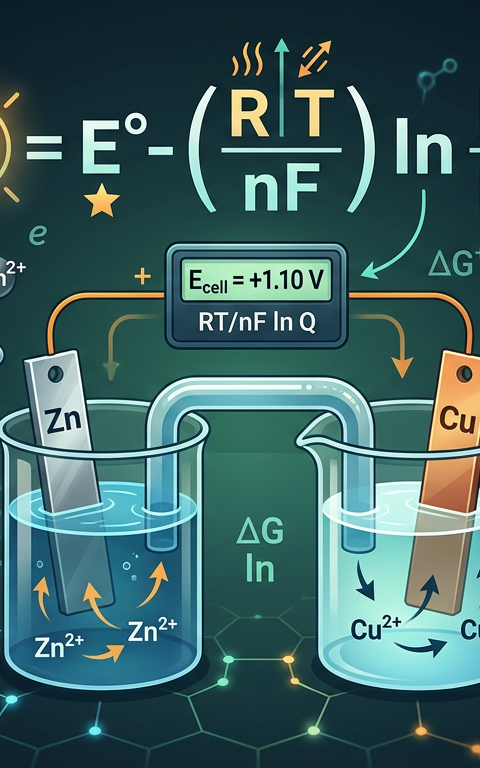
Hard Nernst Equation Practice Questions
Master the Nernst equation with these hard practice questions. Learn to calculate cell potentials under non-standard conditions with step-by-step solutions.
Apr 4, 2026

Medium Nernst Equation Practice Questions
Master the Nernst equation with these medium-level practice questions and detailed solutions. Perfect for chemistry students tackling non-standard cell potentials.
Apr 4, 2026
Easy Nernst Equation Practice Questions
Master the Nernst Equation with these easy practice questions and step-by-step solutions. Learn to calculate cell potentials under non-standard conditions.
Apr 4, 2026

Predicting Voltage: Solving Nernst Equation Problems at Non-Standard State
Master the Nernst equation with our comprehensive practice guide. Includes solved examples, step-by-step calculations, and a quick quiz to test your knowledge.
Apr 3, 2026
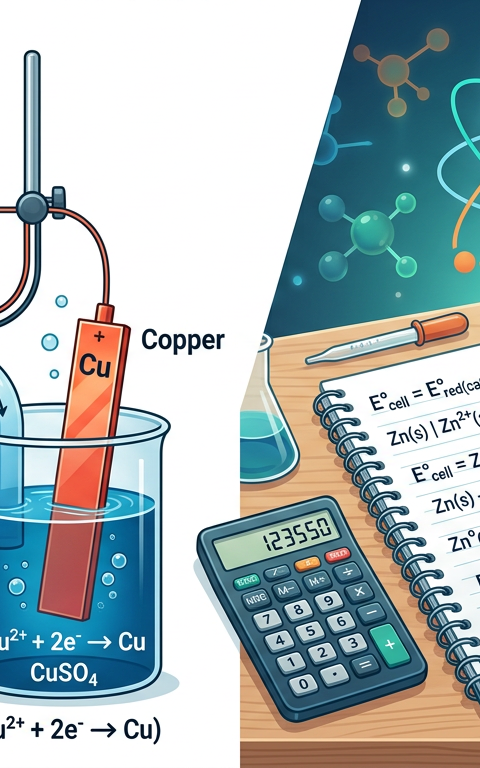
Mastering E°cell: Identifying Anodes and Using the Nernst Equation
Master cell potential calculations with our guide. Includes solved examples, Nernst equation practice, and 10 detailed questions with answers.
Apr 3, 2026