Medium pH Calculation Practice Questions
Concept Explanation
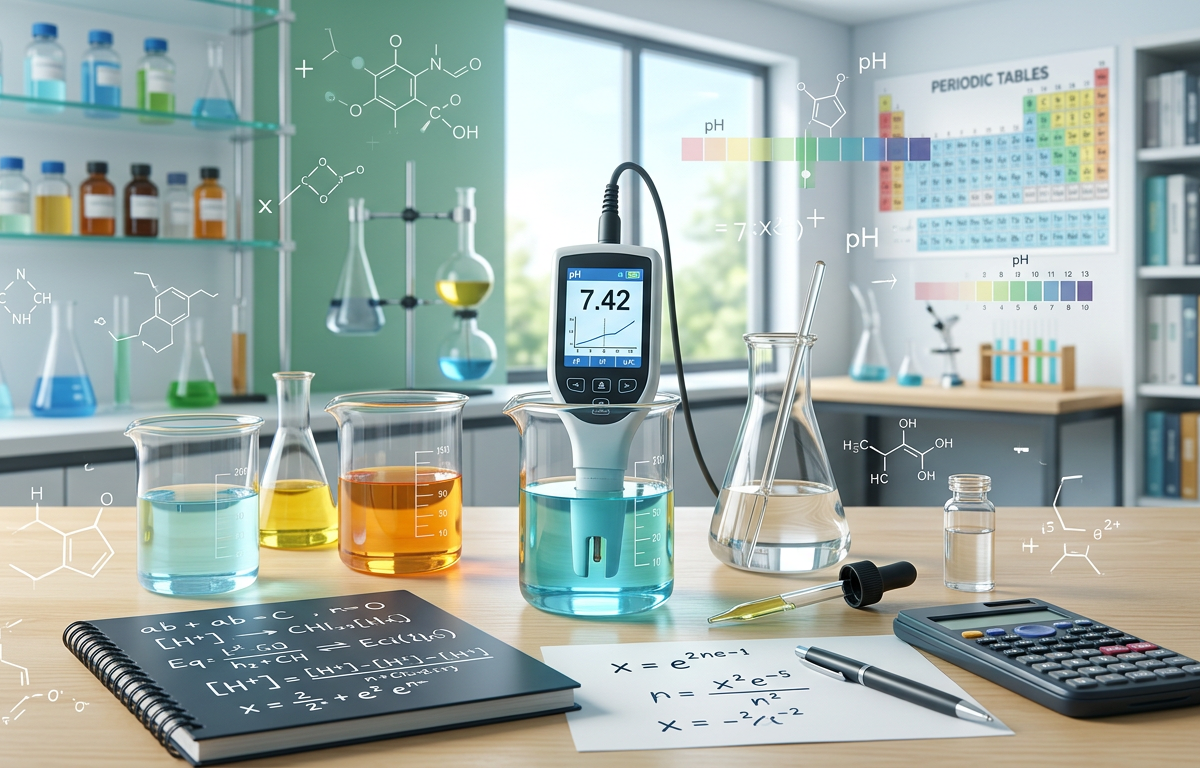
pH calculation is the quantitative measure of the acidity or alkalinity of a solution, determined by the negative logarithm of the hydronium ion concentration ([H₃O⁺]). The pH scale typically ranges from 0 to 14, where a pH less than 7 indicates an acidic solution, a pH of 7 is neutral, and a pH greater than 7 is basic. This logarithmic relationship means that each whole pH unit represents a tenfold change in acidity. To master these calculations, one must understand the relationship between pH, pOH, and the ion-product constant of water (Kw), which is 1.0 × 10⁻¹⁴ at 25°C. For strong acids and bases, the concentration of the solute directly relates to the ion concentration due to complete dissociation. However, for weak acids and bases, one must utilize the Ka and Kb calculations to account for partial ionization. According to Wikipedia's definition of pH, the concept was first introduced by Danish chemist Søren Peder Lauritz Sørensen in 1909.
Solved Examples
Calculate the pH of a 0.025 M solution of Nitric Acid (HNO₃).
Identify the substance: HNO₃ is a strong acid, meaning it dissociates completely: HNO₃ → H⁺ + NO₃⁻.
Determine the [H⁺]: Since it is monoprotic, [H⁺] = [HNO₃] = 0.025 M.
Apply the pH formula: pH = -log[H⁺].
Calculate: pH = -log(0.025) ≈ 1.60.
Find the pH of a 0.0040 M Ba(OH)₂ solution.
Identify the substance: Ba(OH)₂ is a strong base that releases two hydroxide ions: Ba(OH)₂ → Ba²⁺ + 2OH⁻.
Determine the [OH⁻]: [OH⁻] = 2 × 0.0040 M = 0.0080 M.
Calculate pOH: pOH = -log(0.0080) ≈ 2.10.
Convert to pH: pH = 14.00 - pOH = 14.00 - 2.10 = 11.90.
What is the pH of a 0.15 M Acetic acid solution with a Ka of 1.8 × 10⁻⁵?
Set up the equilibrium: HA ⇌ H⁺ + A⁻.
Use the Ka expression: Ka = [H⁺][A⁻] / [HA]. Let [H⁺] = x.
Substitute values: 1.8 × 10⁻⁵ = x² / 0.15 (assuming x is small relative to 0.15).
Solve for x: x = √(1.8 × 10⁻⁵ × 0.15) = 0.00164 M.
Calculate pH: pH = -log(0.00164) ≈ 2.78.
Practice Questions
Calculate the pH of a 0.005 M solution of H₂SO₄, assuming both protons dissociate completely.
A solution has a pOH of 4.75. What is its pH and hydronium ion concentration?
Calculate the pH of a 0.012 M KOH solution.
[CTA_BLOCK_0]
Find the pH of a solution prepared by dissolving 0.50 grams of NaOH in enough water to make 250 mL of solution.
Determine the pH of a 0.10 M Ammonia (NH₃) solution (Kb = 1.8 × 10⁻⁵).
What is the pH of a solution where the [OH⁻] is 3.5 × 10⁻⁹ M?
Calculate the pH of a buffer containing 0.10 M HF and 0.20 M NaF (Ka for HF = 7.2 × 10⁻⁴).
A 0.050 M weak acid solution has a pH of 3.45. Calculate the Ka of the acid.
Calculate the pH of a solution formed by mixing 50 mL of 0.10 M HCl with 50 mL of 0.05 M NaOH.
What is the final pH if 10 mL of 1.0 M HCl is diluted to a total volume of 1.0 L?
Answers & Explanations
pH = 2.00. H₂SO₄ is diprotic. [H⁺] = 2 × 0.005 M = 0.01 M. pH = -log(0.01) = 2.
pH = 9.25; [H⁺] = 5.6 × 10⁻¹⁰ M. pH = 14 - 4.75 = 9.25. [H⁺] = 10⁻⁹·²⁵.
pH = 12.08. KOH is a strong base. [OH⁻] = 0.012 M. pOH = -log(0.012) = 1.92. pH = 14 - 1.92 = 12.08.
pH = 12.70. Moles NaOH = 0.50g / 40.0g/mol = 0.0125 mol. Molarity = 0.0125 mol / 0.250 L = 0.05 M. pOH = -log(0.05) = 1.30. pH = 14 - 1.30 = 12.70.
pH = 11.13. Kb = [OH⁻][NH₄⁺]/[NH₃]. 1.8 × 10⁻⁵ = x² / 0.10. x = [OH⁻] = 0.00134 M. pOH = 2.87. pH = 14 - 2.87 = 11.13.
pH = 5.54. pOH = -log(3.5 × 10⁻⁹) = 8.46. pH = 14 - 8.46 = 5.54.
pH = 3.44. Use the Henderson-Hasselbalch equation: pH = pKa + log([Base]/[Acid]). pKa = -log(7.2 × 10⁻⁴) = 3.14. pH = 3.14 + log(0.20/0.10) = 3.14 + 0.30 = 3.44.
Ka = 2.5 × 10⁻⁶. [H⁺] = 10⁻³·⁴⁵ = 3.55 × 10⁻⁴. Ka = [H⁺]² / [HA] = (3.55 × 10⁻⁴)² / 0.050 = 2.52 × 10⁻⁶.
pH = 1.60. Moles H⁺ = 0.005, moles OH⁻ = 0.0025. Excess H⁺ = 0.0025 mol. Total volume = 0.100 L. [H⁺] = 0.025 M. pH = -log(0.025) = 1.60.
pH = 2.00. Initial moles = 1.0 M × 0.01 L = 0.01 mol. New Molarity = 0.01 mol / 1.0 L = 0.01 M. pH = -log(0.01) = 2.00. Refer to dilution practice questions for more on this technique.
1. If a solution has a pH of 4, what is the concentration of hydronium ions?
Frequently Asked Questions
What is the relationship between pH and [H⁺]?
The pH is the negative base-10 logarithm of the molar concentration of hydrogen ions in a solution. As the concentration of hydrogen ions increases, the pH value decreases, indicating a more acidic environment.
Can pH values be negative?
Yes, pH values can be negative if the concentration of a strong acid is greater than 1.0 M. For example, a 2.0 M HCl solution has a theoretical pH of -0.30, though measurements in highly concentrated solutions are complex.
How does temperature affect pH calculation?
Temperature changes the value of the ion-product constant of water (Kw), which is only 1.0 x 10⁻¹⁴ at 25°C. For more information on environmental factors, see Khan Academy's Acid-Base resources.
Why is pH 7 considered neutral?
At 25°C, pure water auto-ionizes to produce equal concentrations of H⁺ and OH⁻ ions at 1.0 x 10⁻⁷ M each. Since pH is the negative log of this concentration, the resulting value is 7.
What is the difference between pH and pOH?
pH measures the acidity based on hydrogen ion concentration, while pOH measures alkalinity based on hydroxide ion concentration. In aqueous solutions at standard temperature, the sum of pH and pOH always equals 14.
Want unlimited practice questions like these?
Generate AI-powered questions with step-by-step solutions on any topic.
Try Question Generator Free →Enjoyed this article?
Share it with others who might find it helpful.
Related Articles
Hard Le Chatelier’s Principle Practice Questions
Master Hard Le Chatelier’s Principle Practice Questions with our comprehensive guide featuring solved examples, practice problems, and detailed explanations.
Mar 30, 2026
Hard Reaction Quotient (Q) Practice Questions
Hard Reaction Quotient (Q) Practice Questions
Mar 30, 2026
Grams to Moles Practice Questions with Answers
Master grams to moles conversions with our comprehensive guide. Includes step-by-step examples, practice questions, and detailed answers for chemistry students.
Mar 26, 2026
Avogadro’s Number Practice Questions with Answers
Master the mole concept with our Avogadro’s Number practice questions. Includes step-by-step solved examples, a quick quiz, and detailed explanations.
Mar 26, 2026
Empirical Formulas: Solving Ratios from Mass and Percent Data
Master empirical formula calculations with 10 practice questions, worked answers, and a free step-by-step calculator for mass, percentage, and combustion problems.
Mar 26, 2026