Applying MHC Restriction and Clonal Selection to MCAT Passages
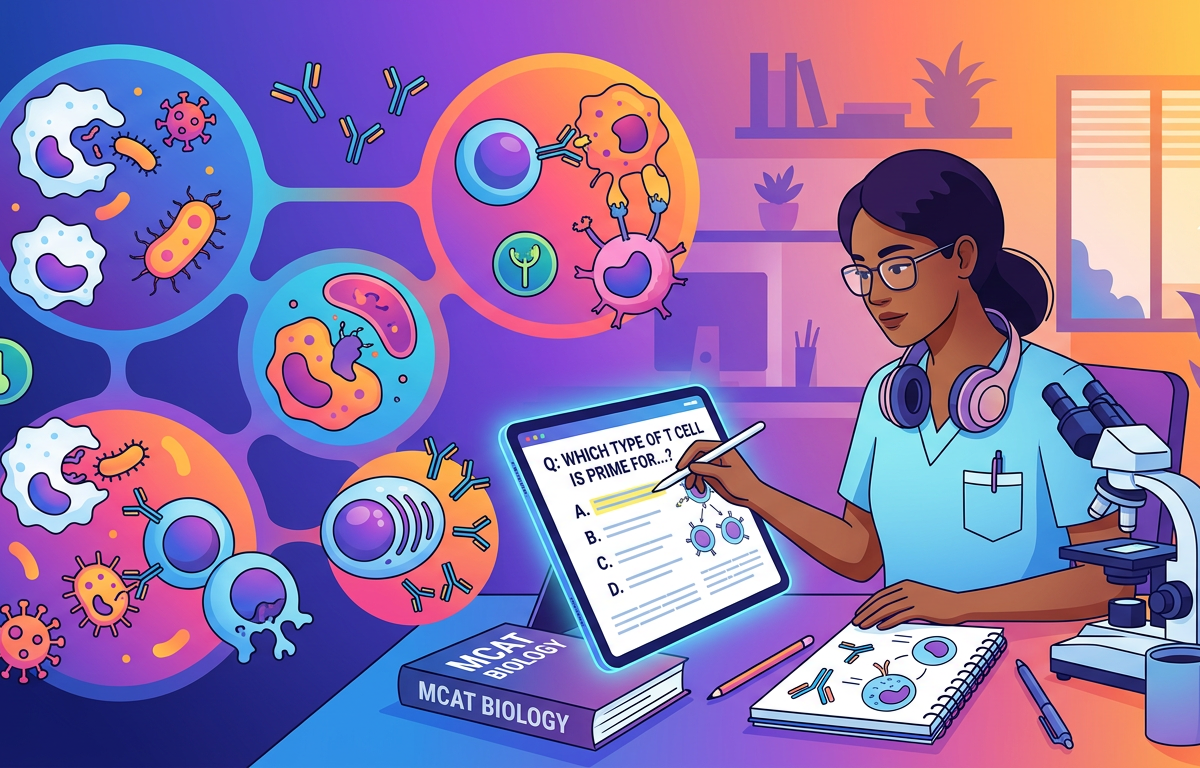
When you see a question about a cell expressing MHC II, your first instinct might be to list every immune cell you know. However, the MCAT requires a narrower focus on professional antigen presenting cells like macrophages and B cells. A common mistake is assuming all nucleated cells can activate helper T cells. In reality, while every nucleated cell uses MHC I to signal internal infection to CD8+ cytotoxic cells, only a specific subset uses MHC II to coordinate the broader systemic response through CD4+ cells.
Intermediate level questions often hinge on the structural differences between the heavy and light chains of an antibody. If a mutation alters the variable region, the entire humoral response may fail because the paratope can no longer achieve high affinity binding with the antigen. Moving beyond simple definitions means understanding the physical consequences of these genetic shifts. This set of problems focuses on those exact distinctions, forcing you to choose between similar looking mechanisms like passive versus active immunity based on the source of the antibodies involved.
Medium MCAT Immune System Practice Questions
Mastering the intricacies of the human defense network is a vital step for any aspiring medical student, and working through medium MCAT immune system practice questions is one of the most effective ways to bridge the gap between basic memorization and clinical application. The immune system is a complex, multi-layered framework designed to protect the body from pathogens, ranging from simple physical barriers like the skin to the sophisticated, highly specific responses of T and B lymphocytes. Because the MCAT frequently tests the integration of biological systems, understanding how immune cells interact with the circulatory and lymphatic systems is essential for a high score. By engaging in retrieval practice, you can ensure that these concepts move from short-term recognition to long-term mastery.
Lineages of Adaptive and Innate Defense
The immune system is a biological structure of cells, tissues, and organs that collaborates to protect the body against foreign invaders such as bacteria, viruses, and parasites. It is traditionally divided into two main branches: the innate (non-specific) immune system and the adaptive (specific) immune system. The innate system provides the first line of defense and responds identically to all pathogens; it includes physical barriers, the complement system, and phagocytic cells like neutrophils and macrophages. In contrast, the adaptive system is characterized by its ability to recognize specific antigens and maintain immunological memory. This branch relies on B cells, which produce antibodies for humoral immunity, and T cells, which manage cell-mediated immunity by directly killing infected cells or coordinating the overall response. Understanding the maturation of these cells—B cells in the bone marrow and T cells in the thymus—is a frequent topic in MCAT biology exam practice.
Key concepts often tested on the MCAT include:
- Major Histocompatibility Complex (MHC): MHC I is found on all nucleated cells and presents endogenous antigens to CD8+ T cells, while MHC II is found on professional antigen-presenting cells (APCs) and presents exogenous antigens to CD4+ T cells.
- Clonal Selection: The process by which only those B or T cells with receptors specific to an invading antigen are activated and proliferated.
- The Lymphatic System: A network of vessels that drains interstitial fluid, transports dietary lipids, and serves as a staging ground for immune cell activation in lymph nodes.
Solved Examples
Reviewing these solved examples will help you understand the logic required for medium-difficulty MCAT questions.
- Example: Antigen Presentation
A researcher identifies a cell that expresses MHC II on its surface. Which of the following cells could this be?
Solution:- Identify the role of MHC II: It is used to present exogenous antigens to helper T cells.
- Recall which cells are "professional" antigen-presenting cells (APCs).
- These include macrophages, dendritic cells, and B cells.
- Therefore, if the cell is a macrophage, it will express MHC II.
- Example: Antibody Structure
If a mutation occurs in the DNA encoding the variable region of an antibody's heavy chain, what is the most likely functional consequence?
Solution:- Determine the function of the variable region: It is responsible for antigen binding (the paratope).
- Analyze the impact of a mutation here: It would likely change the shape or chemical affinity of the binding site.
- Conclusion: The antibody may no longer recognize its specific antigen, impairing the humoral response.
- Example: Passive vs. Active Immunity
A patient receives an injection of gamma globulins after being exposed to Hepatitis B. What type of immunity does this provide?
Solution:- Define the treatment: Gamma globulins are pre-formed antibodies.
- Distinguish between active and passive: Active involves the body making its own antibodies; passive involves receiving them from an external source.
- Conclusion: This is artificial passive immunity, providing immediate but temporary protection.
Practice Questions
Test your knowledge with these medium MCAT immune system practice questions. Use these to refine your active recall strategies.
- Which of the following describes the primary role of the complement system in the innate immune response?
- A specific pathogen enters the cytosol of a liver cell. Which molecule is responsible for presenting fragments of this pathogen to the immune system?
- During an inflammatory response, histamine is released to increase capillary permeability. Which cell type is primarily responsible for this release in the connective tissue?
Need more MCAT practice questions?
Generate unlimited MCAT-style questions with instant explanations and adaptive practice powered by Bevinzey AI.
Generate Questions Free- A patient has a rare genetic defect that prevents the development of the thymus. Which of the following immune functions would be most severely compromised?
- How does the "dual signal" requirement for T cell activation (TCR binding and co-stimulation) help protect the body?
- In the process of B cell maturation, what is the significance of "negative selection"?
- A researcher observes a cell destroying a virally infected host cell that has downregulated its MHC I expression. Which cell type is the researcher likely observing?
- Which of the following best explains why the secondary immune response is faster and more robust than the primary response?
- What is the primary function of the lacteals within the lymphatic system?
- If a B cell undergoes class switching, which part of the antibody molecule is altered?
Answers & Explanations
- Answer: Opsonization and Membrane Attack Complex (MAC) formation. The complement system consists of proteins in the blood that, when activated, can "tag" pathogens for phagocytosis (opsonization) or punch holes in bacterial membranes via the MAC. It is a key component of the innate response. More details can be found on Wikipedia's Complement System page.
- Answer: MHC I. Because the pathogen is in the cytosol (endogenous), fragments are processed and presented on MHC I molecules, which are found on all nucleated cells (including liver cells).
- Answer: Mast cells. While basophils also release histamine in the blood, mast cells are the resident cells in tissues that trigger inflammation and allergic responses.
- Answer: Cell-mediated immunity. The thymus is the site of T cell maturation. Without a thymus, the body cannot produce functional T cells, which are the effectors of cell-mediated immunity.
- Answer: It prevents autoimmunity. By requiring both an antigen signal and a co-stimulatory signal (usually from an APC), the system ensures that T cells aren't activated by "self" antigens in the absence of an actual infection.
- Answer: It eliminates B cells that react too strongly to self-antigens. Negative selection ensures self-tolerance, preventing the immune system from attacking the body's own tissues.
- Answer: Natural Killer (NK) cells. NK cells are part of the innate system and are specifically designed to kill cells that do not express sufficient MHC I, a common tactic used by viruses to "hide" from T cells.
- Answer: The presence of memory B and T cells. These cells were produced during the primary response and can be rapidly activated upon re-exposure, skipping the initial lag phase of clonal expansion.
- Answer: Transport of chylomicrons (fats) from the small intestine. While the lymphatic system is vital for immunity, the lacteals are specialized vessels in the villi that absorb dietary lipids. This is a common crossover topic in MCAT physiology practice.
- Answer: The constant region of the heavy chain. Class switching changes the isotype (e.g., from IgM to IgG) by changing the constant region, while the variable region remains the same to maintain antigen specificity.
1. Which cell type is considered a "professional" antigen-presenting cell (APC) that links the innate and adaptive immune systems?
Frequently Asked Questions
What is the difference between humoral and cell-mediated immunity?
Humoral immunity is mediated by macromolecules found in extracellular fluids, such as antibodies produced by B cells, whereas cell-mediated immunity involves the activation of phagocytes and cytotoxic T-lymphocytes to destroy infected host cells. Both systems work together to provide a comprehensive defense against various types of pathogens.
How does the MCAT test the lymphatic system?
The MCAT typically tests the lymphatic system's role in maintaining fluid balance, transporting fats via lacteals, and its function as a site for immune cell surveillance and activation. For a deeper dive, you can check the Khan Academy guide on the lymphatic system.
What is the importance of the clonal selection theory?
Clonal selection theory explains how the immune system can respond to a vast array of antigens by having a diverse pool of lymphocytes, where only the specific cell that matches an invading antigen is "selected" to multiply and mount a defense. This ensures a targeted response while conserving energy and resources by not producing unnecessary cells.
What are the primary lymphoid organs?
The primary lymphoid organs are the bone marrow and the thymus, which are the sites where lymphocytes are generated and mature. Secondary lymphoid organs, like the spleen and lymph nodes, are where mature lymphocytes actually encounter pathogens and initiate immune responses.
Why is MHC polymorphism significant?
MHC polymorphism refers to the high number of different alleles for MHC genes within a population, which ensures that different individuals can present a wide variety of pathogen-derived peptides. This diversity is a crucial survival mechanism for a species, preventing a single pathogen from evolving to "hide" from every individual's immune system.
Is the skin part of the innate or adaptive immune system?
The skin is a fundamental component of the innate immune system, acting as a physical and chemical barrier that prevents the entry of most pathogens. It utilizes tight junctions, a low pH, and antimicrobial peptides like defensins to provide non-specific protection.
Need more MCAT practice questions?
Generate unlimited MCAT-style questions with instant explanations and adaptive practice powered by Bevinzey AI.
Generate Questions FreeReviewed by
Michael Danquah, MS, PhD
Dr. Michael Danquah is a professor of pharmaceutical sciences and founder of several educational technology platforms focused on improving student learning and performance.
Enjoyed this article?
Share it with others who might find it helpful.
Related Articles

Applying Coulomb’s Law and Potential to MCAT Biological Systems
MCAT Electrostatics Practice Questions with Answers
May 14, 2026

Hard MCAT Philosophy Passage Practice Questions
Master Hard MCAT Philosophy Passage Practice Questions with our comprehensive guide featuring solved examples, practice questions, and expert explanations.
May 17, 2026

Hard MCAT Humanities Passage Practice Questions
Master Hard MCAT Humanities Passage Practice Questions with our comprehensive guide featuring solved examples, practice questions, and expert strategies.
May 17, 2026

Hard MCAT Critical Analysis Practice Questions
Hard MCAT Critical Analysis Practice Questions
May 17, 2026

Hard MCAT Reading Comprehension Practice Questions
Hard MCAT Reading Comprehension Practice Questions
May 17, 2026

Hard MCAT CARS Passage Practice Questions
Master high-difficulty MCAT CARS passages with our expert guide featuring solved examples, practice questions, and detailed logical analysis.
May 17, 2026

Hard MCAT CARS Practice Questions
Master Hard MCAT CARS Practice Questions with our comprehensive guide featuring solved examples, practice passages, and expert reasoning strategies.
May 17, 2026

Hard MCAT Sensation and Perception Practice Questions
Master advanced MCAT Sensation and Perception concepts with hard practice questions, Weber's Law calculations, and detailed explanations of sensory pathways.
May 17, 2026